

Nexo, a digital assets wealth platform, has published “The Future of Digital Wealth 2026,” a report surveying affluent investors across the US, UK, and Argentina that finds operational friction, rather than conviction or risk perception, is the primary barrier keeping high-net-worth investors from integrating crypto into their long-term financial strategies.
The report introduces the Crypto Integration Index, a new composite measure scoring from 1 to 10 how deeply crypto is embedded in an investor’s financial life across five dimensions: allocation size, holding horizon, retirement integration, substitution from traditional assets, and risk perception.
Despite two-thirds of affluent investors surveyed already holding crypto, the average CII score sits at just 4.83, indicating most are exposed to crypto but not yet building wealth with it. Only 4.7% of investors surveyed reached a score of 7 or above, the threshold at which crypto is treated as part of long-term financial planning and has replaced a traditional asset.
“Once an investor gets past the risk perception stage, what’s left is security, fees, and platform user-friendliness and capabilities – the same things we’ve spent years building Nexo to solve,” said Neil Steinhardt, COO, Nexo US. “That’s the gap between owning crypto and actually building wealth with it, and it’s exactly where our platform is designed to meet investors.”
Conviction is not the issue as nearly 20% expect crypto to be their top wealth driver
The data challenges a long-held assumption about what is holding affluent investors back. Just under 20% of respondents already expect crypto to be their number-one personal wealth driver over the next decade, ahead of salary, equities, and real estate.
More than 40% are already invested but not yet building wealth with it, pointing to a gap in integration rather than belief.
“Risk perception used to be the story in every crypto adoption survey. It isn’t anymore,” said Iliya Kalchev, analyst at Nexo. “In our data, risk perception barely separates investors who’ve built real wealth with crypto from those who haven’t — what actually divides them is whether they’ve substituted crypto for a traditional asset and folded it into retirement planning. For affluent investors it’s the planning and the smoothness of operating with that crypto that remains to be resolved.”
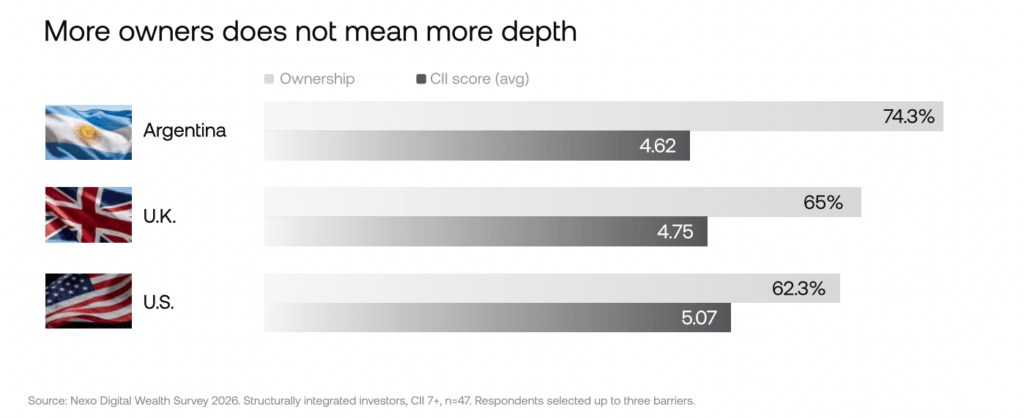
The survey also surfaced notable differences across markets and age groups. Argentina leads on ownership at 74% but trails on integration depth with a CII of 4.62. The US has the lowest ownership rate at 62% but the deepest integration with a CII of 5.07. The UK sits between the two with 65% ownership and a CII of 4.75.
Integration peaks among 35- to 44-year-olds, 28% of whom treat crypto as a core retirement asset, while investors aged 18 to 25 report the highest ownership and conviction — over 90% hold crypto, but only 2% hold a 10-year-plus horizon.
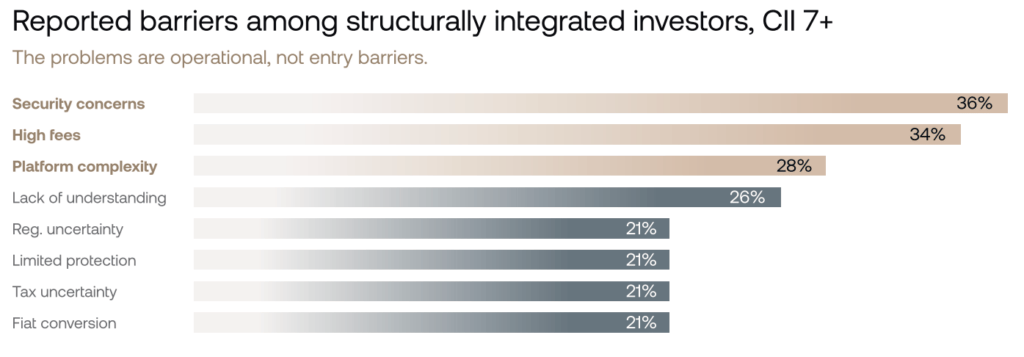
Among investors classified as structurally integrated with a CII of 7 or above, friction shifts toward platform-level concerns: security issues top the list at 36%, followed by high fees at 34% and platform complexity at 28%.
The survey was conducted in February and March 2026 through the research platform Attest among 1,000 affluent investors across the three markets, screened for a minimum of $100,000 in liquid assets in the US and UK, or $40,000 in Argentina.
Featured image via Nexo.