

CertiK, the biggest Web3 security services provider, has released its 2026 Skynet Prediction Markets Report, detailing significant growth in the sector alongside increasing security and regulatory challenges.
In the report, CertiK states that prediction markets entered the mainstream in 2025, with annual trading volume rising fourfold over the year.
However, market activity has consolidated around a small number of major platforms. According to CertiK’s Skynet Top Board evaluation framework, Kalshi, Polymarket, and Opinion now account for the majority of global trading volume, each operating under distinct regulatory, technical, and architectural models.
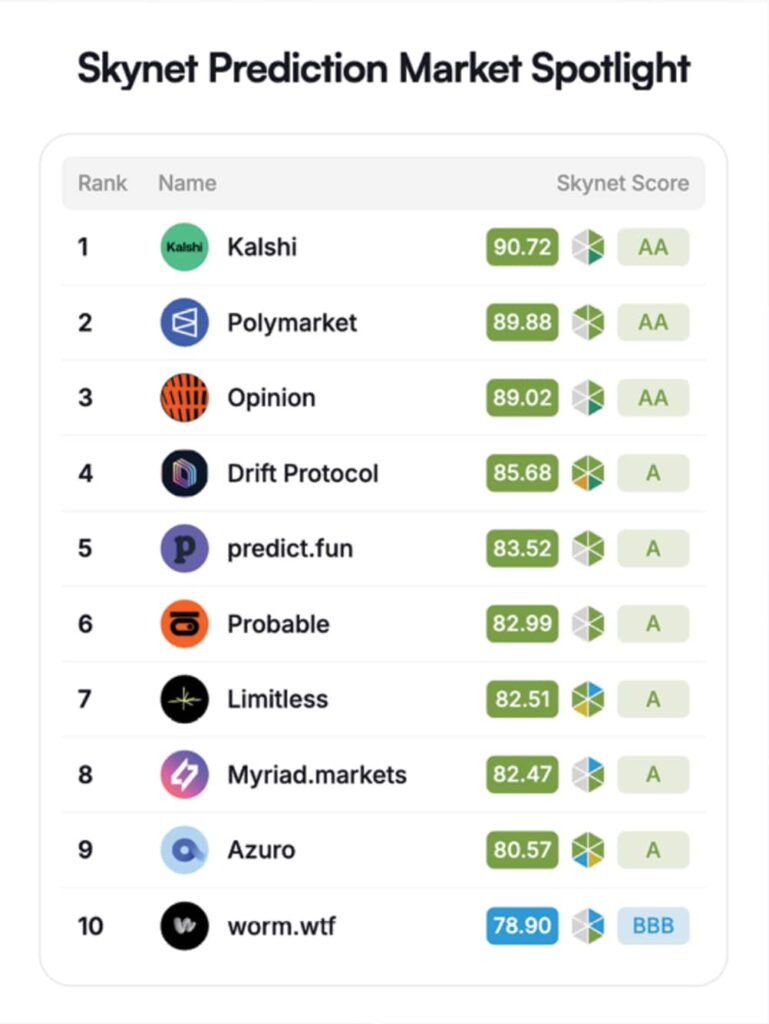
Growth amid rising security and regulatory risks
The report notes that rapid expansion has also brought heightened risks. In December 2025, a third-party authentication provider used by Polymarket was compromised, highlighting how hybrid Web2/Web3 architectures can introduce centralized vulnerabilities even when underlying smart contracts remain secure.
CertiK also points to ongoing risks faced by on-chain platforms, including oracle manipulation, administrative key exposure, and front-running attacks.
Research cited in the report estimates that artificial trading volume reached as high as 60% on certain platforms during peak airdrop-driven incentive periods, distorting liquidity signals and activity metrics. Despite this, CertiK states that probability outputs across major platforms generally remained reliable for forecasting outcomes.
On the regulatory front, the report references Kalshi’s successful challenge before the U.S. Commodity Futures Trading Commission (CFTC), which led to prediction markets being recognized as legal financial products at the federal level in the United States.
At the same time, several European Union countries have banned Polymarket as unauthorized gambling, while emerging state-level restrictions in the U.S. could create a fragmented compliance landscape.
Looking ahead to 2026, CertiK identifies prediction markets as evolving infrastructure for pricing uncertainty across various domains. The report anticipates that additional jurisdictions will formally establish regulatory frameworks for prediction markets, privacy-focused technical improvements will accelerate, and institutional participation will continue to expand.
Featured image via Shutterstock.