

A trading expert is warning that the S&P 500 is approaching a critical technical juncture that could determine whether the broader market remains in a long-term uptrend or slips into a new bear cycle.
Insights by TradingShot, shared in a TradingView post on March 17, base the outlook on the fact that the benchmark index closed two consecutive weekly candles below its 100-day moving average (MA), a development flagged as the first clear bearish confirmation signal.
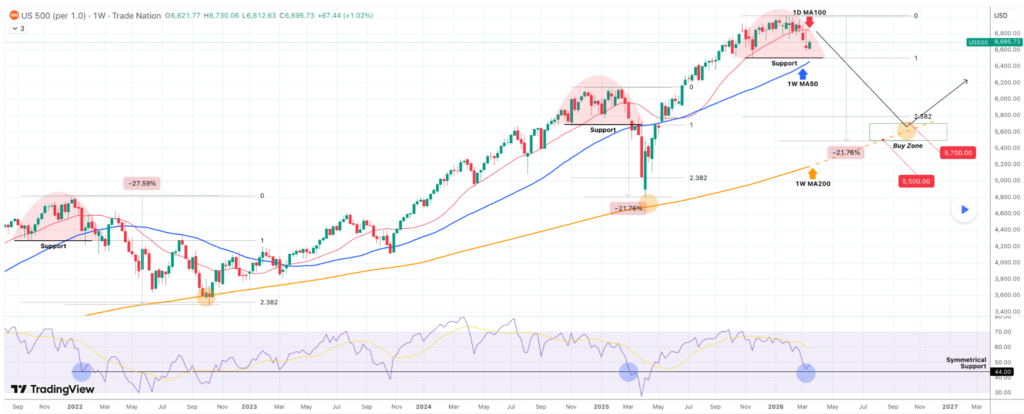
Attention has now shifted to the 50-week MA at around 6,500, which is acting as the final major support level separating bullish continuation from a broader structural downturn.
The outlook notes this level aligns with an arc-shaped topping pattern that has historically preceded sharp corrections.
In past drawdowns, including the 2022 inflation bear market and the 2025 tariff sell-off, the S&P 500 tested this same support while the weekly RSI hovered in the mid-40s, similar to current conditions, signaling a potential decisive breakdown.
If the 50-week moving average breaks, the analysis points to a move toward the 200-week moving average, the market’s key long-term support.
This would mirror past corrections that extended to the 2.382 Fibonacci level, with declines of about 27.6% and 21.8%, signaling substantial downside risk.
S&P 500 next lower target
Based on this pattern, TradingShot noted that the S&P 500 could find a long-term accumulation zone between 5,700 and 5,500, aligning with the Fibonacci target and a typical correction range while remaining slightly above the 200-week average.
If the index falls to the lower end of the projection, it would imply an 18% drop from the last closing value of 6,716.
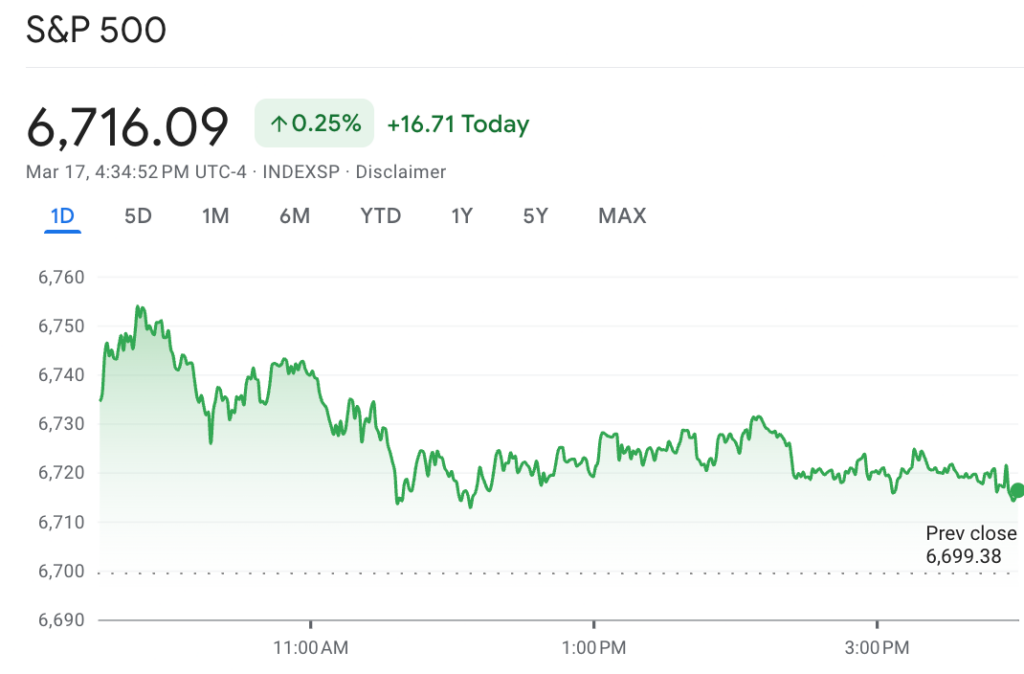
This outlook comes at an interesting time, considering the index has traded in a narrow range this month, rebounding from dips tied to oil supply concerns in the Strait of Hormuz.
While oil prices spiked toward $100 per barrel at their peaks, the S&P 500 has demonstrated underlying strength, with limited sell-offs and rotations into energy and defensive sectors.
Analysts remain cautiously optimistic for 2026, driven by solid corporate earnings growth, AI productivity gains, and economic resilience.
Investors are now eyeing the Federal Reserve’s upcoming meeting for clarity on rates amid the uncertain backdrop.
Featured image via Shutterstock