
SpaceX (NASDAQ: SPCX) could be positioned for further gains after attracting more than $7 billion in institutional inflows over the past year.
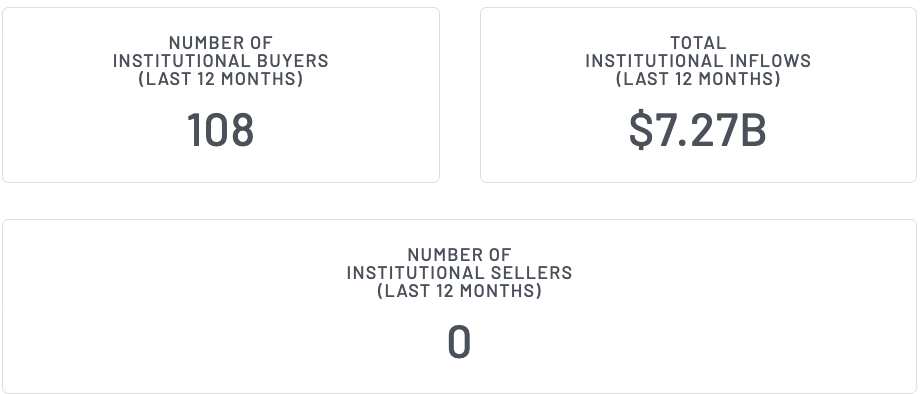
Data shows that 108 institutional investors accumulated SpaceX shares over the last 12 months, generating total inflows of approximately $7.27 billion. Notably, filings show no reported institutional sellers during the same period.
The accumulation trend comes as investors continue to bet on the long-term growth potential of Starlink, Starship, government contracts, and emerging artificial intelligence opportunities tied to SpaceX’s communications infrastructure.
Among the largest reported positions is K5 Global Advisor LLC, which disclosed ownership of 38.6 million shares valued at approximately $6.59 billion. Bond Capital Management LP reported more than 1.05 million shares worth about $180.62 million, while Value Aligned Research Advisors LLC held roughly 589,723 shares valued at $100.76 million.
Other investors reporting positions include Virginia Retirement Systems, Serenity Investment Advisors, TD Waterhouse Canada, Concurrent Investment Advisors, Turner Financial Group, Rik Saylor Financial, and several registered investment advisory firms.
While institutional ownership data is not a real-time indicator of buying activity, the absence of reported sellers alongside billions of dollars in inflows points to strong long-term conviction in SpaceX’s growth outlook.
ChatGPT SpaceX stock price prediction
Using the latest institutional ownership trends alongside SpaceX’s growth outlook, ChatGPT projects a base-case valuation range of $2.4 trillion to $2.8 trillion over the next 12 months.
Under this scenario, SpaceX stock could trade between $180 and $210 per share, representing potential upside of roughly 22% to 42% from the press time share price of $147.
The forecast assumes continued growth in Starlink subscribers, expansion of enterprise and government contracts, and progress toward commercial deployment of the Starship launch system.
A more bullish outcome could emerge if Starship successfully enters commercial service and demonstrates meaningful cost advantages over existing launch vehicles. In that case, SpaceX could approach a valuation of $3 trillion to $3.7 trillion, implying a stock price range of $225 to $280 per share.
Conversely, slower-than-expected commercialization of Starship or weaker growth across key business segments could limit upside and keep the company closer to a valuation of $1.6 trillion, equivalent to approximately $120 to $135 per share.
Although institutional inflows highlight investor confidence, analysts increasingly view Starship as the most important catalyst for SpaceX’s valuation.
The fully reusable rocket is expected to significantly reduce launch costs while enabling larger payload deployments for Starlink and future commercial missions.
Success in these areas could strengthen SpaceX’s position across satellite internet, launch services, defense contracts, and AI infrastructure markets.
Featured image via Shutterstock