

The S&P 500 has reached its highest level of market concentration on record, surpassing even the peak seen during the Dot-com bubble.
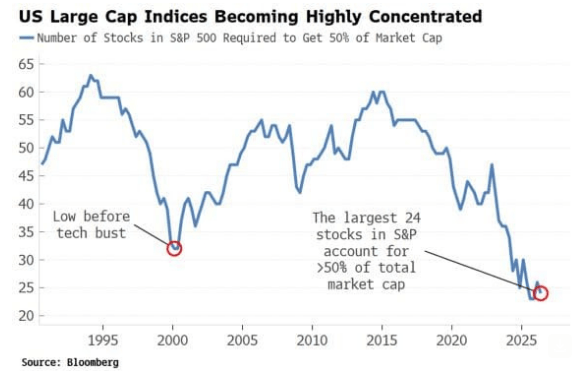
According to Bloomberg data shared on July 22, just 24 stocks now account for more than 50% of the S&P 500’s total market capitalization.
That marks the lowest number of companies needed to represent half of the index’s value and highlights an unprecedented level of concentration within the benchmark.
The metric tracks how many S&P 500 constituents are required to make up 50% of the index’s total market cap.
During the height of the Dot-com bubble around 2000, that figure fell to roughly 32 stocks before rebounding as market leadership broadened in the years that followed.
Today, the number has dropped to 24, highlighting how a small group of mega-cap companies is exerting increasing influence over the performance of the broader U.S. stock market.
The rise in S&P 500 market concentration has largely been driven by technology giants that have benefited from the artificial intelligence boom and continued digital transformation spending.
Companies including Nvidia (NASDAQ: NVDA), Apple (NASDAQ: AAPL), Microsoft (NASDAQ: MSFT), Amazon (NASDAQ: AMZN), and Alphabet (NASDAQ: GOOGL) have seen their market values surge over the past several years, increasing their weighting within the index.
Recent market data indicates that the ten largest stocks account for between 36% and 42% of the S&P 500’s total value. Expanding that group to the 24 largest companies pushes the cumulative share above 50%, a level never previously recorded.
S&P 500 concentration risks
The growing concentration raises concerns about S&P 500 concentration risk, as the index has become increasingly dependent on the performance of a relatively small number of companies.
While the dominance of mega-cap stocks has helped drive benchmark gains, it also means weakness in a handful of top holdings could have an outsized impact on the broader market.
This dynamic has drawn comparisons to the Dot-com bubble, when heavy concentration in technology stocks preceded a sharp market correction.
However, unlike the late 1990s, many of today’s largest companies generate substantial profits, maintain strong balance sheets, and occupy dominant positions in their respective industries.
Even so, the latest stock market concentration data suggests investors may want to monitor whether leadership broadens beyond the current group of market heavyweights.