
A trading strategy that monitors stock transactions disclosed by members of the U.S. House of Representatives has posted positive returns in 2026, despite recent weakness in the equities market.
Dubbed the U.S. House Long-Short Strategy, the Quiver Quantitative portfolio follows investment activity reported by lawmakers, using their disclosed stock purchases and sales to guide its trading decisions.
According to its performance, the strategy has returned 15.56% since the beginning of 2026.
However, its recent performance has weakened, with the portfolio recording a 22.54% loss over the past 30 days. Its compound annual growth rate (CAGR) stands at 30.32%.
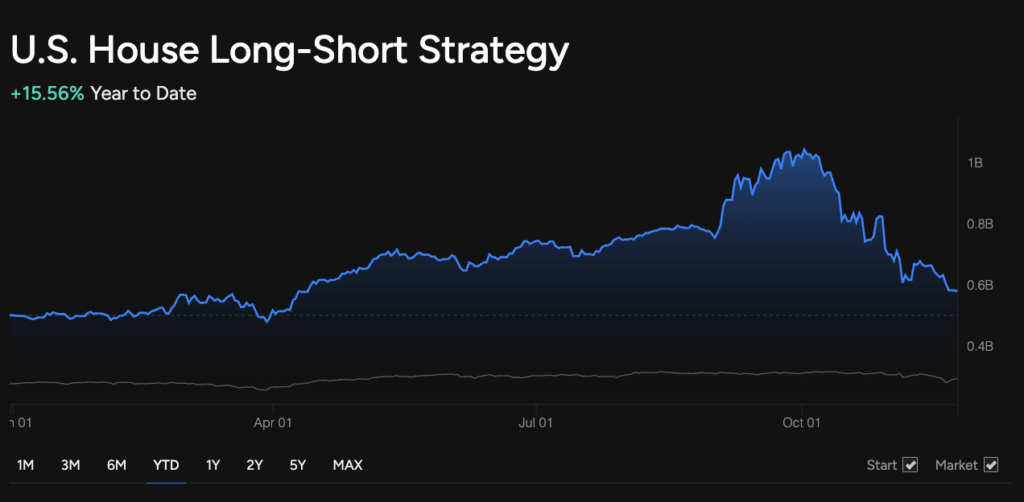
The investment model takes long positions in stocks purchased by House members and short positions in stocks they have sold. It uses 130% long exposure and 30% short exposure, allowing it to benefit from both rising and falling stock prices.
The portfolio is rebalanced weekly to account for newly disclosed congressional transactions, with its historical backtest dating back to April 1, 2020.
Key performance metrics
The strategy has experienced considerable volatility, with a maximum drawdown of 44.10%, indicating its largest historical peak-to-trough decline.
Its beta of 1.13 suggests greater sensitivity to broader market movements, while its alpha stands at 0.09. Meanwhile, its Sharpe ratio of 0.820 measures its historical risk-adjusted returns.
It is worth noting that technology stocks dominate congressional trading activity in 2026, with Microsoft, Apple, and Nvidia among the most frequently disclosed transactions.
According to congressional trading disclosures compiled by Congress Watch, Microsoft led with 79 reported transactions through November 19, involving 28 lawmakers. These included 44 purchases and 35 sales.
Apple followed with 69 transactions involving 28 lawmakers, although sales outnumbered purchases, at 38 and 31, respectively. Nvidia recorded 59 transactions, with 25 purchases and 34 sales involving 22 members of Congress.
Risks of following congressional trades
Congressional stock trading has attracted attention because lawmakers participate in decisions that can affect entire industries, including technology, healthcare, defense, and financial services.
The practice has also raised concerns about potential conflicts of interest, particularly given lawmakers’ involvement in legislation and government policy.
Under the Stop Trading on Congressional Knowledge (STOCK) Act of 2012, members of Congress must publicly disclose covered financial transactions within 45 days of making them.
However, following congressional trades does not guarantee profitable investments. Disclosures can arrive weeks after transactions occur, potentially leaving investors with less favorable entry prices.
Featured image via Shutterstock