
Veteran economist Peter Schiff has warned that the sharp decline in SpaceX (NASDAQ: SPCX) stock could be a warning sign for other high-cap assets that have benefited from investor enthusiasm.
In a July 22 post on X, Schiff highlighted that SpaceX last closed just above $115 per share, nearly 20% below its $135 IPO price and almost 50% below its post-listing peak of $225.
The stock’s reversal, he argued, could represent a broader shift in sentiment toward “overhyped” assets. Interestingly, the economist mentioned not only equities but cryptocurrencies too, which have really struggled this year.
“SPCX closed just above $115, nearly 20% below its IPO price and almost 50% below its high. This could be a harbinger of things to come for other overhyped stocks and cryptos. Look out below!” Schiff wrote.
SpaceX stock price could serve as a market benchmark
Trading at $115, the space exploration company is down 6.7% on the daily chart as of press time, July 23.
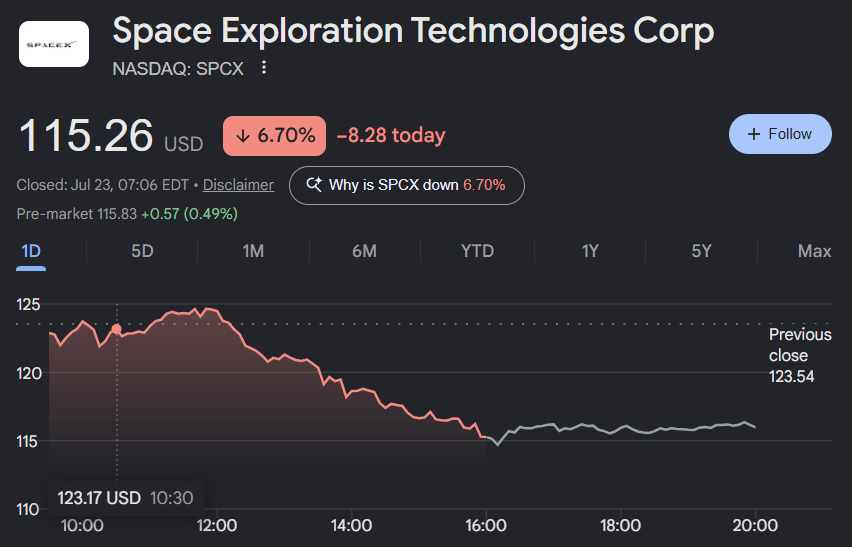
SpaceX stock daily price. Source: Google Finance
The decline has come amid concerns over lofty valuations, broader weakness in technology stocks, and potential future selling pressure as additional shares become available following lockup restrictions.
Known for his skepticism regarding speculative investments of all sorts, the analyst has repeatedly argued that markets may be pricing in overly optimistic expectations around artificial intelligence (AI), digital assets, and high-growth companies.
Notably, Schiff had issued a similar warning just a couple of days prior, claiming that the AI stock rally may be nearing a major reversal, pointing to the recent decline in SpaceX shares as a possible warning signal.
However, it must be noted that Schiff does not believe artificial intelligence itself is a bubble. Rather, he argues that investor enthusiasm surrounding AI-related stocks has likely become excessive.
“AI isn’t a bubble, but AI stocks are. The bubble has likely already popped,” Schiff wrote.
Similarly, he also pointed to increasing competition in the sector, particularly from lower-cost Chinese AI models such as Moonshot AI’s Kimi K3 and DeepSeek Chat. More precisely, he argued that U.S. AI companies could face pressure as investors reassess valuations and the long-term competitive landscape.
Featured image via Shutterstock