Most memecoin launches ask buyers to trust a creator’s promises. The public may not know whether token settings can change later, whether a team has a hidden allocation, or where the contributed funds can go after a round closes.
MemeToro is taking a code-first approach to this problem. The project has published its first FairLaunchEscrow.sol contract as part of a 1,373-line Solidity release.
The upcoming memecoin launchpad is designed to connect AI-generated launch proposals to public smart-contract rules, making the funding process more visible before a token reaches the market.
MemeToro: Building a Next-Gen Memecoin Launchpad With New Rules
MemeToro is building a BNB Chain platform for AI-guided memecoin launches. The planned system begins with an AI agent that studies online trends, news, and market signals before proposing a token idea.
The agent is designed to publish a launch manifest. This gives users a written record of the idea, the evidence behind it, the token supply, the funding cap, and the rules that would apply to the round.
MemeToro is not only a launchpad concept. $MT is intended to support platform access, memecoin funding, staking, rewards, future trading tools, prediction markets, and a news portal.
The project’s fair-launch model aims to remove private token tiers. Instead of asking buyers to trust that a team will avoid an insider allocation, the contract is designed to reject an allocation plan that includes one.
This approach gives MemeToro a strong position in the memecoin market. It is trying to make the launch itself a product that users can inspect, not a black box that ends once a token starts trading.
What A $500 $MT Position Could Look Like
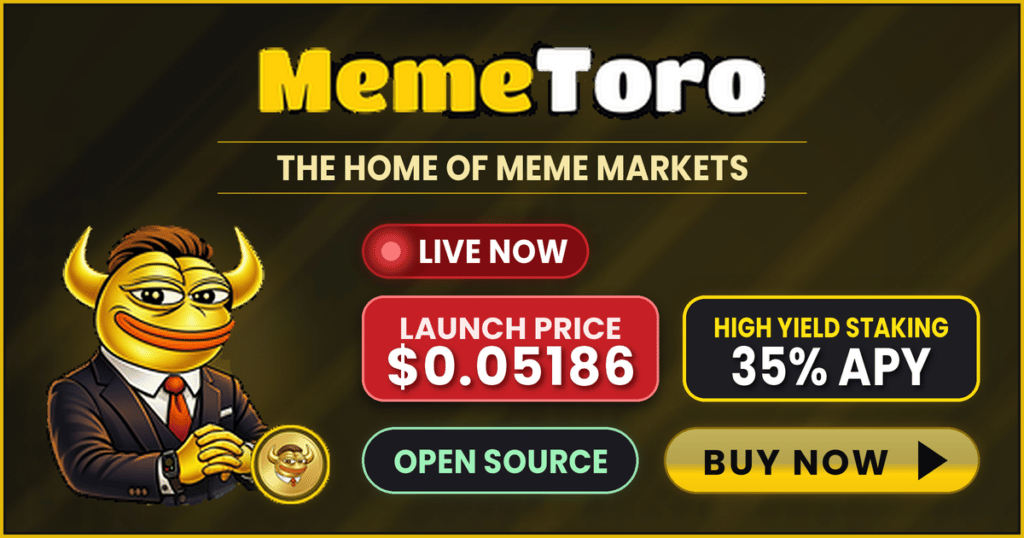
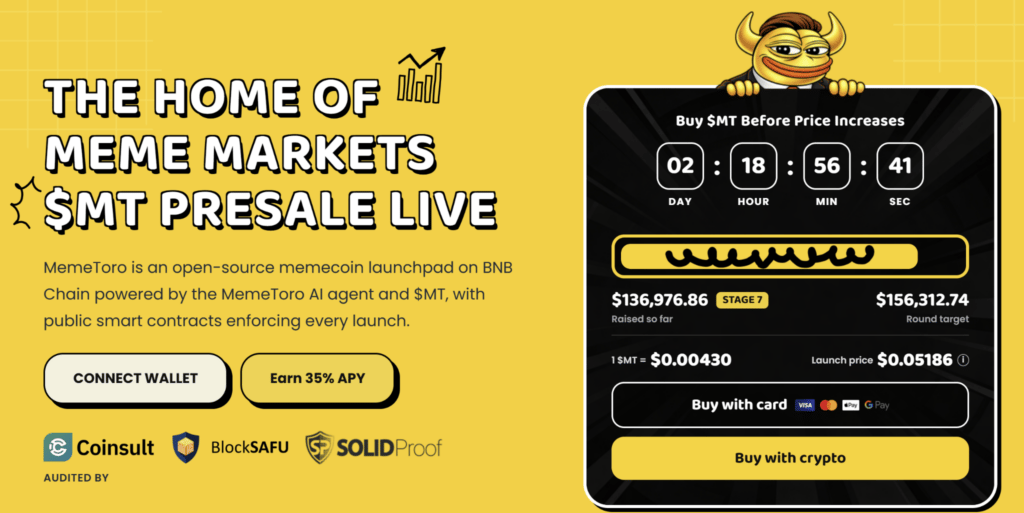
At $0.00430 per MemeToro $MT token, a $500 Stage 7 purchase would provide approximately 116,279 $MT before fees. MemeToro displays a $0.05186 launch target.
If $MT traded at that exact target, the allocation would have a theoretical value of around $6,028. That equals about 12.06 times the starting amount.
A far more aggressive $1 billion fully diluted valuation would imply a price near $0.8333, based on the 1.2 billion-token supply. The same allocation could then be worth about $96,899 in theory.
These are scenario calculations, not guarantees. The outcome depends on the launchpad being completed, trading liquidity, product use, market demand, and wider crypto conditions.
FairLaunchEscrow Locks The Terms Of One Funding Round
FairLaunchEscrow.sol is designed to hold contributor funds for one specific launch round. It sets the terms when the round is created and is intended to keep those settings fixed.
This includes the funding cap, deadline, threshold, allocation structure, and other launch conditions. A creator should not be able to edit those terms after users have sent money.
The contract also stores a fingerprint of the public manifest. That allows users to check whether the on-chain round matches the launch terms they saw before funding it.
An upcoming memecoin launchpad needs this kind of connection between public information and contract logic. Otherwise, a project can publish one plan on a website and execute another plan on-chain.
MemeToro’s escrow design is built without an owner, admin role, or upgrade path. That means the team is not planning a control wallet that can later update the contract rules.
The architecture is deliberately restrictive. In a launch contract, what is missing can be as important as what is added.
Zero Insider Allocation Is Designed Into The Math
Hidden team tokens and insider allocations are major concerns in the memecoin market. A creator can buy cheaply, receive an undisclosed share, and then sell into public demand after launch.
MemeToro’s escrow draft is designed to make this harder at the contract level. The proposed token supply must be fully allocated between contributors and liquidity.
There is no planned category for a founder, early investor, or private team allocation. If a calculation produces a small remainder because of rounding, the extra amount is designed to go to liquidity.
The upcoming memecoin launchpad also restricts where contributed funds can go. The stated paths are refunds to contributors or the planned liquidity executor.
This does not guarantee that every future token will perform well. A fair launch can still face low demand, market weakness, or heavy selling.
However, it can remove one common risk: the creator receiving a secret supply or changing the terms after the public round begins.
MemeToro lists Coinsult, BlockSAFU, and SOLIDProof as audit or review providers. Buyers should check the latest report scope when the final mainnet contracts are available.
FAQs
What does the fair-launch escrow do?
It is designed to hold one round’s funds and apply locked rules around funding, refunds, claims, allocations, and planned liquidity.
Can the MemeToro team change the contract later?
The published design has no owner, admin role, or upgrade path, so the stated aim is to prevent post-deployment rule changes.
What work remains before the platform goes live?
MemeToro still needs to complete the real executor, factory, testnet deployment, manifest connection, and independent security review.
More Information on MemeToro ($MT) Presale Here:
Website: https://memetoro.com/
Telegram: https://t.me/memetoro_mt