
As the benchmark S&P 500 continues to trade near all-time highs amid volatility, Bank of America Securities has issued the most cautious outlook on Wall Street for 2026.
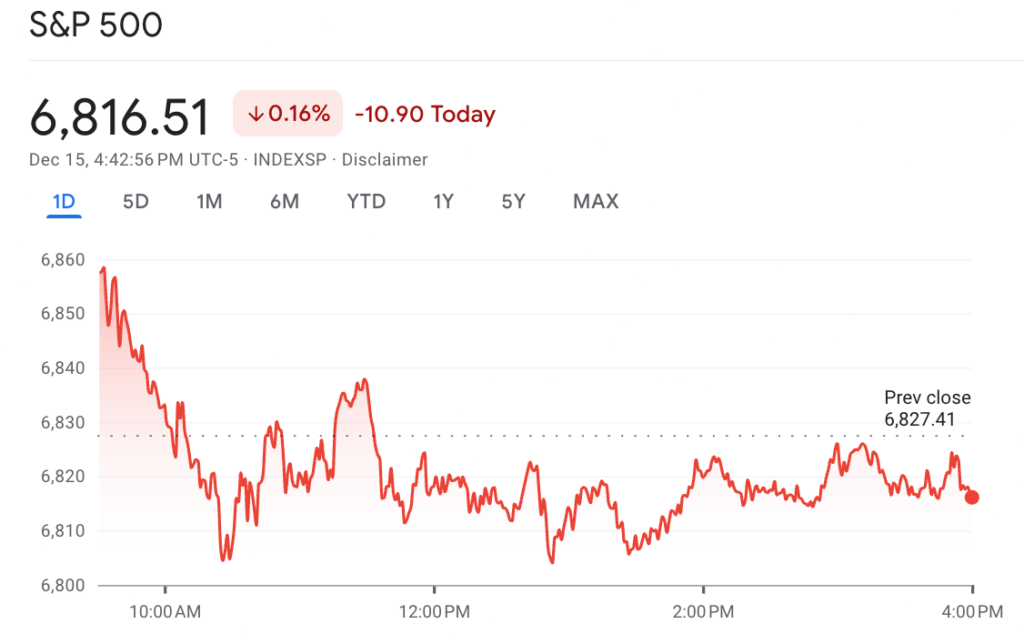
Notably, the firm is projecting limited upside from current levels. It expects the benchmark index to end next year at 7,100, implying a gain of less than 5% from its Monday close of 6,816, after briefly pushing above 6,900 for the first time last week.
The bearish stance is driven by expectations of valuation pressure across U.S. equities. Bank of America’s U.S. equity and quantitative strategy team anticipates meaningful multiple compression as the market remains heavily concentrated in large-cap technology and artificial intelligence (AI)-linked stocks.
These companies dominate index weightings but are viewed as less economically sensitive and more vulnerable to sentiment shifts once growth expectations normalize.
Bank of America, however, expects recent weakness in technology stocks to persist as AI adoption increasingly disrupts the labor market, weighing on consumption and pressuring earnings across consumer-facing sectors.
As a result, the bank favors a defensive stance for 2026, overweighting consumer staples and underweighting consumer discretionary stocks, which are more sensitive to household spending.
Wall Street optimistic on S&P 500
The outlook stands in contrast to most major banks and strategists, who expect artificial intelligence to extend the bull market into 2026.
For instance, as reported by Finbold, JPMorgan expects the index to reach 7,500 by the end of 2026 and potentially exceed 8,000 if the Federal Reserve delivers faster and deeper rate cuts, citing resilient economic growth, accelerating AI investment, and strong earnings momentum.
Goldman Sachs, on the other hand, raised its target to 7,600, citing expanding corporate profits, AI-driven productivity gains, and continued strength in mega-cap technology stocks, which it expects to account for a large share of earnings growth.
Notably, Morgan Stanley is among the most bullish, projecting an S&P 500 target of 7,800, arguing that recent pullbacks reflect valuation pressures rather than deteriorating fundamentals. Elsewhere, UBS sees the index ending 2026 around 7,500, while Oppenheimer forecasts 7,100.
While risks remain, banks largely agree that earnings growth, easing monetary policy, and AI adoption should underpin further upside.
Featured image via Shutterstock