

Although Micron Technology, Inc. (Nasdaq: MU) stock has dropped over 29% since mid-June 2026, Wall Street analysts expect the company’s shares to reach a new all-time high (ATH) over the next 12 months.
Vijay Rakesh, an expert at Mizuho Securities, reiterated a ‘Buy’ rating for Micron stock, according to a note sent to clients that Finbold analyzed on August 11. Rakesh maintained the firm’s 12-month price target for MU at $1,375, suggesting a potential 59.7% upside.
Mizuho raised its 12-month MU stock price target from $1,150 to $1,350 on June 25, 2025. Despite the notable correction since the target lift, Rakesh maintained a Buy rating for this memory stock.
The research firm expects the core Dynamic Random-Access Memory (DRAM) and NAND memory chip market to remain structurally tight through 2027, fueled by the AI boom. Moreover, this analyst does not expect a meaningful supply of memory chips from competitors until 2028, thus bolstering bullish sentiment for Micron stock.
As such, Rakesh downplayed recent fears of Apple Inc. (NASDAQ: AAPL) seeking memory hardware supply from China’s ChangXin Memory Technologies (SSE: 688825).
Wall Street bullish on Micron stock
In addition to Mizuho Securities, Atif Malik at Citigroup Inc. (NYSE: C) and Timothy Arcuri reaffirmed a ‘Buy’ rating for MU shares. Malik, however, lowered the bank’s 12-month price target to $1,150 from $1,400, suggesting a possible 33.57% rise.
On the other hand, Arcuri expects Micron stock to reach $1,625 over the next 12 months, a potential 88.73% uptick. Consequently, 30 Wall Street analysts surveyed by TipRanks have set an average 12-month price target of $1,569.07 for MU, an expected 82.24% gain.
MU share price outlook
Over the last 6 months, MU’s share price has spiked over 107%, trading at approximately $861 at press time. As a result, the company had a market capitalization of roughly $972.4 billion.
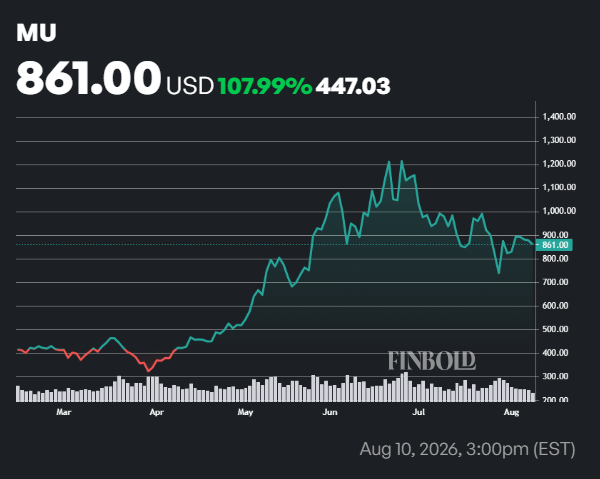
Amid the strong demand for memory chips, Wall Street analysts argued that the recent MU selloff could be viewed as a temporary correction rather than a market reversal.
Featured image via Shutterstock