
Although the world’s top two semiconductor giants, Nvidia (NASDAQ: NVDA) and Advanced Micro Devices (NASDAQ: AMD), share many similarities, they have recently diverged in both their stock market performance in the previous 12 months and their Wall Street price targets for the next 12 months.
The Royal Bank of Canada’s RBC Capital has been the latest to weigh in on how the two blue-chip chipmakers might fare in 2026, and it has, indeed, issued rather different forecasts for the two giants.
Nvidia (NASDAQ: NVDA)
On January 14, 2026, RBC Capital’s Srini Pajjuri initiated his coverage of Nvidia stock with a positive ‘Outperform’ – ‘Buy’ – rating and an optimistic $240 12-month price target.
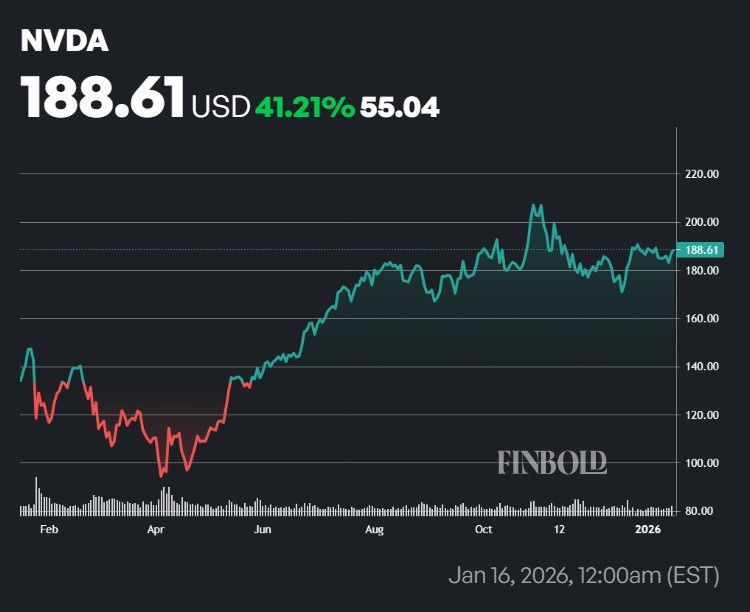
Should the forecast be met, it would mean NVDA shares have followed up on their previous one-year 41.21% rally to $188.61 with an additional 27.25% rise within an equal timeframe.
According to Pajjuri, the key drivers behind the optimistic target are the expectations that cloud capital expenditures will remain elevated for up to 18 months, and that Nvidia will continue benefiting from growing inference power demand and enterprise-level artificial intelligence (AI) adoption.
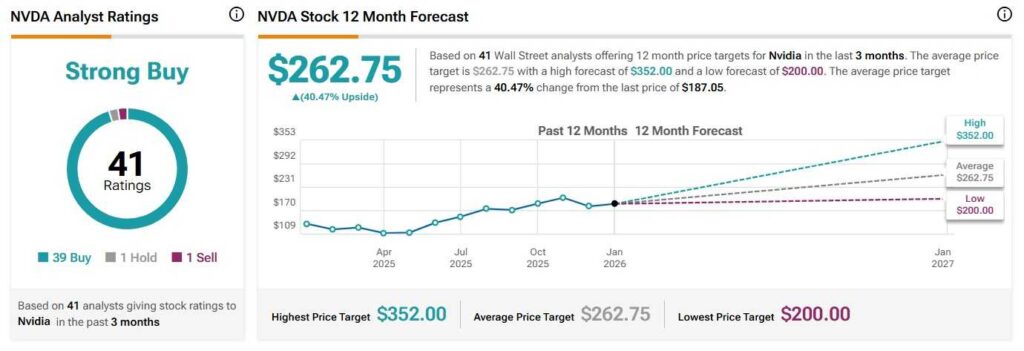
The RBC Capital expert, with his latest coverage, echoes the Wall Street consensus. On average, NVDA stock is considered a ‘Strong Buy,’ and is, also on average, expected to surge 40.47% in the next 12 months, per the TipRanks data Finbold reviewed on January 16.
Advanced Micro Devices (NASDAQ: AMD)
Elsewhere, Pajjuri proved somewhat more bearish than his peers when he initiated coverage of AMD stock on January 14. Specifically, he rated the semiconductor giant as ‘Sector Weight’ – ‘Hold’ – while assigning a $230 price target.
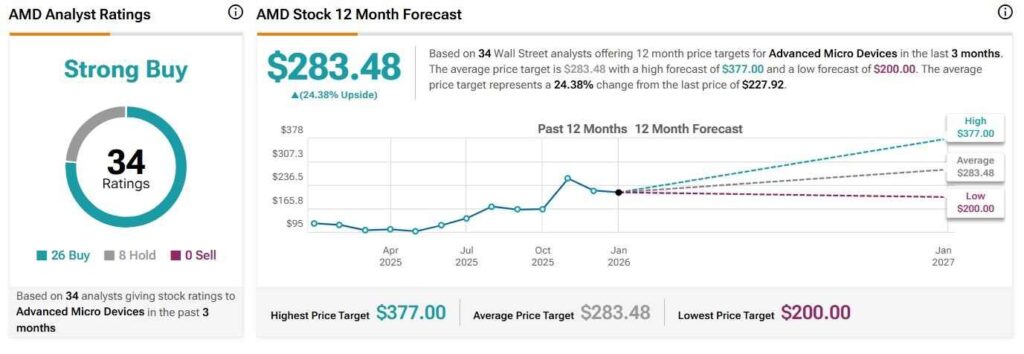
Interestingly, such a forecast not only predicts AMD will be trading sideways through the rest of 2026, but is also notably lower than the average ‘Buy’ rating accompanied by a $283 price target.
Additionally, the coverage is somewhat quaint considering that, unlike NVDA stock, which is up 41.21% in the last 12 months, AMD shares have rallied 96.26% within the same timeframe and are trading at $232.45 at press time on January 16.
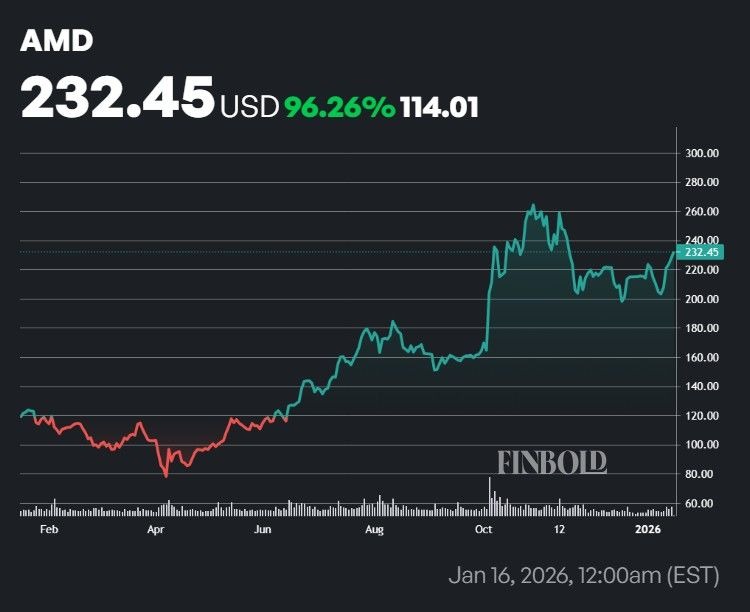
According to the note, the relative bearishness can be attributed to doubts about Advanced Micro Devices’ ability to continue grabbing market share.
Though the company’s lineup – and the Helios racks in particular – is impressive, other big tech companies such as Meta (NASDAQ: META), Microsoft (NASDAQ: MSFT), and even OpenAI – a firm that recently reached an investment agreement with AMD – all have in-house application-specific integrated circuits (ASIC) – essentially custom chips – programs scheduled for 2026 and 2027.
Featured image via Shutterstock