
SpaceX (NASDAQ: SPCX) is debuting on June 12, reportedly at a $1.77 trillion valuation. While the figure would certainly rank it among the world’s most valuable companies, it would still trail the semiconductor giant Nvidia (NASDAQ: NVDA), which currently commands a market capitalization of roughly $5 trillion.
However, artificial intelligence (AI) suggests that the space explorer could overtake the chipmaker in terms of market capitalization in less than a decade, though the outcome depends heavily on the pace of growth at both companies.
To get a rough estimate of how things might develop, we asked OpenAI’s leading algorithm, ChatGPT’s, when SpaceX is going to surpass Nvidia. Here’s what it said.
This is when SpaceX is going to overtake Nvidia, according to ChatGPT
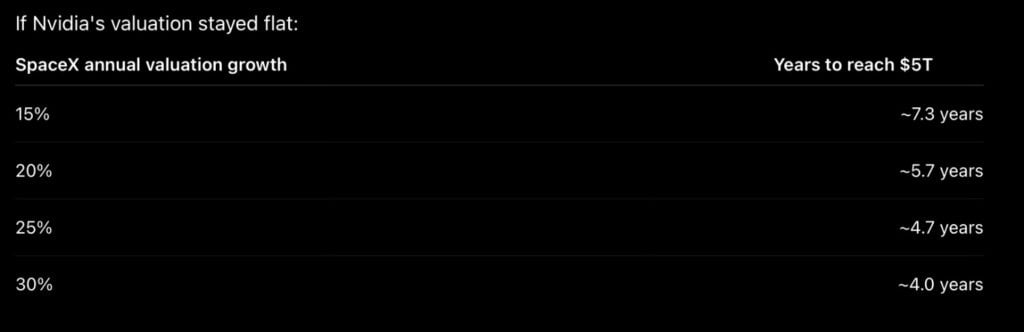
The model first noted that SpaceX would need to increase its valuation by nearly 180% to match Nvidia’s current size. If Nvidia’s market value remained unchanged, SpaceX could, in theory, accomplish that in approximately four years if it sustained annual growth of 30%, or around six years if growth averaged 20%.
It is, however, not very likely that Nvidia is going to remain in the same place for essentially half a decade. Indeed, a more likely (base) scenario assumes that both companies will continue expanding. For example, if SpaceX grows its valuation by 25% to 30% annually, and Nvidia grows its own by 10% to 15% per year, Elon Musk’s company would not come out on top until the early-to-mid 2030s – if it all.

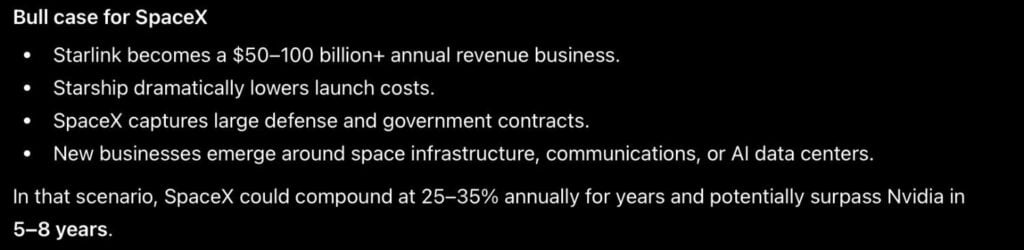
A more bullish scenario – in which Starlink evolves into a global telecommunications powerhouse, Starship unlocks entirely new markets, and the company forges top-tier government contracts – could allow SpaceX to overtake Nvidia within five to eight years, ChatGPT predicted.

Can SpaceX surpass Nvidia at all?
However, the chatbot also cautioned that each of the scenarios highlighted above is nothing more than mere speculation. This is primarily because sustaining rapid growth is incredibly difficult at multi-trillion-dollar valuations.
For example, to reach $5 trillion in four years, SpaceX would need to add more than $3 trillion in market value, an increase two times larger than the market value of Tesla (NASDAQ: TSLA).
Moreover, while Nvidia’s dominant position in artificial intelligence infrastructure continues to generate massive revenue and profits, SpaceX still remains a bet on future growth opportunities.
Accordingly, the question of whether it can ultimately surpass Nvidia may depend on its ability to transform into a business that extends far beyond its current operations.
Featured image via Shutterstock