

Moderna (NASDAQ: MRNA) stock is rocketing in pre-market trading on Wednesday after the biotechnology company and its partner, Merck, reported positive Phase 3 results for their personalized mRNA-based cancer vaccine for melanoma.
Notably, shares of Moderna closed the previous session at about $63 but surged 90% in pre-market trading, briefly rising to $120.
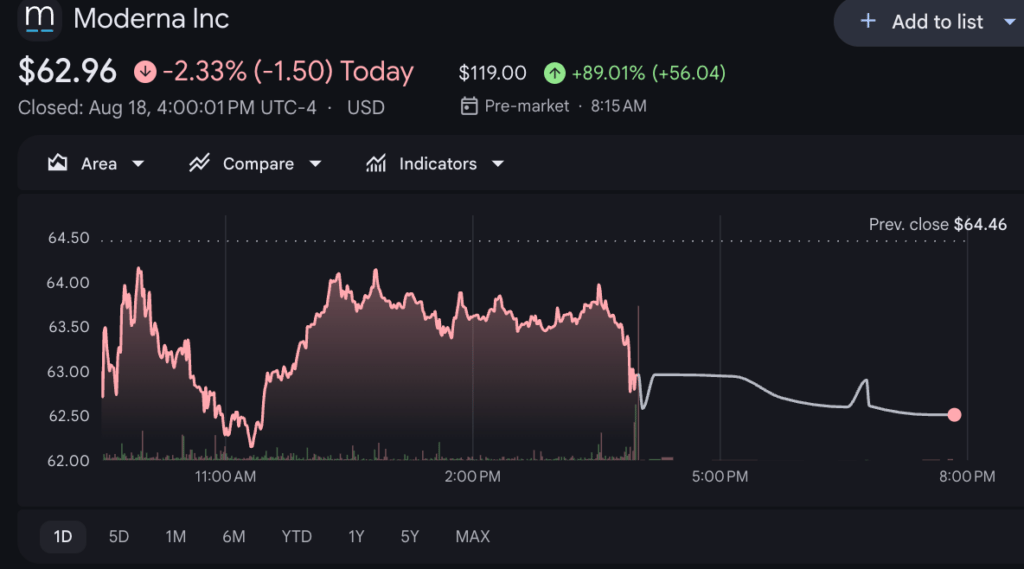
The sharp move follows a major clinical milestone that could significantly expand Moderna’s business beyond its declining COVID-19 vaccine franchise.
The rally was triggered by topline data from the Phase 3 INTerpath-001 trial evaluating intismeran autogene, also known as V940 or mRNA-4157, in combination with Merck’s Keytruda.
The study enrolled more than 1,100 patients with high-risk stage IIB to IV melanoma whose tumors had been completely removed through surgery.
At a planned interim analysis, the treatment combination met its primary endpoint of recurrence-free survival and demonstrated a statistically significant improvement compared with Keytruda alone.
Key trial achievements
The trial also achieved a key secondary endpoint of distant metastasis-free survival, indicating a reduced risk of the cancer spreading to other parts of the body. Researchers reported no new safety concerns.
The Moderna melanoma trial represents the first successful Phase 3 study of an individualized neoantigen therapy and the first positive Phase 3 result for an mRNA-based cancer treatment.
The therapy uses Moderna’s mRNA platform to create a personalized vaccine tailored to mutations unique to each patient’s tumor. Combined with Keytruda, it is designed to help the immune system identify and destroy cancer cells more effectively.
The companies plan to present detailed results at a future medical conference and discuss regulatory submissions with health authorities. A potential approval could come as early as 2027.
Success in melanoma marks a major milestone for Moderna as it seeks to expand its mRNA technology beyond COVID-19 vaccines. The Phase 3 results validate the company’s cancer strategy and strengthen its oncology pipeline, which includes programs targeting lung, bladder, and kidney cancers.
The findings also provide a potential new growth driver for Merck’s Keytruda franchise while boosting confidence in mRNA-based cancer treatments.
With regulatory discussions expected to follow, investors are reassessing Moderna’s long-term revenue potential, helping drive the stock sharply higher today.
Featured image via Shutterstock