
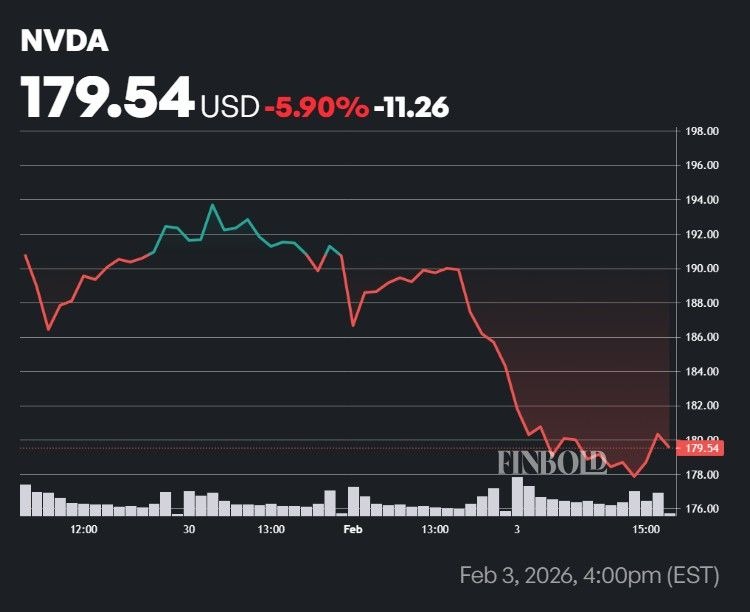
The stock of the semiconductor giant Nvidia (NASDAQ: NVDA) has been struggling to maintain its value since 2026 started, and suffered a sharp, 5.90% decline in the last week of trading that took it from approximately $190 to its February 4 pre-market price of $179.54.
In addition to general instability driven primarily by external factors, NVDA shares have been affected by a series of business-related issues and mounting risks associated with the artificial intelligence (AI) boom.
How China is sending Nvidia stock lower
Perhaps the most obvious headwind for Nvidia has been its inability to benefit from the previously-announced end to the restriction for H200 chip exports to China.
Despite previously appearing to once again provide access to the world’s largest economy by purchasing power parity (PPP) for the blue-chip chipmaker, the Chinese government has been less than excited to keep buying from the American firm.
Specifically, earlier in January, the People’s Republic’s customs authority signalled that orders from Nvidia have been heavily discouraged and have, in fact, been all but banned. China has, for years, been working on developing a domestic supply of advanced hardware, including AI-powering microchips.
Although the situation briefly appeared to have turned bullish for the world’s biggest semiconductor giant in late January, with Beijing reportedly clearing ByteDance, Tencent, and Alibaba (NYSE: BABA) to buy Nvidia’s products, the U.S. government stepped in to again hamper the efforts.
As reports from February 4 indicate, H200 exports to China are still pending a national security review despite President Donald Trump approving them months earlier, effectively stalling the chipmaker’s re-entry into the East Asian market.
The bureaucratic barricade has, simultaneously, led potential Chinese customers to refrain from placing orders before the situation in Washington clears up.
The OpenAI Nvidia stock headwinds
Elsewhere and despite the overall importance of the People’s Republic for the global economy, it is possible that the export issues related to it are not the main source of headwinds for Nvidia in February 2026.
Late in 2025, the semiconductor giant’s announcement of intent to invest $100 billion in the world’s most recognizable AI company – OpenAI – drew a lot of attention both as a sign of confidence that the boom will continue, and as another bit of circumstantial evidence that a dangerous bubble has formed.
Indeed, the massive scale of AI-related investments is widely interpreted as risky – at least outside the circles of executives who are likely to directly benefit from a continued expansion – as they are orders of magnitude greater than the industry’s revenue at press time and in the foreseeable future.
Given the sensitivity of the topic, it is not strange that the revelation that Nvidia shall not, in fact, be investing the full $100 billion caused much discussion and uncertainty, especially regarding the possibility that AI is about to have a ‘Dot-com moment’ in 2026.
Could 25% of Nvidia data center chips go unused?
The issue is only made more pointed by observations from the prominent technology journalist Ed Zitron, who estimates that – primarily due to an energy bottleneck – as much as 25% of all data centers constructed could remain dormant.
While more traditional infrastructure buildouts – such as railways or highways – are not adversely affected by low usage immediately upon construction, semiconductors tend to get outdated quickly, making data centers that remain out of use expensive and largely wasted investments.
Featured image via Shutterstock