

The U.S. housing market has been a contentious topic for years, with high prices relative to income and the sheer number of vacant homes generating at least one popular conspiracy theory. The latest numbers regarding pending sales have only added fuel to the fire, and the entire market appears in danger of collapsing in 2026.
In December 2025, month-over-month pending home sales fell across four different regions in the U.S. for a total index decline of 9.3%, per a report published on January 21, 2026, by the National Association of Realtors (NAR).
Furthermore, last month’s results constitute an all-time low for the entire housing market, and serve as something of a follow-up to Redfin’s report indicating that, between late 2024 and 2025, the ratio between sellers and buyers has doubled, with 37% more seeking to sell a home than to buy one.
The growing gap and dwindling sales have, according to Lawrence Yun, NAR’s chief economist, shown that the market is ‘not out of the woods,’ despite months of promising data that preceded the December figures. Yun also noted that:
Data shows closing activity increased in December. However, new listings did not keep pace so inventory decreased. Consumers prefer seeing abundant inventory before making the major decision of purchasing a home. So, the decline in pending home sales could be a result of dampened consumer enthusiasm about buying a home when there are so few options listed for sale.
Will the U.S. housing market crash in 2026
Looking ahead to 2026, the house prices in the U.S. could experience a sharp drop due to the decreasing number of pending sales and President Donald Trump seemingly removing one major player – Wall Street – from the equation.
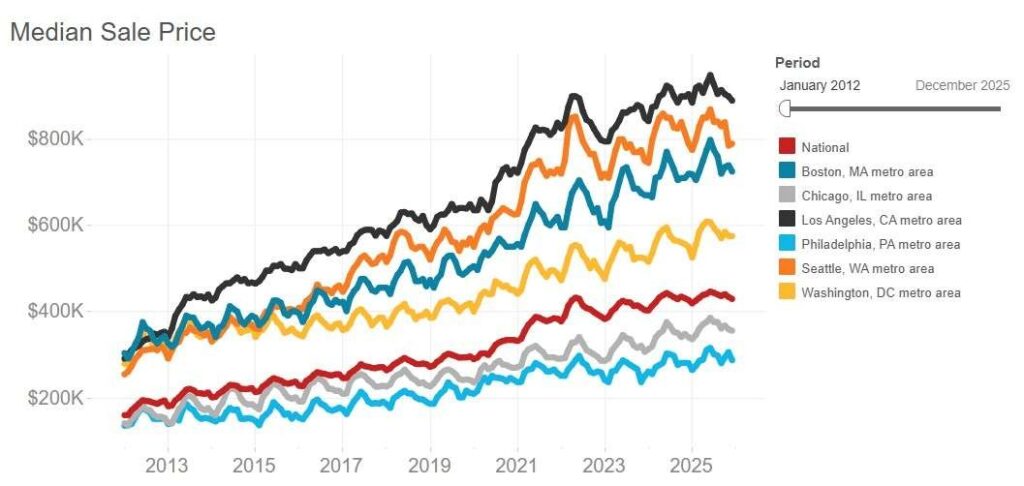
The Administration’s decision has the stated goal of helping Americans purchase their first home at a reasonable price – Redfin data shows that the median home prices in major cities ranged from approximately $282,000 in Philadelphia to $890,000 in Los Angeles in December – but appears to be responding to a popular conspiracy theory.
Specifically, the story is that part of the reason why homes have become out of reach for numerous Americans is that the investment giant BlackRock (NYSE: BLK) has been buying up vast quantities of houses.
For its part, the company has been claiming it does not buy individual houses, and most reputable sources call the theory baseless.
Blackstone – a company that is in the rental real-estate business and is frequently confused with BlackRock – also claims that it owns less than 1% of relevant available housing across the markets it operates in. Critics, on the other hand, note that despite the average being low, the firm owns a substantially higher share in certain lucrative urban areas.
Notably, while the two corporations might not be as impactful – or sinister – as popular culture implies, they are major players in the real-estate market nonetheless.
Still, President Trump’s actions, paired with weakening sales, could trigger a drop in U.S. home sales.
The last shall be first, and the first last
While this is good news for many Americans seeking to purchase their first residence but have, thus far, been priced out of the market, it could also signal financial hardship for the less wealthy 50% of U.S. citizens.
Indeed, a Federal Reserve of St. Louis (FRED) report indicated that, in 2023, as much as half of the net worth of the bottom 50% of Americans is accounted for by their real estate – a state of affairs that has likely only grown worse by 2026 between the rising price of a median house and the overall cost-of-living crisis.
Lastly, it is possible the U.S. housing market will not crash in value, but continue cracking on the ability-to-own-a-home side. A major reason for the Blackrock conspiracy theory – and the commonplace hostility to such companies – comes from the fact that there are, allegedly, some 15 million vacant homes in the U.S.
Such a vast supply of potentially available housing would, at face value, indicate that the very laws of the free market are breaking, given how much median home prices have been shooting up.
Still, the impact of the vacant houses is determined by numerous factors, including, as much else in the real-estate market, by ‘location, location, and location,’ as the old adage goes.
Featured image via Shutterstock