

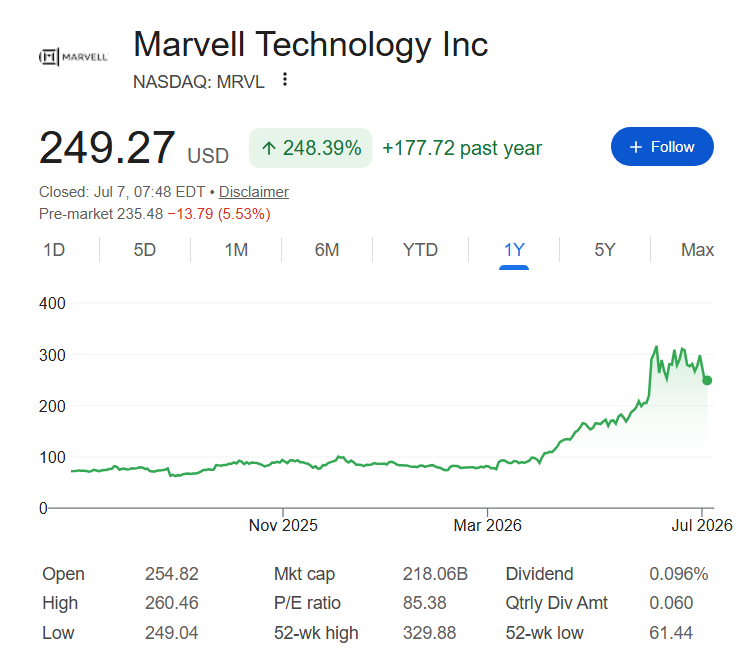
Investors who saw Marvell (NASDAQ: MRVL) stock’s early 2025 crash amidst a wider semiconductor boom as a buying opportunity and purchased the equity in the summer of that year would have, by July 7, 2026, seen remarkable returns on their trade.
Specifically, MRVL shares were changing hands at $71.55 on July 7, 2025, while, at press time, they stand 229.11% higher at $235.48. Thanks to the rally, $1,000 worth of Marvell stock bought a year ago would have turned into a stake worth $3,291.13 for a $2,291.13 profit.
For comparison, the same amount invested in the S&P 500 benchmark index would have grown by $209.90 to $1,209.90.
Still, despite its success, an MRVL trade 12 months ago would have been less successful than buying Intel (NASDAQ: INTC) – which is up 455% within the timeframe – or AMD (NASDAQ: AMD) – which rallied 309% – though it would have beaten an Nvidia (NASDAQ: NVDA) investment as the world’s largest company is up 23%.
Additionally, purchasing any chipmaker would have been a worse investment than seeking profits in the memory sector, given the 52-week strength of companies such as SanDisk (NASDAQ: SNDK).
What is next for Marvell Stock in 2026
Elsewhere, despite Marvell stock remaining significantly higher than it stood a year ago or even at the start of 2026, it suffered a substantial correction from its June highs.
Indeed, MRVL shares saw their rally accelerate at the very end of May as Nvidia CEO Jensen Huang opined the firm could become the world’s next trillion-dollar company, leading to a rapid rise from approximately $205 to an all-time high (ATH) of $329.88.
The upsurge, however, proved unsustainable, with Marvell’s rise being closely linked with other major technology firms involved with the artificial intelligence (AI) rally and with the entire industry hitting a rough patch in the sixth month of 2026.
Indeed, retail and enterprise backlash in the way AI usage was billed triggered a destabilizing debate over the costs and benefits of the technology and led to widespread allegations that corporations were shifting their approach from maximizing to minimizing token usage.
By early July, reports that Meta Platforms (NASDAQ: META) is considering starting to rent out its excess capacity provided additional headwinds since they called into question the actual balance between compute supply and demand following, on the one hand, setbacks in data center construction, and, on the other, the vast capital expenditures dedicated to said infrastructure.
Featured image via Shutterstock