
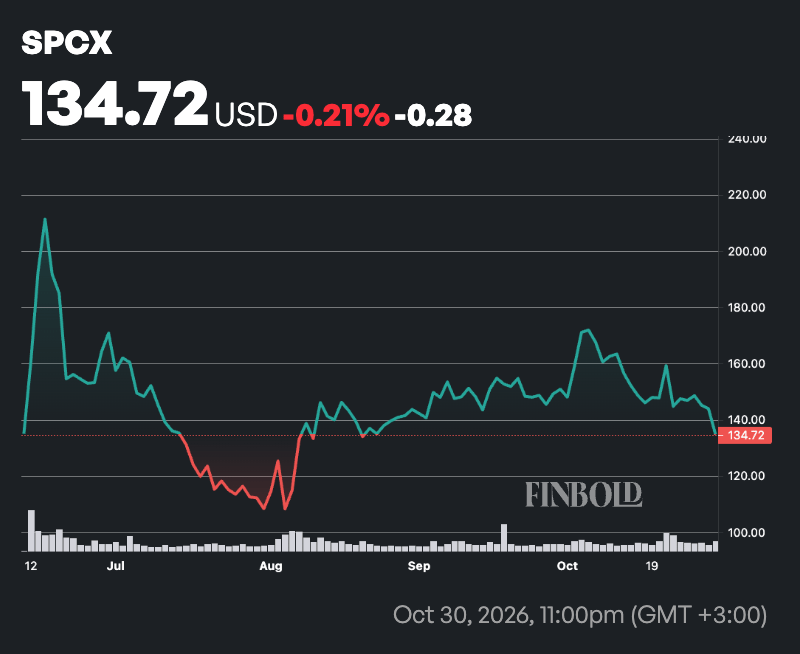
An investor who put money into SpaceX (NASDAQ: SPCX) stock two months ago would now be sitting on a loss, as shares have retreated from their September valuation.
By press time on November 1, SpaceX stock was trading at $134, down 5.13% from $142 two months earlier.
As a result, a $1,000 investment would now be worth approximately $948.73, representing a paper loss of $51.27.
Advertisement
Why SpaceX investors are cautious
Notably, SpaceX investors remain concerned about the company’s substantial AI spending and customer concentration.
In this vein, AI company Anthropic accounted for approximately 34.5% of third-quarter revenue through a computing agreement worth up to $120.5 billion through 2029. SpaceX has also guided for fourth-quarter capital expenditure of $35 billion to $40 billion.
In its third-quarter results, SpaceX reported net income of $4.4 billion, compared with a $1.1 billion loss a year earlier. Adjusted EBITDA rose 306% to $8.8 billion, while operating income reached $2.8 billion.
Its Super Intelligence segment led revenue with $7.56 billion, followed by Connectivity, primarily driven by Starlink, at $5.25 billion. The traditional Space business contributed approximately $1.77 billion.
However, the headline profit figure requires some qualification. SpaceX reported a consolidated net loss of $413 million for the first nine months of 2026, while third-quarter earnings included investment gains, interest income and a tax benefit. This makes underlying operating performance and cash generation important measures of its profitability.
SpaceX growth potential
Overall, SpaceX’s long-term growth prospects hinge on expanding Starlink and monetizing its AI infrastructure.
Advertisement
Starlink generates recurring subscription revenue across residential, enterprise, aviation, maritime, and government markets, with third-quarter Connectivity operating income rising 99% year over year to approximately $2.4 billion.
Meanwhile, Super Intelligence revenue increased approximately 830% year over year to $7.56 billion, generating $431 million in operating income.
However, expansion remains costly, with capital expenditure reaching $48.1 billion in the first nine months of 2026 and free cash flow falling to negative $35 billion.
At the same time, another potential catalyst is a possible combination with Tesla (NASDAQ: TSLA). On October 20, the companies formed special committees to evaluate a potential transaction, although no agreement has been reached.
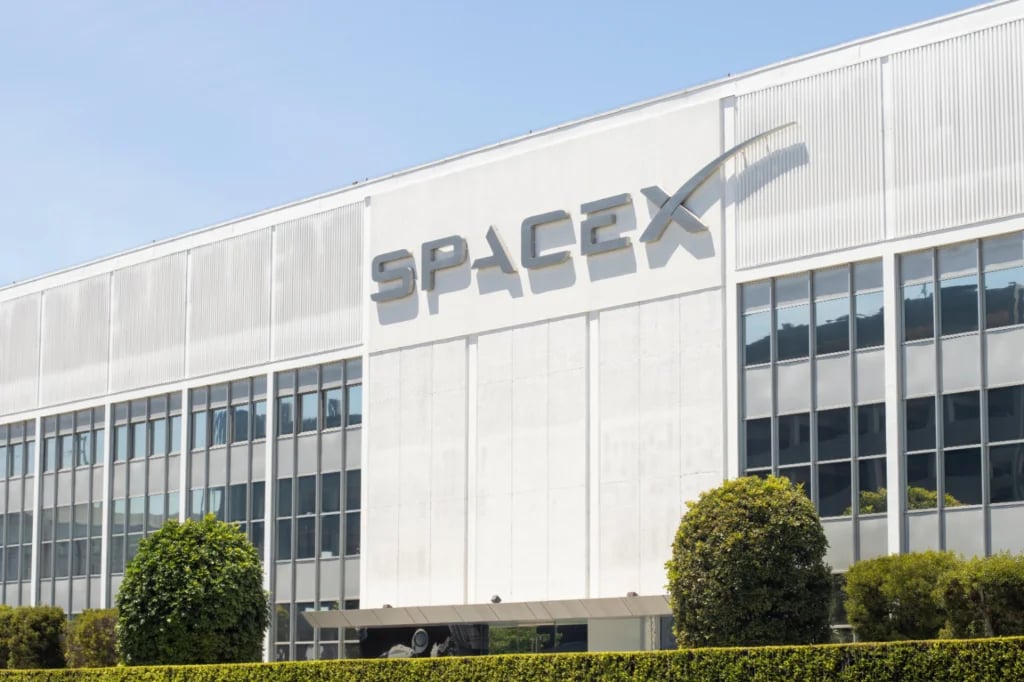
Featured image via Shutterstock