

U.S.-listed cannabis stocks are back in focus as expectations build around a potential shift in federal marijuana policy.
Markets have reacted positively to reports that President Donald Trump is considering directing regulators to reclassify cannabis from Schedule I to Schedule III under the Controlled Substances Act.
While such a move would not legalize marijuana outright, it would mark the most significant federal reform in decades, easing regulatory pressure, reducing punitive taxes, and potentially attracting institutional capital.
The prospect has already sparked a sharp rally in cannabis equities, suggesting investors are positioning ahead of possible policy action before the end of 2025.
At the center of this optimism is the potential rollback of Section 280E, which prevents cannabis companies from deducting ordinary and necessary business expenses.
Reclassification would materially improve after-tax profitability and cash flow, while better access to banking and capital markets could support valuation expansion, particularly for scaled and financially disciplined operators.
Against this backdrop, a select group of U.S.-listed cannabis stocks appears well-positioned if regulatory momentum continues.
Tilray Brands (NASDAQ: TLRY)
Tilray Brands (NASDAQ: TLRY) stands out as a direct beneficiary of renewed optimism around federal reform after spending the past two years strengthening its financial profile.
In its latest quarter, the company reported about $200 million in revenue, with cannabis contributing just under half and beverages and wellness products making up a growing share.
Adjusted EBITDA turned positive at roughly $13 million, and Tilray returned to quarterly net profitability after posting losses a year earlier. The company ended the quarter with more than $400 million in cash and marketable securities and reduced near-term debt, reinforcing its balance sheet while many peers remain capital-constrained.
These gains matter because Tilray’s valuation is highly sensitive to regulatory shifts and investor sentiment. As a liquid Nasdaq-listed stock, it is often a first point of entry for institutional investors seeking cannabis exposure, meaning confirmation of reclassification could accelerate capital inflows.
Meanwhile, Tilray’s international medical cannabis business, led by double-digit growth in Germany, and its more stable beverage segment provide diversification, limit downside risk, and position the company to convert regulatory momentum into sustained earnings growth if U.S. policy changes materialize.
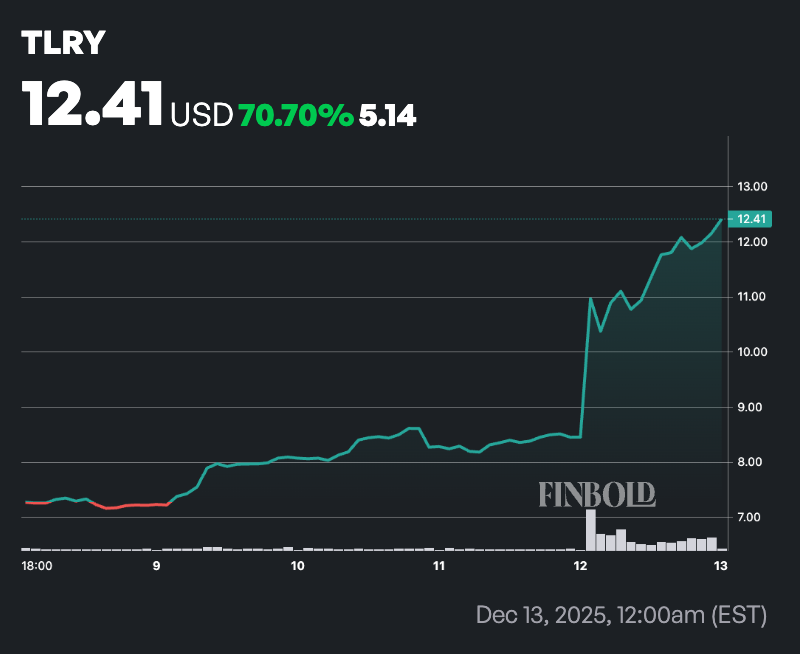
As of press time, TLRY stock was trading at $13.15 uop over 40% at last closing session.
Canopy Growth (NASDAQ: CG)
Meanwhile, Canopy Growth (NASDAQ: CG) offers a more leveraged play on U.S. cannabis reform, supported by improving fundamentals and a strengthened balance sheet.
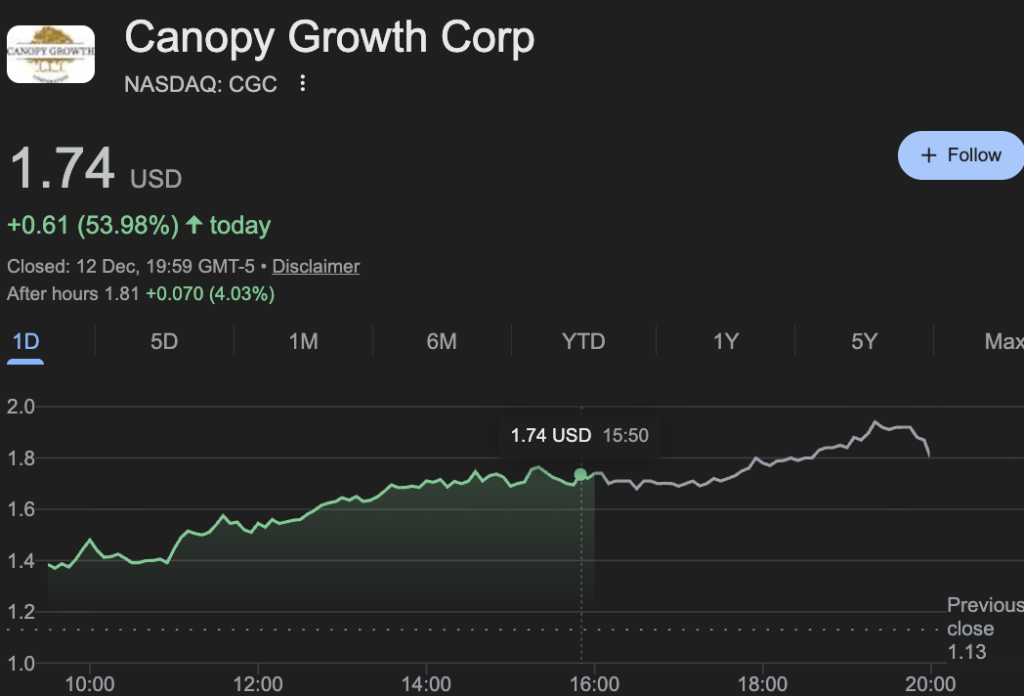
On reports of the latest regulatory developments, the stock rallied more than 50% to close the last session at $1.74.
For the second quarter of fiscal 2026, ended September 30, 2025, Canopy reported revenue of approximately $49 million, with performance in its core Canadian business showing clear improvement.
Adult-use cannabis revenue rose about 30% year over year, while medical cannabis revenue increased roughly 17%, signaling stabilization and renewed growth.
Although the company remains unprofitable on a net basis, adjusted EBITDA losses continued to narrow, reflecting ongoing cost reductions and operational streamlining.
Canopy’s liquidity position has also improved meaningfully. The company reported cash and cash equivalents of approximately $217 million, exceeding total debt by roughly $51 million and easing prior balance-sheet concerns. This stronger liquidity provides sufficient runway as the company awaits regulatory clarity in the U.S.
At the same time, Canopy remains positioned for U.S. market participation through its Canopy USA structure, which is designed to activate if federal restrictions ease.
Reclassification would improve access to banking, reduce tax burdens, and increase the likelihood of normalized capital market participation across the sector.
Featured image via Pexel