
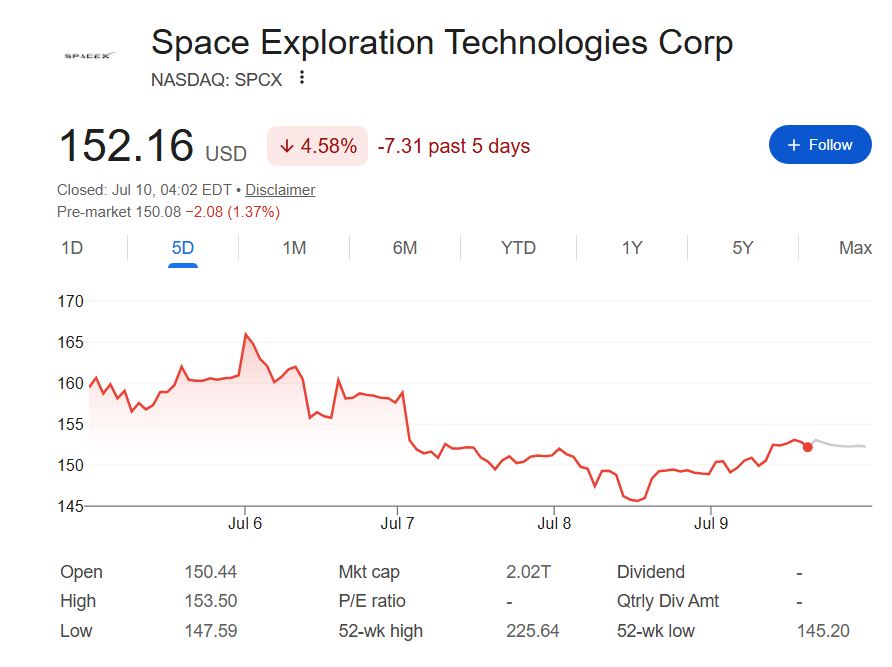
Despite the initial hype and the rapid rocketing to the all-time high (ATH) of $225.64, investing in SpaceX (NASDAQ: SPCX) stock close to the equity’s public launch would have, at best, turned into a middling trade by press time on July 10.
Specifically, shares of SPCX have been gravitating toward their initial, June 12 morning price of $150 through the last week, with the previous regular session leaving them at $152.16 and the Friday morning pre-market pacing them at $150.08.
Under the circumstances, purchasing $1,000 worth of SpaceX stock close to the company’s first opening bell at $150 would have led to only $0.53 in gains by press time and a position worth $1,000.53.
Making the same trade several hours later at the June 12 closing bell – and the price of $160.95 – would have seen the holdings diminish by 6.75% to $932.46 for a $67.54 loss.
Still, investors who managed to fill their orders at the SpaceX initial public offering (IPO) valuation of $1.77 trillion and share price of $135 would still be in profit. Specifically, a $1,000 IPO trade would have grown to $1,111.70 for $111.70 in profits.
Notably, the situation at press time on July 10 stands in stark contrast with the equity’s performance a week after the SpaceX launch. Indeed, a $1,000 investment in SPCX shares made at IPO was worth as much as $1,370 by Friday, June 19.
SpaceX stock 2026 bull case
Elsewhere, SpaceX shares find themselves in an uncertain position in early July.
On the one hand, the company boasts overwhelming Wall Street confidence, exemplified by an overall ‘Strong Buy’ rating from institutional analysts, estimated 2030 and 2040 revenue in trillions of dollars, and even a high $800 12-month price target assigned by Raymond James: a 440% predicted upside.
Similarly, the company is deeply embedded with the government via a series of long-standing and expanding contracts and has also taken to wearing multiple hats by acquiring an artificial intelligence (AI) business in the form of xAI and a social media business in the form of X.
Along with the wealth the novel technology is expected to bring to the firm, both according to several major institutions and to the pre-IPO SpaceX regulatory filing, Starlink satellite internet remains a major source of revenue and, arguably, prestige.
Lastly, Elon Musk’s newer public company also benefits from an uncommonly friendly environment, with Nasdaq being only one of several major entities that have allowed SPCX shares into its indices far faster than usual.
The 2026 bear case for shares of SPCX
Simultaneously, however, the more bearish outlook for the stock appears to be prevailing in the firm’s first month in the markets.
To begin with, despite the fast-track inclusion into the Nasdaq-100 on July 7, index fund buying activity appears to have so far failed to enable a SpaceX launch above $150.
The setup also brings the long-standing concerns regarding the firm’s valuation into focus. At its press time, market capitalization of $2 trillion, it is the seventh-largest company on the planet, even though its revenue in the most recent known quarter was below $5 billion and despite the firm operating at a loss during the period.
Valuation concerns are further compounded by the company, despite being best-known for its rockets, identifying its largest sales opportunity – and the largest total addressable market valued in tens of trillions – in its AI-related business.
Notably, though executives, analysts, and other observers remain highly optimistic about AI, the technology is yet to generate meaningful sales or profits and, arguably, yet to demonstrate capabilities sufficient to justify the past and expected capital expenditures.
Leaked financials of OpenAI – the biggest company in the industry – provide a stark example, considering that the revenue growth between 2024 and 2025 was far outstripped by the rise in costs and remains overshadowed by the firm’s vast commitments and funds raised.
Finally, along with fast-track inclusion into indices such as the Nasdaq-100, SpaceX is also notable for how swiftly most insiders will be permitted to sell, creating a potential near-term downside risk for the shares of SPCX.
Featured image via Shutterstock