

This week has not been favorable to the crypto market, with XRP losing the crucial $1.41 support zone despite growing institutional demand.
On the plus side, bulls continue to defend the $1.32 support level, leaving room for a potential rebound if institutions continue to post net inflows.
Last week alone, spot XRP ETFs posted $60.5 million in net inflows, and the momentum has carried over into this week, with more than $10.7 million in inflows in the past couple of days.
Retail sentiment, however, appears to be weakening. The Crypto Fear & Greed Index is currently at 25, firmly in ‘Extreme Fear’ territory.
As a result, short-term XRP price predictions don’t appear favorable, with machine learning algorithms also arguing for further downside by the end of the month.
Machine learning algorithm predicts XRP price on June 1, 2026
According to Finbold’s AI prediction agent, XRP is expected to average at $1.34 on June 1, representing a 2.4% decline from the current market price of $1.37.
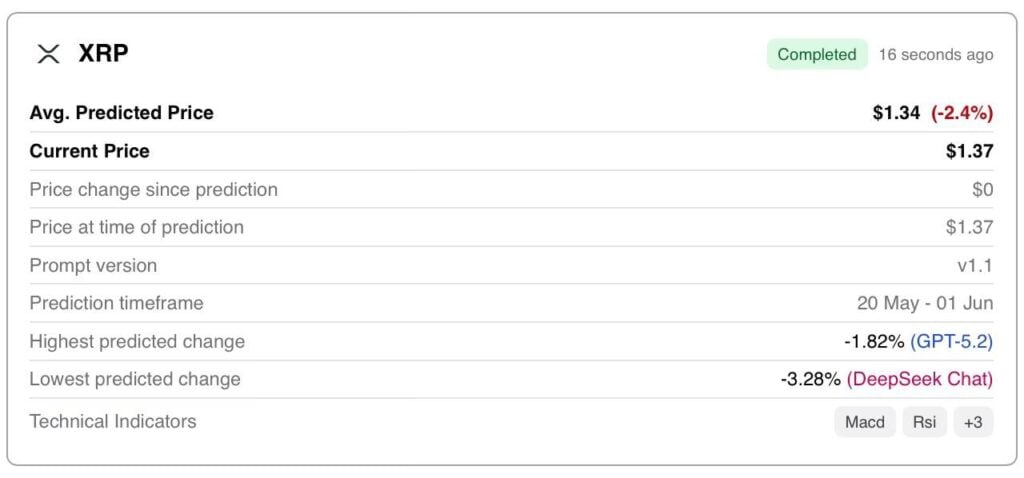
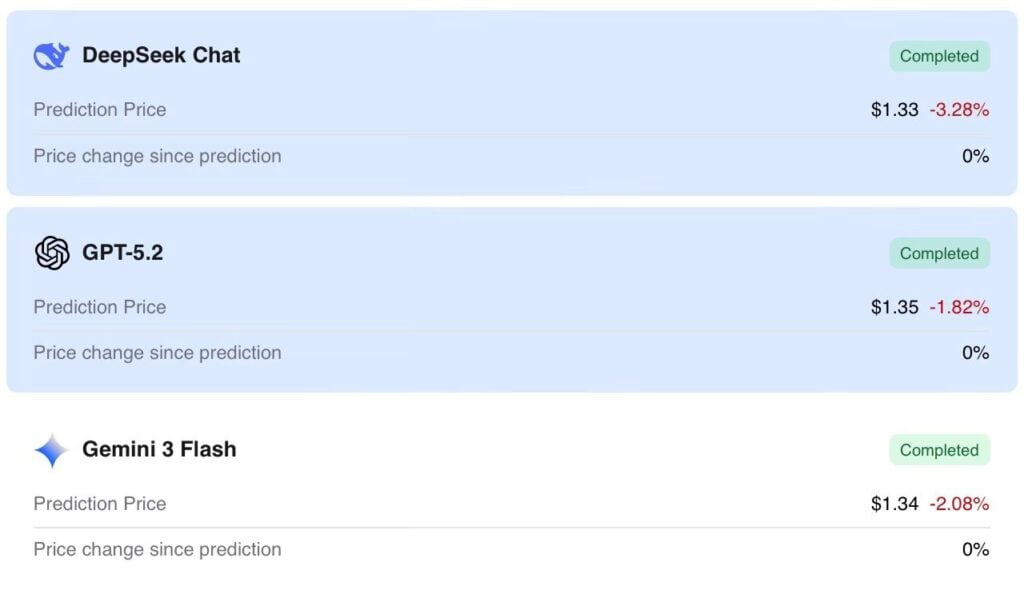
The algorithm combined the outputs from three leading artificial intelligence (AI) models: Gemini 3 Flash, ChatGPT 5.2, and DeepSeek.
Among them, ChatGPT delivered the least bearish forecast, predicting XRP at $1.35, or roughly 1.82% below current levels.
Meanwhile, DeepSeek Chat issued the most bearish target at $1.33, implying a 3.28% downside from current prices. Google’s Gemini 3 Flash landed in between with a prediction of $1.34, down 2.08%.
While all three forecasts suggest that near-term weakness is likely to continue, their projected downside remains in a relatively tight range, meaning they see no major breakdowns on the horizon.
XRP developments
Among the most noteworthy developments that could affect XRP prices going forward is the XRP Ledger’s (XRPL) upcoming technical upgrade scheduled on May 27, 2026. This amendment, dubbed FixCleanup3_1_3, will introduce backend improvements to boost reliability and reduce technical debt.
At the same time, Ripple is advancing its plans to make the network quantum-resistant by 2028. If all goes accordingly, the strategy could further strengthen the blockhain against cyber threats, making XRP appeal among security-focused institutions.
“The quantum threat isn’t hypothetical. It is an engineering challenge with a clear timeline. What puts XRPL in a strong position is that we are not starting from scratch. We already have core capabilities like key rotation and a validator network that can coordinate upgrades at scale,” said J. Ayo Akinyele, Head of Engineering, RippleX.
On-chain whale activity, however, remains mixed. Namely, recent data have shown periods of accumulation and large redistribution events. Usually, such moves suggest strategic repositioning rather than a clear directional trend.
Overall, amid cautious broader market sentiment, whale movements could continue to drive short-term volatility, even if institutional demand remains positive.
Featured image via Shutterstock