
A ChatGPT analysis projects that SpaceX (NASDAQ: SPCX) could surpass Amazon’s (NASDAQ: AMZN) market cap between 2028 and 2030, driven by growth in its core businesses, including Starlink, artificial intelligence infrastructure, and space operations.
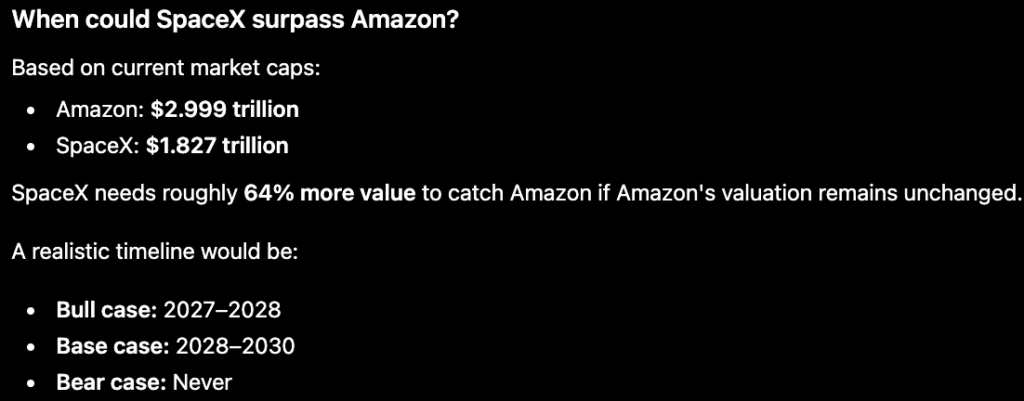
The prediction comes as SpaceX holds a market capitalization of approximately $1.83 trillion, compared to Amazon’s $3 trillion.
To overtake Amazon, SpaceX would need to increase its market value by about 64%, or roughly $1.17 trillion.
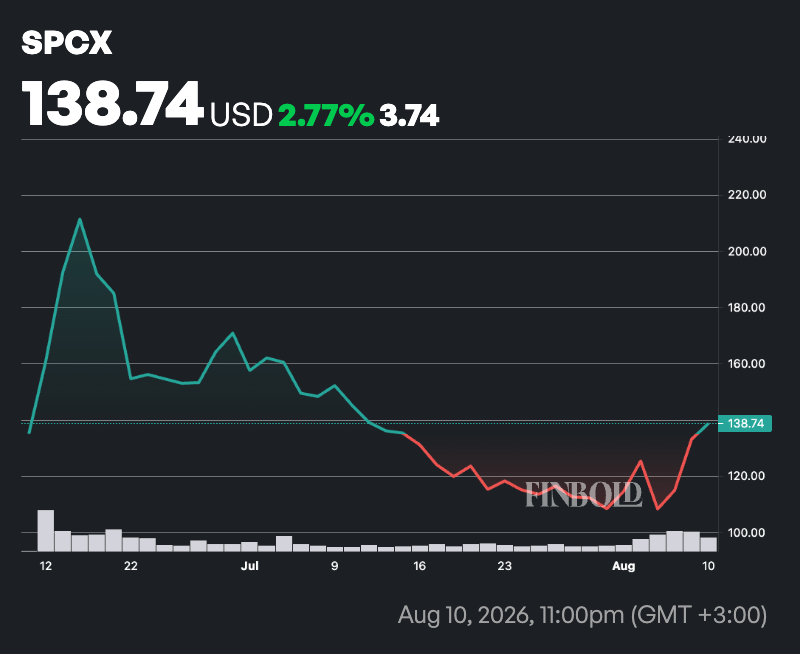
Assuming no major change in its share count, that would imply a stock price of around $228 per share, up from about $138 currently.
ChatGPT’s analysis placed SpaceX’s realistic long-term valuation between $4 trillion and $6 trillion, supported by continued growth in Starlink, AI infrastructure, and its launch business.
A more conservative valuation range of $3 trillion to $4 trillion could still be enough for SpaceX to surpass Amazon.
Valuations above $10 trillion would likely require breakthroughs in areas such as large-scale space infrastructure and orbital computing.
A ChatGPT forecast generated on August 11 identified 2028 to 2030 as the most likely period for SpaceX to achieve the milestone, with a bullish scenario pointing to 2027 if growth accelerates.
The case for Amazon stock
Amazon, however, remains a formidable competitor, supported by the strength of AWS, expanding AI services, and its dominant positions in digital advertising and e-commerce.
While the gap remains significant, SpaceX has been growing faster than Amazon in recent quarters, driven by strong momentum in Starlink and AI-related businesses.
Unlike Amazon, which is primarily valued on AWS, advertising, e-commerce, and logistics, SpaceX is gaining exposure to multiple high-growth markets.
Starlink remains its largest growth engine, with subscriber expansion, aviation and maritime connectivity, and government contracts expected to support future revenue growth.
AI is also emerging as a major catalyst, as investors increasingly view SpaceX as both an aerospace and AI infrastructure company.
In addition, Starship’s potential commercial success could unlock new opportunities in satellite deployment, lunar logistics, and orbital infrastructure.
Featured image via Shutterstock