
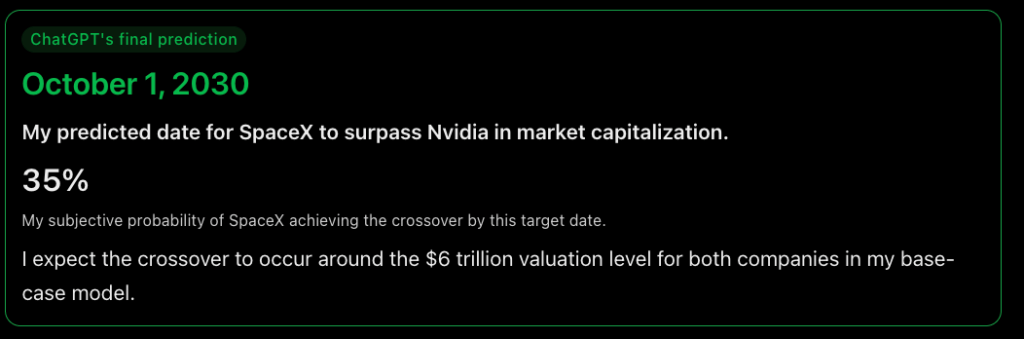
SpaceX (NASDAQ: SPCX) could surpass Nvidia (NASDAQ: NVDA) in market capitalization by October 2030, according to a prediction by OpenAI’s ChatGPT.
The forecast identified October 1, 2030, as the target date for the crossover, although ChatGPT assigned the outcome a 35% probability by then.
As of press time, SpaceX had a market capitalization of about $1.89 trillion, compared with Nvidia’s $3.93 trillion, meaning the former would need to more than double its valuation relative to the chipmaker to overtake it.
Advertisement
For SpaceX to surpass Nvidia, ChatGPT’s base-case model assumes the former’s market capitalization grows by approximately 35% annually, compared with 12% for Nvidia.
Under these assumptions, the companies could approach $6 trillion valuations around October 2030, when SpaceX could move ahead.
SpaceX and Nvidia stock’s bullish scenario
However, the forecast remains uncertain, with ChatGPT’s bullish scenario placing the potential crossover as early as December 2028, while its bearish outlook pushes the milestone to between 2033 and 2035.
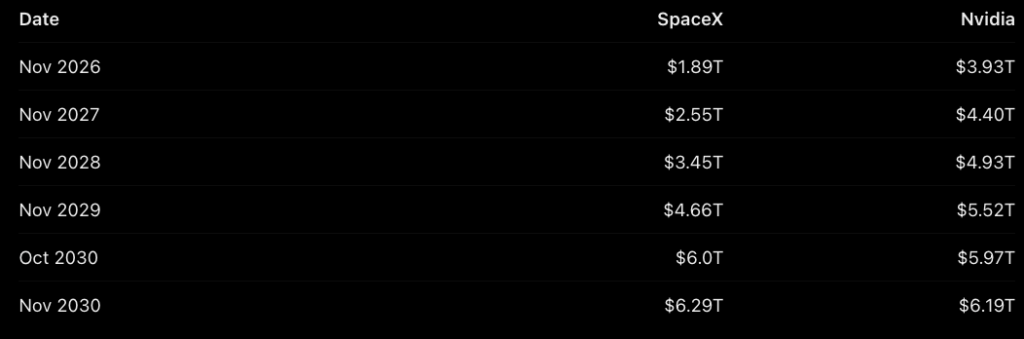
Under these assumptions, SpaceX’s market capitalization could increase from $1.89 trillion in November 2026 to approximately $2.55 trillion in November 2027, $3.45 trillion in November 2028, and $4.66 trillion in November 2029.
Over the same period, Nvidia’s valuation could rise from $3.93 trillion to approximately $4.40 trillion in November 2027, $4.93 trillion in November 2028, and $5.52 trillion in November 2029.
By October 2030, SpaceX could reach a market capitalization of approximately $6 trillion, slightly exceeding Nvidia’s projected $5.97 trillion. By November 2030, the gap could widen, with SpaceX reaching approximately $6.29 trillion against Nvidia’s $6.19 trillion.
Advertisement
NVDA and SPCX shares fundamentals
The prediction comes as SpaceX continues expanding beyond its traditional rocket-launch business into AI computing and satellite communications.
The company reported $14.6 billion in third-quarter 2026 revenue, representing 161% year-over-year growth, while its Super Intelligence division contributed approximately $7.6 billion.
SpaceX’s latest Starship milestone could also strengthen its long-term growth prospects. On November 14, the company successfully recovered its spacecraft using the launch tower’s mechanical arms in Texas, marking an important step toward fully reusable launch systems.
However, the Super Heavy booster has yet to demonstrate a successful return to the launch pad during the same mission.
Meanwhile, Nvidia faces a different set of challenges following Jensen Huang’s departure as chief executive, which has introduced uncertainty around the semiconductor giant’s leadership.
The company is also contending with US-China chip export restrictions and growing competition in AI computing.
Featured image via Shutterstock