
The early morning of March 18 proved a big day for Nvidia (NASDAQ: NVDA) in terms of Wall Street analyst rating and price target upgrades, considering it involved as many as 10 expert notes.
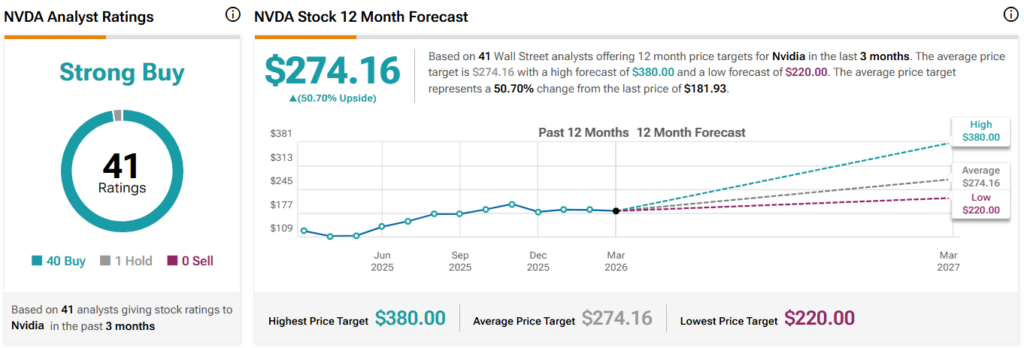
Of these, the most optimistic revision came from Kevin Cassidy, an analyst at Rosenblatt, who confirmed that the blue-chip chipmaker is still considered a ‘buy’ at his firm, but who also raised the 12-month NVDA shares price forecast from $300 to $325.
This upgrade is also significant due to the expert’s reputation. Specifically, Cassidy is a top-rated analyst with a 55% success rate and an average return of 23.50% on his predictions, based on the data Finbold retrieved from the stock analysis platform TipRanks on March 18.
Wall Street remains bullish with latest 12-month Nvidia stock price targets
Elsewhere, out of the remaining nine revisions, eight confirmed a bullish view of Nvidia shares as they featured ‘Buy’ ratings and price targets ranging between $240 and $300.
Of these, Needham’s Quinn Bolton was responsible for the lowest, $240 forecast and Bernstein’s Stacy Rasgon for the highest – once Rosenblatt is excluded – at $300.
Deutsche Bank analyst Ross Seymore was an outlier in the crowd as he is the only expert out of the ten to rate Nvidia stock as ‘Hold’ on March 18, while giving a $200 12-month price target.
Why Wall Street is revising Nvidia stock 12-month price targets
Lastly, the deluge of new ratings can arguably be attributed to the ongoing annual GTC developer conference, during which Nvidia unveiled a long list of seemingly positive news and ambitious plans.
Earlier, CEO Jensen Huang’s claims that his firm sees a $1 trillion revenue opportunity arising from artificial intelligence (AI) through 2027 drew much attention, but led to no meaningful investor reaction.
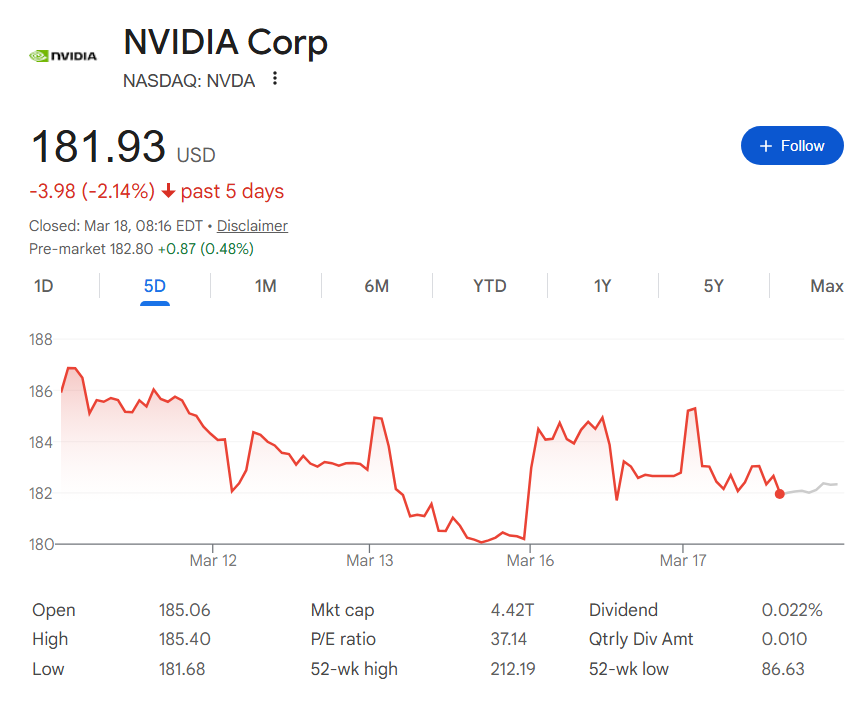
Indeed, despite the conference, NVDA stock remains in the red in every commonly used timeframe covering 2026, other than the most recent extended session.
With their latest closing price of $181.93, Nvidia shares are 0.70% down in the daily chart, 2.14% down in the last week, 3.22% in the last month, and have declined 3.66% year-to-date (YTD).
Their March 18 press time price of $182.80, however, means that they are up 0.48% in the extended session.
The growing gap between Wall Street and Main Street
Such a discrepancy between ratings and performance might simultaneously be a showcase of the growing chasm between Wall Street and Main Street as well as between enterprises and consumers.
While most analysts and experts – and executives – have continued expousing their unwavering faith in AI, investors have, apparently, either stopped responding or begun responding negatively.
Key examples of the trend came earlier in 2026 when both Microsoft (NASDAQ: MSFT) and Nvidia suffered massive one-session market capitalization drops following the release of otherwise strong earnings reports.
On the consumer front, the semiconductor giant recently unveiled the latest generation of its visual enhancements for video games – the DLSS 5 – to widespread ridicule and a strong backlash.
Specifically, while the previous iterations of the systems have been welcomed by gamers and are, arguably, generally beloved, the newest model appears mostly described as another example of a company forcing ‘AI slop’ upon its customers.
For what it’s worth, CEO Jensen Huang might be taking note of the mounting public restiveness regarding artificial intelligence since he also recently went against a key narrative of AI – the elimination of human work – and opined he expects Nvidia to have more employees in the future, not less.
Featured image via Shutterstock