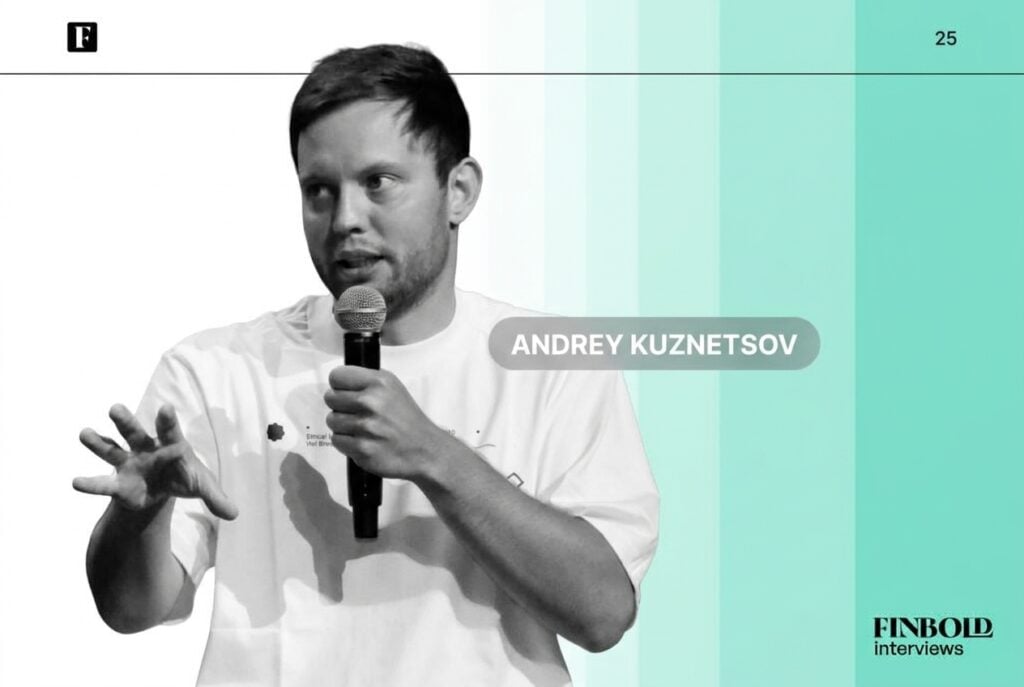

Crypto was supposed to bring financial services to people traditional banks had left behind. Instead, much of the industry has spent years developing products for people who already understand crypto.
Andrey Kuznetsov, Co-Founder and CTO of HAQQ Network and Islamic Coin, believes the next wave of adoption will look very different, with most users unaware that blockchain technology powers the services they use.
In an interview with Finbold, he argues that the companies best positioned to reach those users will have clear financial rules built into their technology from the start. He also discusses why he considers Islamic finance one of crypto’s most overlooked markets and how tokenized assets and AI could shape financial services by 2030.
Crypto started with the promise of banking the unbanked. Do you think the industry has lost sight of that goal?
In a lot of ways, yes. We started with much bigger ambitions but ended up building products for people who were already familiar with crypto.
Today, we expect users to understand wallets, seed phrases, gas fees, and different networks just to move their money around.
And most of this complexity is unnecessary. We’ve made enormous progress with blockchain infrastructure, yet we still expect ordinary people to adapt to how crypto works when it should be the other way around.
Look at the internet in the late ’90s, when people used to talk about going online. Now it’s part of almost everything we do, and we barely notice it. I expect the same with crypto and we’ll know it’s succeeded when people stop thinking about the technology altogether.
You’ve described Islamic finance as a largely untapped market for crypto. What do you think the industry has overlooked?
For starters, the sheer size of it. There are nearly two billion Muslims worldwide, around 1.2 billion of whom are online, and Islamic finance already has almost $6 trillion in assets. Yet crypto has barely reached this market.
Across the Muslim world, people share many of the same financial principles. They want access to modern financial services, but those services also need to respect their beliefs. And there’s demand among non-Muslims too, particularly among people who value ethical, transparent finance.
We’ve spent years competing for the same pool of crypto users while this market has stayed largely underserved. It’s a blue ocean, and we’ve explored only a small part of it.
Can you build Islamic finance principles directly into blockchain technology, or does compliance still depend on human oversight?
You can put a lot of these rules into code, but you can’t replace scholars with smart contracts. And we don’t have to reinvent financial products from scratch.
For example, Aave took traditional lending and adapted it for DeFi. We can do something similar with established Islamic finance models, such as asset financing with an agreed markup or arrangements where investors share in business profits.
At HAQQ, we’ve proposed a Shariah Oracle that lets us register compliance decisions on-chain. That gives developers and users a way to check whether an application meets the required standards.
But we still consult scholars to interpret the standards and assess products, much like financial companies consult lawyers.
Tokenized real-world assets have attracted growing interest. Why do you think they have particular potential in Islamic finance?
Islamic finance already has a strong connection to real assets, so tokenization makes a lot of sense here. Gold and platinum are natural candidates, and so are sukuk, which are tied to underlying assets or projects. We started by tokenizing physical gold, creating DEEN as a digital token backed by real gold.
The wider market is growing quickly. Tokenized US Treasuries went from $769 million to $2.2 billion during 2024, and some forecasts put the tokenized asset market between $4 trillion and $30 trillion by 2030. The UAE is already positioning itself as a hub for this activity.
I expect we’ll see more applications in private credit, where businesses can raise capital directly from investors, and halal supply chains, where blockchain could help finance trade and track goods from producers to retailers.
Which emerging markets do you think offer the greatest opportunities for crypto adoption?
I’d start with Indonesia. It has the world’s largest Muslim population, and many people skipped the laptop era and went straight to smartphones. Around 99% of internet users accessed the web through their phones in 2024. Yet nearly 44% of adults still had no account with a bank or another financial service provider.
Many also struggle to secure financing for their businesses.
Microfinance could help close that gap. We could use on-chain liquidity to finance small businesses through interest-free arrangements, with investors earning a share of the profits. Some models target annual returns of 20–25%, with risks attached, of course. Those returns come from business profits, which is quite different from the token-based yields we’re used to seeing in DeFi.
There’s also considerable potential in Malaysia, Saudi Arabia, and Nigeria.
HAQQ has its own Layer 1 blockchain, but you’ve also announced Ethiq, a Layer 2 on Ethereum. Why do you need both?
HAQQ gives us our own infrastructure and more control over how compliance works at the protocol level. That’s important when financial applications need to follow specific rules.
But Ethereum has a huge ecosystem and access to liquidity that would take years to build independently. Ethiq will let us tap into that ecosystem and bring our compliance-focused approach to a much wider audience.
I expect we’ll see more specialized Layer 2 networks built around specific regulatory or industry requirements, all connected to larger pools of liquidity.
AI is changing both how financial software gets built and how it operates. What has changed most for you as CTO?
AI can produce code much faster now, but someone still has to coordinate how everything fits together. I sometimes compare the CTO’s role to city planning. You set the boundaries, decide how things connect, and identify where people need to step in.
My experience with trading systems has taught me to be careful with software that makes decisions on its own, especially when money or customer data is involved. AI agents need isolated environments, clear permissions, and automated checks, with human oversight for sensitive decisions. Most of the risk comes from how we manage these systems.
If we have this conversation again in 2030, what changes would you expect to see in how people use financial services?
I expect assets like stocks, commodities, sukuk, and small-business credit to become much more common on-chain. People will access them through familiar financial apps, with blockchain handling transactions in the background. I also expect crypto and traditional markets to become more closely connected, and AI to take on more of the fundamental analysis.
AI agents will probably become major users of financial APIs. They’ll handle payments and other tasks on our behalf, with clear permissions that control what they can access and do.
Hopefully, by then, all of this will simply be part of how people manage their money.
Read more interviews here.