
Goldman Sachs believes the recent stock market sell-off could be approaching a turning point, with hedge fund capitulation creating potential buying opportunities.
In this vein, the bank’s Volatility Panic Index reached 9.8 out of 10 on Friday, reflecting an aggressive reduction in institutional equity exposure. However, Goldman cautioned that extreme panic does not necessarily signal an immediate market bottom.
In five previous instances when its index exceeded 9 during Fed rate-hiking cycles, the S&P 500 gained an average of just 0.4% over the following three months.
In Q4 2018, the index also signaled extreme fear, but the S&P 500 fell another 6.8% before bottoming.
Nevertheless, Goldman sees potential entry opportunities as hedge funds reduce exposure and valuations become more attractive.
Momentum-driven commodity trading advisers (CTAs) have sold approximately $57 billion in equities over the past month, turning their US stock positioning net short by roughly $19 billion. A recovery could prompt them to return as buyers.
Bullish outlook on the S&P 500
The banking giant maintains a constructive longer-term outlook, projecting that the S&P 500 could reach 8,700 over the next 12 months.
However, a sustained recovery will depend on stronger confidence in AI earnings, a less restrictive Federal Reserve, and broader investor capitulation.
Meanwhile, Goldman believes the latest correction has yet to trigger the widespread selling typically associated with major market bottoms, leaving room for further volatility before a sustained recovery.
The assessment comes as Wall Street experiences one of its steepest corrections in recent years, with technology and artificial intelligence (AI) stocks bearing the brunt of the selling pressure.
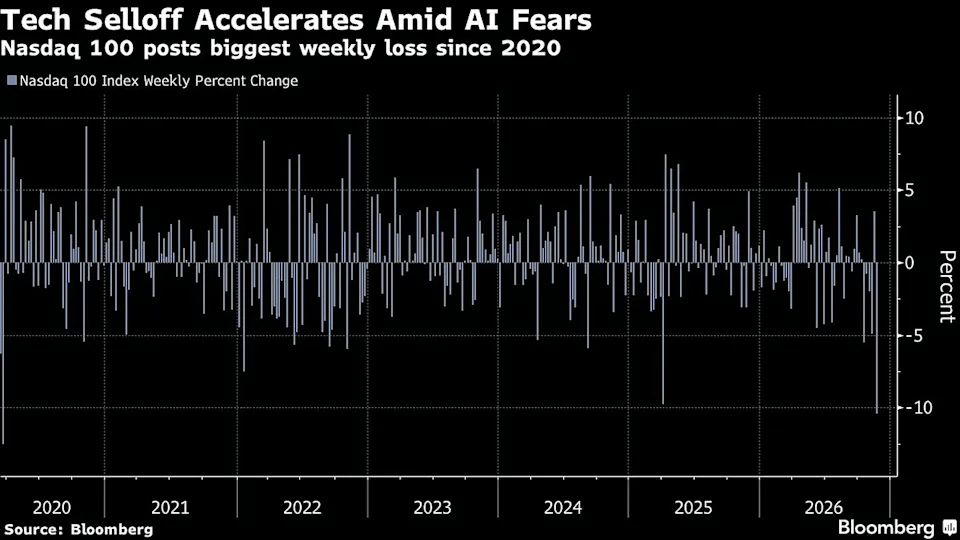
The S&P 500 has fallen more than 10% from its October record, entering correction territory after seven consecutive sessions of losses. The Nasdaq Composite has also erased its 2026 gains, while the Nasdaq 100 has approached bear-market territory following a sharp retreat from its October peak.
Hedge funds have sold global equities for three consecutive weeks, with short selling in individual US stocks reaching its highest weekly level since June 2022. Short sales have also exceeded purchases by approximately 1.5 to 1.
Fundamental long-short hedge funds have reduced their net leverage to 42.3%, its lowest level in a year, indicating a significant reduction in equity exposure.
Why the stock market is crumbling
The latest stock market sell-off has been driven by concerns over elevated technology valuations, uncertainty surrounding AI investments, and expectations of further Federal Reserve rate increases.
Investors are increasingly questioning whether massive spending on AI infrastructure, particularly data centers and advanced semiconductors, will generate sufficient returns to justify the valuations of leading technology companies.
Persistent inflation has also raised concerns that the Federal Reserve could maintain restrictive monetary policy or consider further rate increases.
Higher borrowing costs typically weigh on equity valuations, particularly for growth-oriented technology companies that depend heavily on future earnings.
Meanwhile, political and regulatory uncertainty surrounding data center construction and technology development has further clouded the outlook for AI-related investments.
Featured image via Shutterstock