
While no cryptocurrency can guarantee seven-figure profits in the short run, we asked ChatGPT to pick one cryptocurrency to make you a millionaire in 2027.
Of all possible choices, the chatbot settled for Solana (SOL) as one speculative candidate with the potential to benefit from the next phase of blockchain adoption the most.
Can Solana make you a millionaire in 2027?
According to ChatGPT, the choice came down to Solana’s established ecosystem and its growing role in decentralized finance (DeFi), stablecoin payments, and the tokenization of real-world assets. That is, unlike smaller cryptocurrencies that rely primarily on speculative hype, SOL already supports a broad range of applications, providing a foundation for potential long-term growth.

One of Solana’s biggest potential catalysts next year is the expansion of on-chain financial services. That includes greater use of stablecoins, decentralized exchanges (DEX), and tokenized stocks and funds used to increase activity across the network. Naturally, institutional involvement and improvements to blockchain infrastructure could further strengthen its position in the digital asset market.
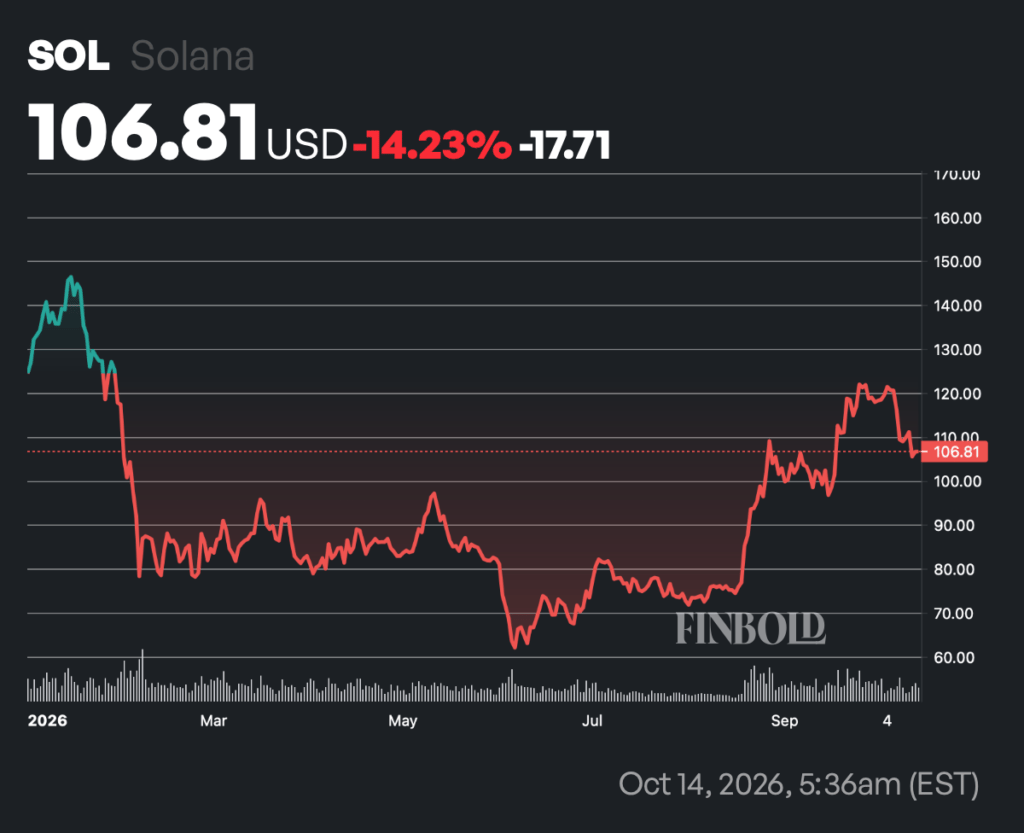
However, growing adoption does not necessarily translate into higher SOL prices. Solana faces competition from other blockchain networks, while regulatory uncertainty, market volatility, and changes in investor sentiment could weigh on its performance. A significant price increase by the end of 2027 remains possible, but it is far from guaranteed, especially considering the asset is still down 14% in 2026.
How much do you need to invest in Solana to become a millionaire?
Another factor to consider is that the financial implications depend heavily on the initial investment. For example, turning $100,000 into $1 million would require a tenfold return, meaning Solana would need to climb from $106 to $1,060.
On the other hand, a $50,000 investment would need to increase twentyfold to reach the same amount, so the asset would need to change hands at $2,120. Such gains would require an exceptionally strong performance and should not be treated as a base-case expectation.
In theory, of course, almost any cryptocurrency can make you a millionaire in 2027 if you invest enough money and the price rises sufficiently. However, there is a crucial distinction between having enough capital to reach $1 million and earning enough profit to become a millionaire.
In other words, reaching a $1 million portfolio value is not the same as generating $1 million in profit. ChatGPT’s Solana choice was thus based on its growth potential, not on a belief that it is guaranteed to make someone a millionaire by the end of 2027. More simply, the chatbot does not expect Solana to increase, say, twentyfold by the end of 2027 – it rather sees it as an asset with a credible growth thesis.
Comparison with some other crypto millionaire picks
In conclusion, the algorithm also presented some potential alternative cryptocurrencies to make you a millionaire next year, specifically XRP and Zcash (ZEC).
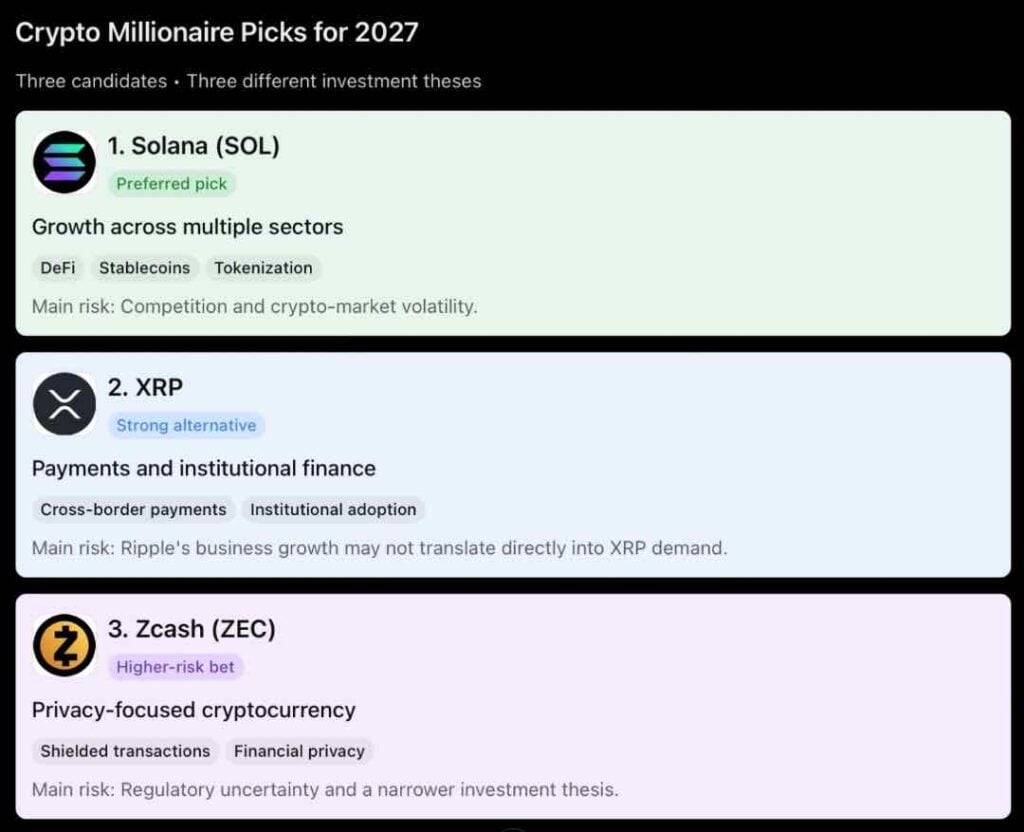
XRP was a strong alternative because its investment case centers on cross-border payments, institutional adoption, and financial infrastructure. However, the artificial intelligence (AI) argued that growth in Ripple’s business does not necessarily translate into equivalent demand for XRP.
Zcash offers a more speculative proposition based on demand for financial privacy and shielded transactions. That is, its potential upside could be substantial if privacy-focused cryptocurrencies gain traction, but regulatory uncertainty and a more concentrated investment thesis make it a riskier choice.
ChatGPT’s one cryptocurrency to make you a millionaire in 2027
Ultimately, ChatGPT’s pick is Solana, based on its existing ecosystem and potential exposure to expanding blockchain-based financial activity.
Nonetheless, investors should distinguish between an asset with growth potential and one likely to deliver life-changing returns within a specific timeframe.
Despite the algorithm’s call, SOL still remains a high-risk investment, and anyone considering it should be prepared for substantial losses as well as potential gains.
Featured image via Shutterstock