
Tesla (NASDAQ: TSLA) could be on track for a deeper decline toward $200 after losing a key technical support level, according to market analysis.
The bearish outlook comes as the stock continues to struggle following its post-earnings sell-off, with shares trading around $313 after falling roughly 30% year-to-date.
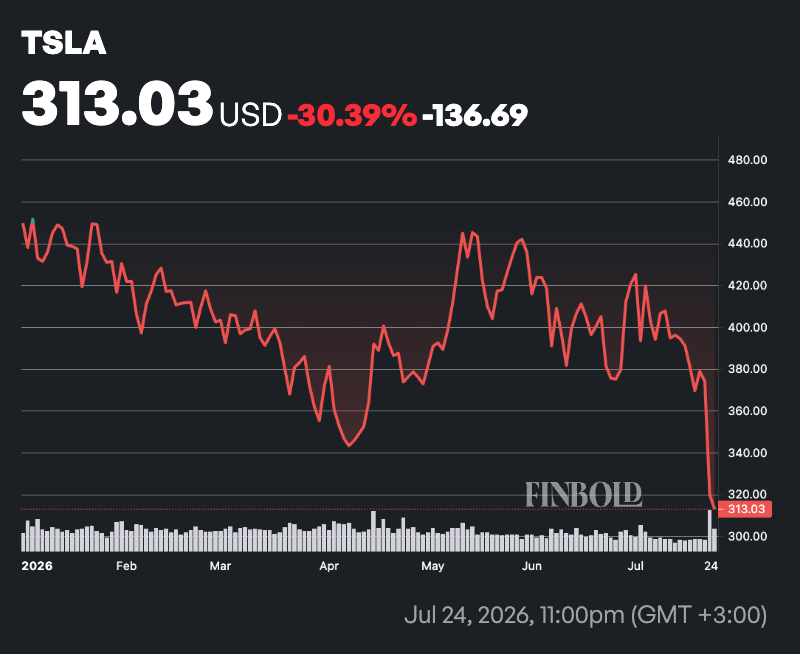
The TSLA stock analysis shared by Ali Martinez in an X post on July 26 shows Tesla breaking below mid-range support near $360, a level that had previously acted as a key floor within the stock’s broader trading channel.
With that support now breached, traders are watching the $280 area as the next major downside target. If selling pressure persists, the channel bottom near $200 could come into focus.
At the same time, Tesla’s long-term trading structure appears to be weakening after the recent breakdown.
According to the analysis, TSLA faces resistance near $485, with former support around $360 and lower channel support close to $200. Tesla closed at $313, well below the $360 level.
The loss of this technical floor shifts the short-term focus toward $280, with a potential extension toward $200 if bearish momentum remains intact.
Such a move would represent an additional decline of about 36% from current levels and a drop of nearly 60% from Tesla’s 52-week high of $498.83.
Tesla stock fundamentals
The bearish technical setup emerged after Tesla’s second-quarter 2026 earnings report triggered one of the stock’s sharpest declines in years.
Although revenue rose 26% year-over-year to $28.24 billion and vehicle deliveries reached a record 480,126 units, investors focused on weakening profitability. Adjusted earnings per share came in at $0.33, missing Wall Street expectations of roughly $0.51 to $0.55.
Meanwhile, operating margin fell to 1.4% from 4.1% a year earlier, while free cash flow turned negative at approximately $1.09 billion.
Capital expenditures surged 142% to $5.79 billion as Tesla increased spending on artificial intelligence, robotaxis, Optimus humanoid robots, battery production, and manufacturing expansion.
The market reacted negatively, sending Tesla shares down about 12% to 15% after earnings and wiping out more than $140 billion in market value.
Despite the near-term pressure, Tesla continues to report strong growth in several strategic areas. Full Self-Driving paid subscriptions climbed 56% year-over-year to 1.48 million, while the company expanded unsupervised robotaxi operations across multiple U.S. cities.
Tesla has also begun Cybercab production preparations at Giga Texas and continues advancing Optimus development, projects many bullish investors view as key long-term growth drivers.
While Wall Street’s average price target remains around $400, investors are increasingly weighing Tesla’s AI and autonomy ambitions against declining margins, rising spending, and execution risks.