

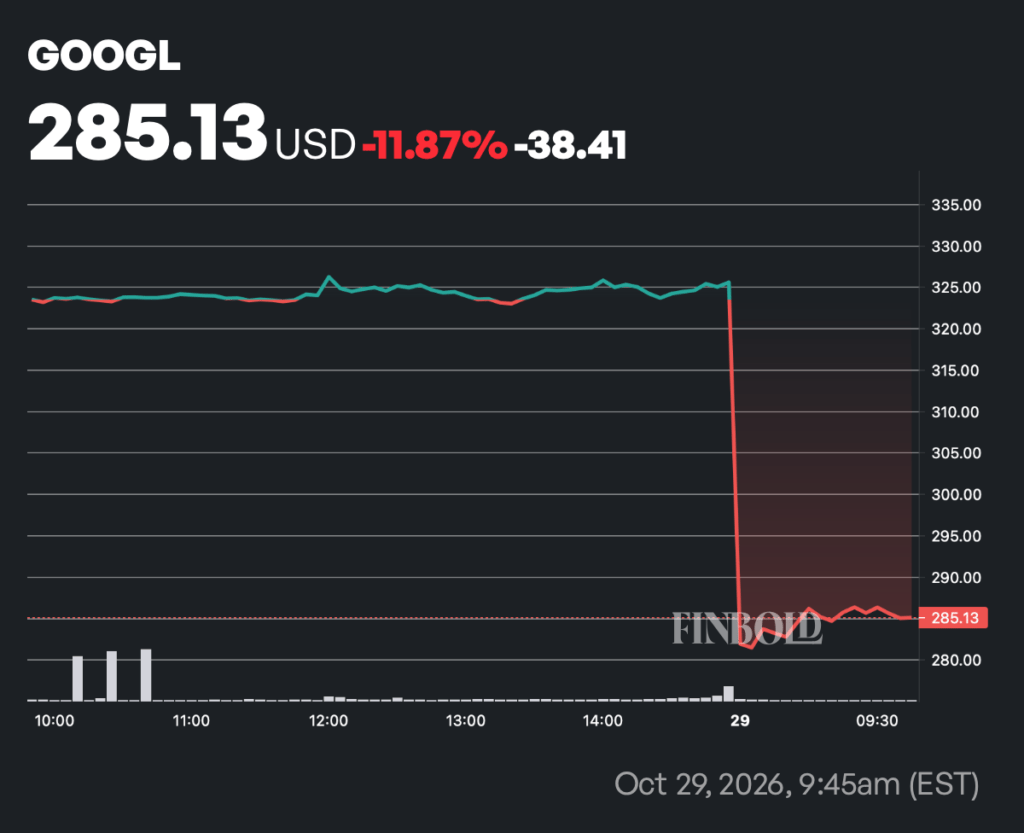
Google (NASDAQ: GOOGL) stock is on track for its worst single-day decline in history, with shares plunging roughly 12% following its third-quarter earnings report.
Not only that, but the sell-off is threatening to erase nearly $500 billion from the company’s market capitalization – potentially one of the largest losses ever recorded by a U.S. company.
As the price has dropped from $321 to $285, GOOGL shares are now trading at the lowest price-to-earnings (P/E) multiple in history, at 14.273.
Advertisement
Why is Google stock slipping?
The market’s concerns about the results are understandable. Namely, search revenue grew 12% to approximately $63 billion, missing Wall Street’s $65 billion estimate, while rising artificial intelligence (AI) infrastructure spending pushed free cash flow to a deficit of roughly $9 billion.
However, the underlying growth story remains substantial in other respects. For instance, Google Cloud revenue more than doubled to approximately $31 billion, and the Gemini app surpassed 1 billion users.
Of course, investors are increasingly questioning when those investments will translate into sustainable cash flow and whether AI will ultimately strengthen or disrupt its core search business. As a result, 18 Wall Street analysts have slashed their Google stock price forecasts.
Google shares post record losses
Overall, the scale of the sell-off is extraordinary. Alphabet’s estimated $496 billion loss would dwarf its previous worst single-day decline of approximately $275 billion. As such, it would be comparable to Nvidia’s (NASDAQ: NVDA) roughly $593 billion loss in January 2025.
As analysts note, the investment narrative now comes down to valuation versus execution risk. If AI sinks Google’s search dominance and expenses continue to put pressure on cash flow, things could indeed go south.
Conversely, though, if Alphabet maintains its search leadership, scales its cloud business, and eventually does monetize its AI efforts, the current valuation could offer substantial upside.
Advertisement
Therefore, several major firms, including Bank of America (BofA) and Morgan Stanley, still maintain bullish ratings despite lowering their targets.
Featured image via Shutterstock