

As 2025 draws to a close, U.S. equity markets have delivered broad-based gains across nearly all major stock sectors.
However, one segment has notably lagged behind the rest. Real estate has emerged as the only stock market sector to post negative returns this year.
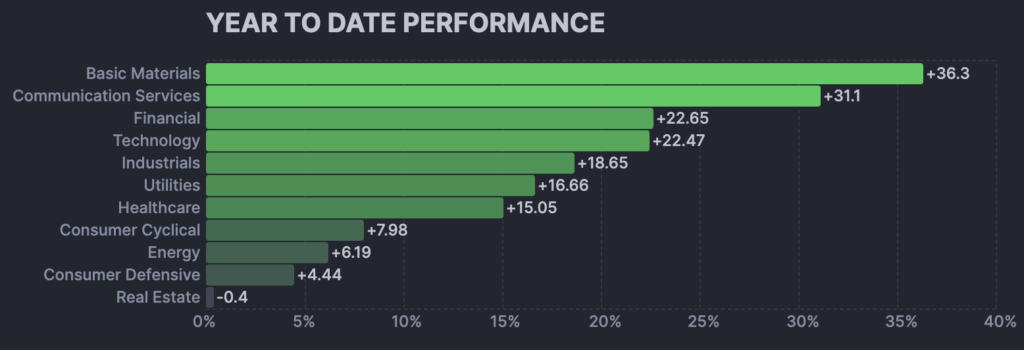
Year-to-date performance data shows the real estate sector down approximately 0.4% in 2025, making it the sole decliner among the 11 major sectors.
In contrast to real estate’s slight decline, the top-performing sectors posted robust results. Basic materials led the market with a gain of roughly 36.3%, followed by communication services at about 31.1%.
Financials and technology both delivered strong returns, up approximately 22.7% and 22.5%, respectively. Industrials rose about 18.7%, utilities climbed around 16.7%, and healthcare advanced near 15.1%. Consumer cyclical stocks increased by almost 8%, energy finished near 6.2%, and consumer defensive names gained approximately 4.4%.
Why real estate dropped in 2025
Real estate stocks have lagged mainly due to their sensitivity to interest rates. Elevated borrowing costs in 2025 pressured valuations and profitability, especially for debt-heavy real estate investment trusts, while higher yields reduced the appeal of income-focused real estate stocks relative to fixed-income alternatives.

Sector performance was also uneven. Office, retail, and some residential segments faced weak demand, refinancing risks, and a slow recovery in commercial property activity. Although niche areas such as healthcare and specialized real estate showed resilience, their gains were insufficient to offset broader weakness.
Despite ending 2025 in negative territory, real estate could recover if interest rates ease and property fundamentals improve. For now, it remains the only major stock sector to finish the year with a loss.
By comparison, other sectors benefited from stronger earnings growth, improving margins, and sustained investor appetite for risk assets.
Technology and communication services were supported by continued innovation in artificial intelligence (AI) and capital investment, while financial stocks gained from higher interest rate environments. Basic materials led the market as commodity prices and industrial demand remained firm through much of the year.
Featured image via Shutterstock