
As artificial intelligence systems continue to scale, their rising energy demands are emerging as a potential constraint on future development, according to Lado Okhotnikov, founder of biotech and technology platform Holiverse.
Industry estimates suggest global data center energy use could rise significantly before the end of the decade, largely due to the growing computational demands of advanced AI models. This has renewed questions over whether today’s power infrastructure can keep up.
“The problem is becoming especially urgent now, as AI is advancing rapidly and its energy demands are growing just as fast,” Okhotnikov said. “Even today,” he stresses, “we must think about where we will source that energy without compromising people’s lives or existing industries.”
Okhotnikov acknowledged that renewable energy sources such as wind, solar, and geothermal already play an important role in meeting current demand.
“Renewable energy collected on Earth is no longer a fantasy: many countries are actively transitioning to it, and I hope this shift will only accelerate,” he said.
However, he noted that land-based renewables may face limitations when applied to always-on, global AI systems:
“Very soon, we will have to look to space—because the future, without question, belongs there.”
The vision for a space-based energy backbone
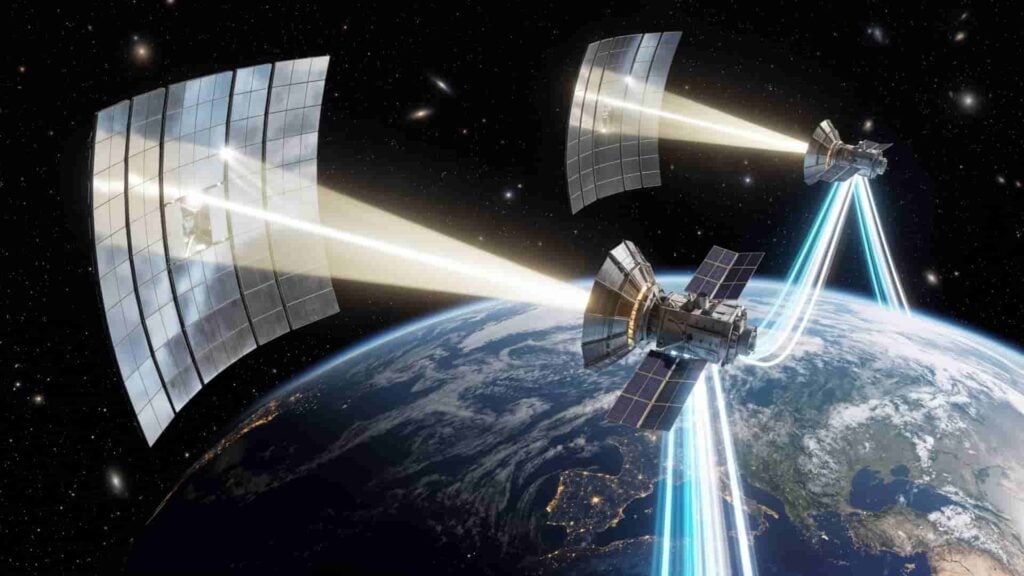
One concept receiving growing attention is Space-Based Solar Power (SBSP), which involves placing solar arrays in orbit to collect continuous sunlight and transmit energy wirelessly to Earth.
Space agencies including the European Space Agency, NASA, and Japan’s JAXA are currently researching the feasibility of space-based solar power, and a 2025 techno-economic study focused on the European energy grid found that SBSP could help provide stable, continuous power alongside intermittent renewable sources.

“The solar power we can collect here on Earth is only a tiny fraction of what is available in space,” observes Okhotnikov, whose perspective is inherently long-term. “In my view, this is where an enormous potential lies for new developments—and this is exactly what we are working on at Holiverse.”
According to Okhotnikov, Holiverse is examining how future AI infrastructure could be supported by alternative energy models, such as space-based systems, as part of a longer-term research outlook.
Building the foundation for a limitless AI future
While space-based solar power is still in the research phase, progress in reusable launch systems, robotics, and materials science has brought the concept closer to practical consideration. Even so, major technical, regulatory, and cost hurdles remain before it can be deployed at scale.
“We are developing technologies capable of powering the next era of AI,” Okhotnikov states. “It’s a demanding process that brings together some of the brightest minds in this field, and I believe that in the foreseeable future we will be ready to take tangible steps toward making this project a reality.”
As AI continues to spread across fields such as climate modeling, healthcare, and scientific research, questions about how to power it are becoming increasingly central to its long-term growth.
Featured image via Roman Popov.