
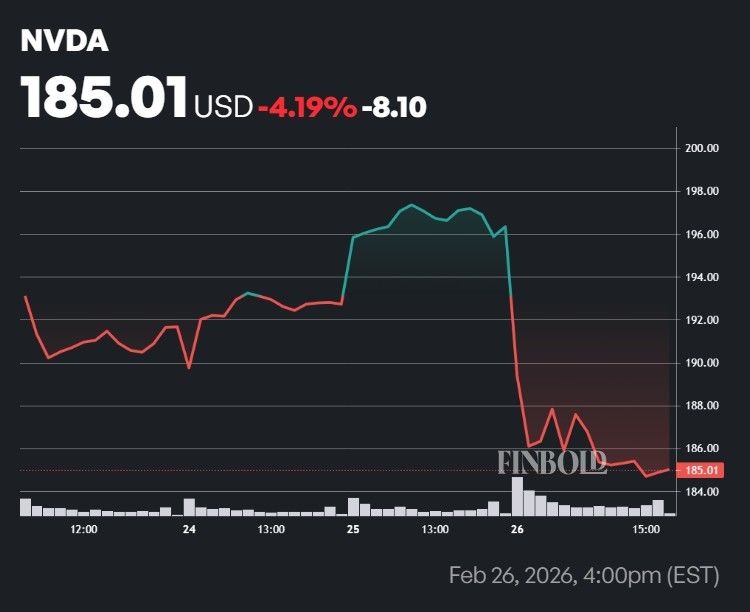
The immediate aftermath of Nvidia’s (NASDAQ: NVDA) latest earnings report, published in the afternoon of February 25, appeared to confirm the artificial intelligence (AI) boom is very much ongoing, with the equity rallying more than 5% within an hour.
Still, trading has since taken a dramatic turn with NVDA stock falling 5.46% in the February 26 regular session, effectively wiping $260 billion from the semiconductor giant’s market capitalization.
An apparent confirmation of the bearish case came late on Thursday when Coreweave (NASDAQ: CRWV) – a firm whose major backer is none other than Nvidia – unveiled its admittedly lacking earnings and suffered an 11.38% drop to $86.52 in the extended session leading to Friday, February 27.
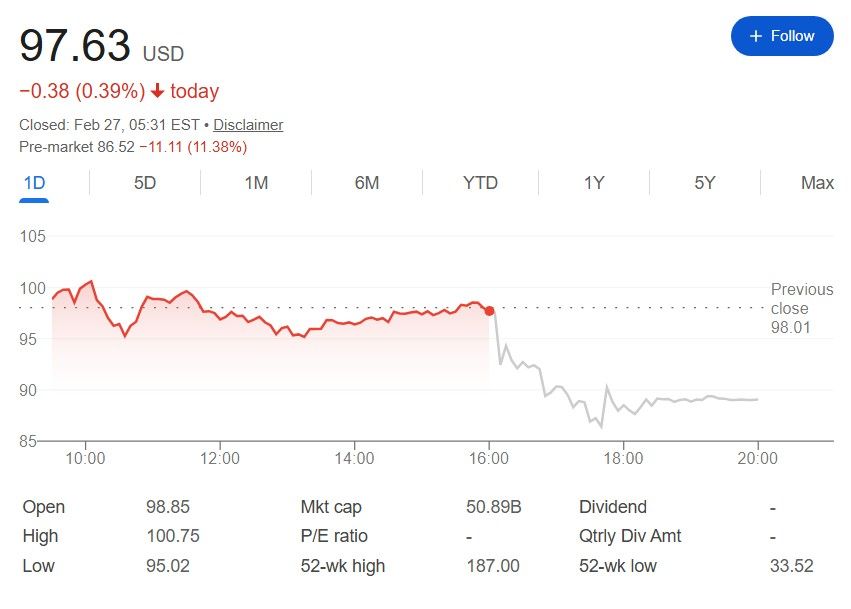
Is CRWV stock price drop a canary in the AI mine?
To begin with, Coreweave’s stock market drop arguably appears to be of little concern. With the firm unveiling $1.57 billion in revenue – against the expected $1.55 billion – and $0.89 loss per share – $0.49 was forecasted – a sharp drop was to be expected.
Furthermore, the downturn was exacerbated by the first-quarter guidance, anticipating between $1.9 billion and $2 billion, while the consensus previously stood at $2.29 billion.
However, some level of instability could have been expected in early 2026, considering the firm made a transition from a cryptocurrency miner to an AI infrastructure provider relatively recently.
Still, though the state of CRWV stock itself is likely not a wider concern, the state of its business might be a systemic risk.
Already at the time of its business pivot, some observers noted that Nvidia’s backing was not only a boon but also a necessity for the company to retain any semblance of stability.
Here’s why Nvidia stock wiped $260 billion despite blockbuster earnings
The fact that it, about a year after the fact, underperformed expectations, only brings the general doubts about the AI industry’s road to profitability into sharper focus.
Elsewhere, it is precisely these doubts that might explain Nvidia’s drop despite the apparently blockbuster earnings.
Specifically, late 2025 introduced fears that the entire sector is engaging in so-called circular investments where a firm gives money to a different company so that that firm can purchase a service or a product.
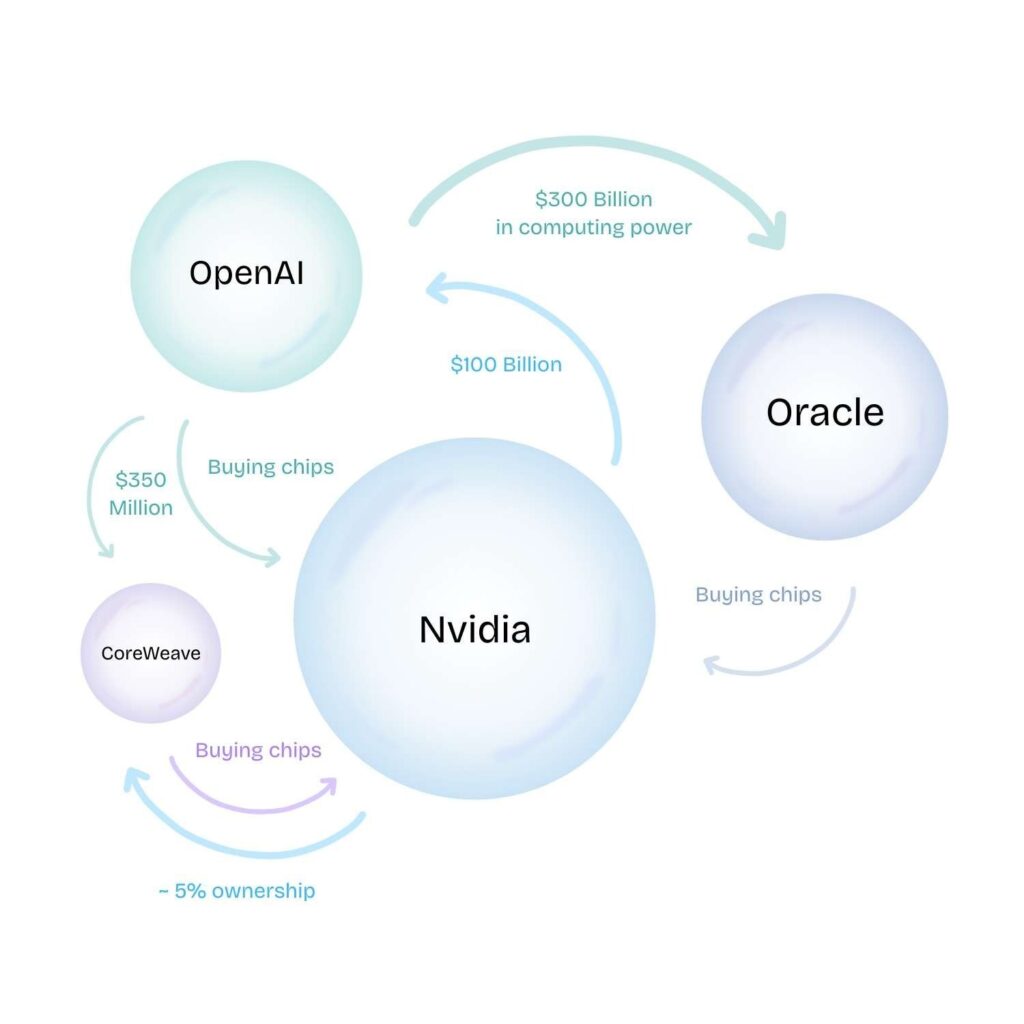
Troublingly, some of Nvidia’s biggest corporate investments – at least those the blue-chip chipmaker has not reneged on – have been in its own clients like OpenAI.
‘Big Short’ Michael Burry reveals key risk for Nvidia stock
Furthermore, Nvidia’s latest regulatory filings did much to reinforce such fears.
As the famous ‘Big Short’ investor Michael Burry noted on his Substack on February 26, the changes in the industry compelled the world’s biggest semiconductor firm to place non-cancellable orders to the tune of billions of dollars, even before demand is known:
To be clear, NVDA has been forced to place non-cancellable purchase orders well before demand is known. This appears structural to the new trajectory of product development and not temporary.
Additionally, precisely the question of demand has been weighing heavily on investors. Recent figures regarding AI usage – ostensibly backing the unprecedented investments in infrastructure such as data centers – are impressive at face value, but they come with numerous caveats.
Why 2026 AI adoption leaves room for doubt
Since the current high-tech boom started in earnest with the public release of ChatGPT in late 2022, many companies have been engaging in so-called ‘AI washing’ – a practice in which a firm labels a more traditional product as ‘artificial intelligence’ on minor or no changes for marketing purposes.
More recently, big tech has been enforcing its AI models on users with little regard to the desirability of such changes. Newer Windows-intended laptops come with a dedicated Copilot button, and Copilot has, indeed, been integrated into the operating system itself.
Google (NASDAQ: GOOGL) famously placed its ‘AI overview’ at the top of search results and has started pushing the ‘AI mode’ for search rather aggressively.
Even some less-discussed companies, such as the antivirus firm Kaspersky, now mandate product installation and activation via an LLM (large language model)-like chat.
Such practices – especially when paired with some companies reportedly enforcing AI usage at the workplace – make assessing the actual organic adoption of the technology difficult to gauge.
The impact and the prospects of the sector are made even more uncertain by the existing studies finding that the impact of artificial intelligence on productivity is relatively negligible and by the growing societal issues in the form of ‘AI psychosis.’
Other data, such as OpenAI’s own internal forecast that it will lose approximately $14 billion in 2026 – even when tempered by the $100 billion in projected revenue within just a handful of years – further darken the picture.
The same can also be said of the fact that much of the technology adoption that does exist exists due to companies effectively subsidizing their users by giving access substantially below cost.
Why AI boom may not be over despite CRWV and Nvidia stocks crashing
All of that being said, tolling the bells for Nvidia, big tech, and other parts of the AI sector in February and March 2026 is likely premature.
The semiconductor giant, as well as other key players like Microsoft (NASDAQ: MSFT), Amazon (NASDAQ: AMZN), and Google, remain exceptionally wealthy companies with robust fundamentals. Indeed, they have both the cash and the stability to weather most short and mid-term turbulence in the market, or slowdowns in technological development.
Furthermore, even if reports on AI have recently been lacking, many of humanity’s largest breakthroughs came fairly suddenly and relatively unexpectedly, meaning that the road to a major artificial intelligence leap that could validate the massive expenditure is very much open.
Simultaneously, while investors have come to view Jim Cramer’s analysis with skepticism and the former hedge fund manager is a known and long-term NVDA stock bull, he is hardly the only one to view the latest sell-off as less than a systemic risk.
For example, Gordon Johnson of GJL Research – generally known as the top Tesla (NASDAQ: TSLA) bear but also a frequent contrarian to big tech narratives – also shared on February 26 that the Nvidia stock drop is not the result of fundamentals, but ‘market mechanics.’
Specifically, Johnson argued that, in the wake of the earnings report, NVDA was faced with ‘an options wall of ~$200/shr (share),’ that it failed to clear, thus leading brokers to sell in order ‘to reverse sold calls.’
Ultimately, the most likely result of the Nvidia stock drop in late February and early March is a renewed rally.
Featured image via Shutterstock