

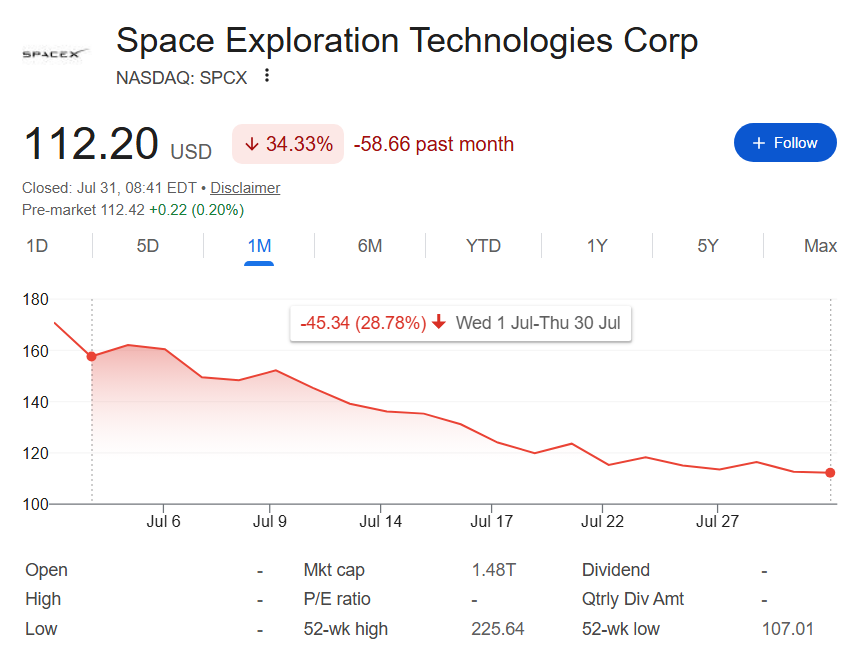
After an especially strong start to its existence as a publicly traded company, SpaceX (NASDAQ: SPCX) took a downward turn and is, at press time on July 31, only slightly above its all-time low of $107.01.
Indeed, while SPCX shares‘ downturn started already in mid-June and shortly after reaching their all-time high (ATH) of $225.64, investors who expected July to feature a bullish reversal would have been left disappointed.
Specifically, the seventh month of 2026 only deepened the SpaceX stock price crash and, at press time, the equity is 28.78% below where it stood just after June ended, and, at $112.20, 16.89% below the initial public offering (IPO) price of $135.
Under the circumstances, traders who assessed they had evaded both the IPO hype rally and the subsequent correction and invested $10,000 on July 1 would have done so at an average price of $157.54.
Thus, by the morning of July 1, they would have suffered $2,878 in losses and experienced their position drop to $7,122.
Is SpaceX stock price about to rally in August?
Looking ahead, next week could bring heightened volatility to shares of SPCX with the August 4 earnings report – the company’s first-ever as a public firm – presenting as an especially likely catalyst.
Notably. while analysts are expecting significant revenue growth relative to the $4.7 billion reported for the first quarter (Q1), they still expect SpaceX to remain an unprofitable company.
Furthermore, the Q2 filing will come mere days before the first insider unlocks enable new selling pressure.
Along with Elon Musk’s popularity with retail investors all but guaranteeing initial hype, the SpaceX IPO was notable for ensuring fast-track inclusion into the benchmark Nasdaq-100 index – an event that so far failed to trigger the anticipated rally from automatic buying – and for how fast insiders would be allowed to start selling.
The third factor in particular was used by critics to level accusations that the rocket, social media, and artificial intelligence (AI) company’s offering is designed to provide ‘exit liquidity’ for the firm’s wealthy early backers and stakeholders.
Additionally, the bearish view was amplified by the severe mismatch between the firm’s actual financials – less than $5 billion in revenue and a quarterly loss in Q1 – and its initial valuation – $1.77 trillion at the IPO – and the implausible though possible growth projections.
Featured image via Shutterstock