

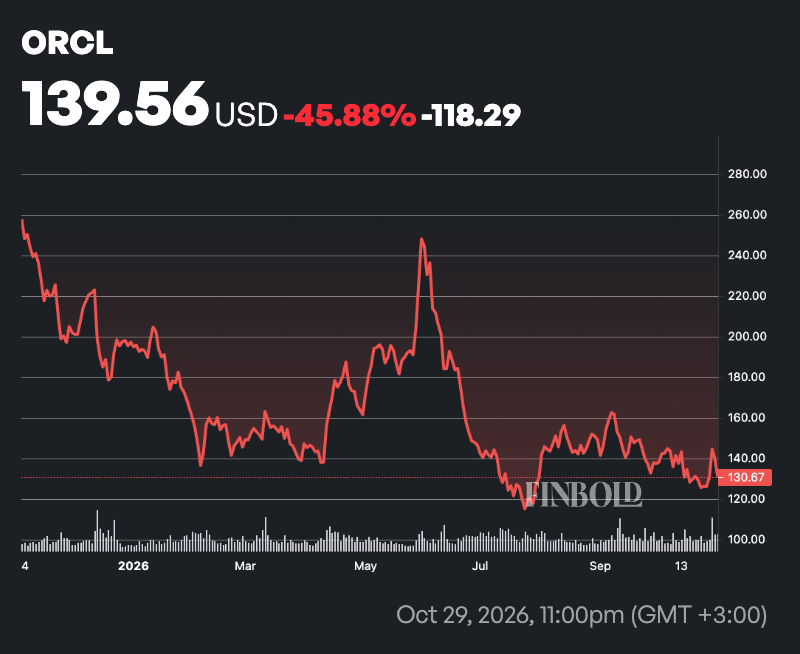
An investor who purchased Oracle (NYSE: ORCL) stock a year ago and reinvested every dividend payment would now be sitting on a loss of almost 50%.
Oracle has maintained a quarterly dividend of $0.50 per share over the past year, translating into $2 in annualized dividends. However, the payouts have offered little protection against the stock’s sharp decline.
For instance, an investor who purchased 100 Oracle shares on October 31, 2025, at $262.61 per share would have initially invested $26,261.
Advertisement
Breakdown of Oracle dividend investment
The investor would have received four quarterly dividend payments between January and October 2026, each worth $0.50 per share. Assuming all payments were reinvested at the respective payment-date share prices, the investor would have accumulated approximately 1.43 additional shares.
The reinvestments would have taken place at $177 on January 23, $163 on April 24, $114 on July 24, and $126 on October 23.
Consequently, the investor would now own approximately 101.43 Oracle shares. However, the additional shares would have done little to offset the stock’s depreciation.
Oracle closed at $130 on Friday, valuing the investor’s holdings at approximately $13,254. This represents a paper loss of approximately $13,007, or 49.53%, against the initial investment of $26,261.
Without dividend reinvestment, the original 100 shares would be worth $13,067, with approximately $200.95 received in cash dividends. This would bring the total investment value to $13,267, slightly higher than under the reinvestment strategy.
The technology company pays dividends quarterly, with its latest $0.50 distribution made on October 23, 2026. Its next estimated payment date is January 22, 2027.
Advertisement
Meanwhile, Oracle’s forward dividend payout ratio stands at 18.07%, suggesting the current distribution represents a relatively small proportion of forecast earnings.
Oracle stock fundamentals
Beyond its share-price performance, Oracle’s expanding cloud infrastructure business offers exposure to growing demand for artificial intelligence computing capacity.
In its fiscal 2026 fourth-quarter results, Oracle reported that cloud infrastructure revenue grew 93% year over year to $5.8 billion, while total cloud revenue increased 47% to $9.9 billion. Its remaining performance obligations also reached a record $638 billion, highlighting substantial contracted demand.
More recently, at its October 28 investor day, Oracle outlined a target of generating at least $225 billion in annual revenue by fiscal 2030. It also expects to achieve positive free cash flow in the second half of fiscal 2028 and generate at least $30 billion in free cash flow in fiscal 2029.
The company also committed to limiting additional capital raises through fiscal 2030 to $20 billion, excluding debt refinancing, addressing concerns about financing its AI infrastructure expansion.
Nevertheless, investors remain concerned about the substantial capital expenditure required to build AI data centers, rising financing needs and the time needed for those investments to generate sustainable cash flow.
Featured image via Shutterstock