
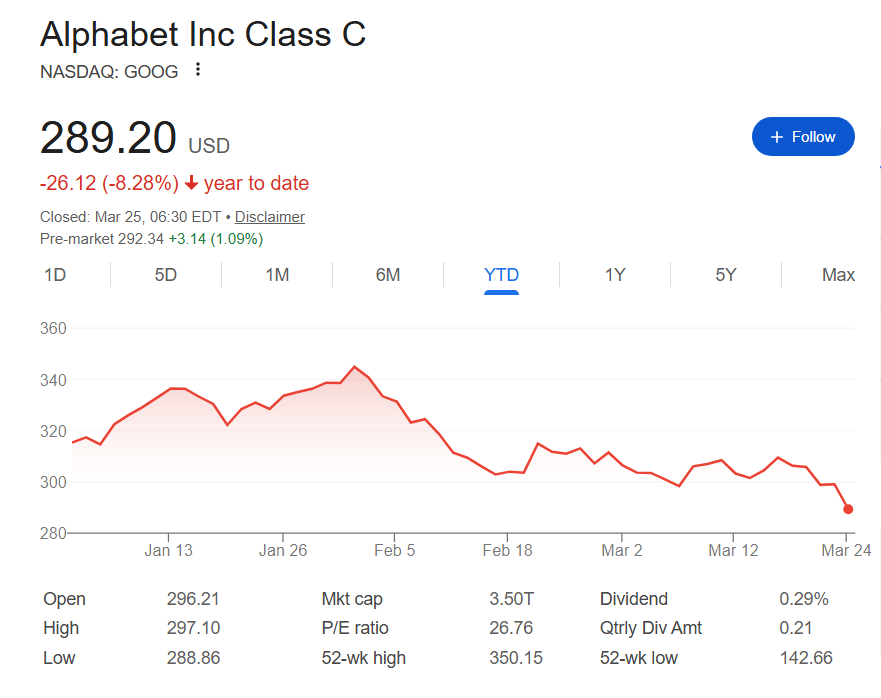
March 24 proved the worst stock market session Google (NASDAQ: GOOGL) experienced since June 2025 as Alphabet shares plunged 3.28% from $299.02 to $289.20 between the morning and closing bells.
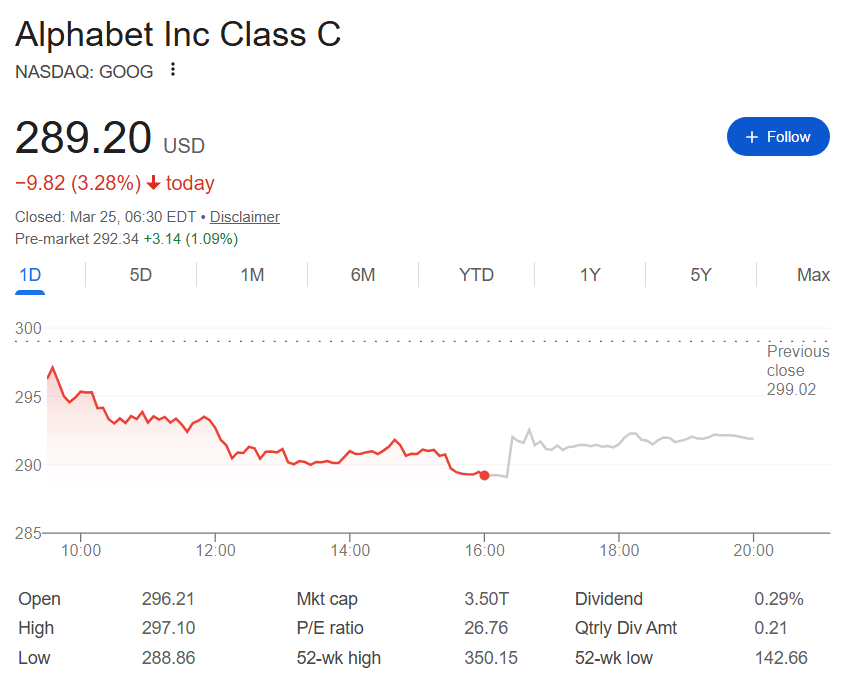
The sharp pullback – and the limited, 1.09% extended session recovery – however, raises the question of whether the blue chip technology giant’s equity might have just presented a value buying opportunity.
To begin with, GOOGL stock’s 2026 decline that sent the equity 8.28% into the red year-to-date (YTD) has done little to crack Wall Street’s bullishness.
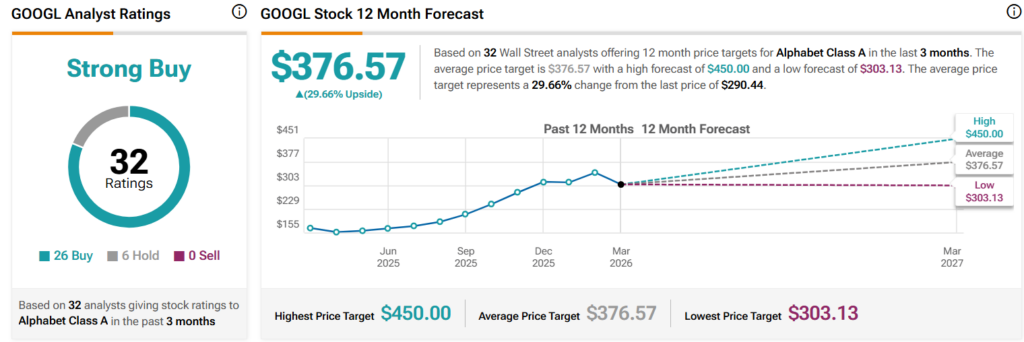
Wall Street sets Google stock price target for the next 12 months
Indeed, Google shares are, overall, considered a ‘Strong Buy’ and are, on average, expected to rally 29.66% from their latest close and trade at $376.57 in 12 months, per the data Finbold retrieved from Tip Ranks.
Perhaps the strongest endorsement of Alphabet comes from the fact that, despite the struggles in the financial markets, every single prominent price target revision issued in March has been bullish, with some analysts forecasting rallies to as high as $400.
Google stock technical analysis
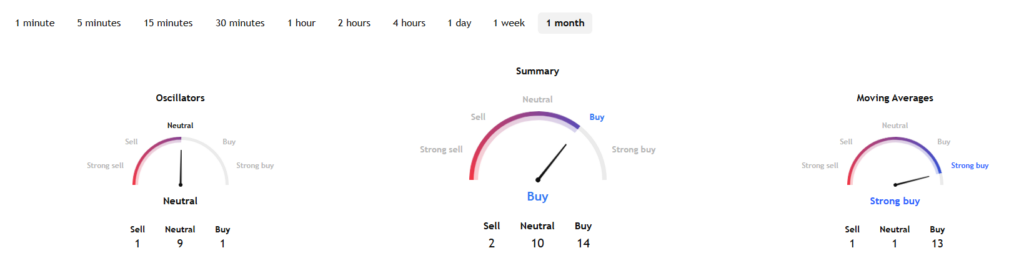
Technical analysis (TA) based on the last 30 days in the market further corroborates the ‘buy’ case.
Specifically, the readings from oscillators, moving averages (MA), and a mix of signals based on the timeframe and retrieved from TradingView paint the same picture as they cumulatively paint Google stock as a worthy purchase.
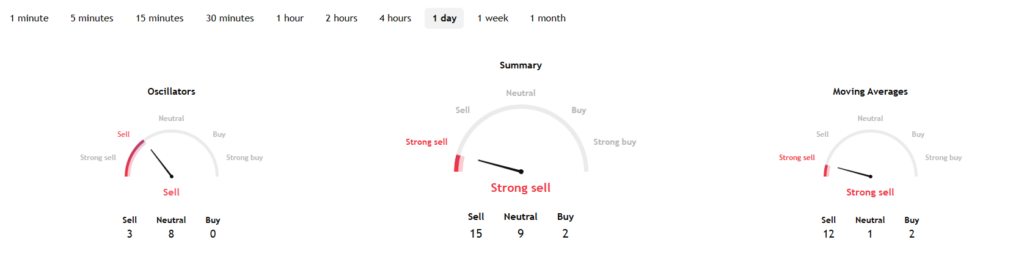
Examining a narrower window, however, indicates that the latest downturn might be the start of a deeper pullback and not a hint that a bullish correction is finally at hand. The last week in the stock market indicates GOOGL shares aren’t decisively moving in either direction, but the last 24 hours shift the thesis to a ‘strong sell.’
Does Google’s continued business dominance guarantee a stock market rally?
Elsewhere, examining Google’s business also raises questions about the company’s likely performance in the coming weeks and months.
At face value, the technology giant is in a very strong position. Along with retaining dominance in its primary market – searching the web and online marketing – Alphabet developed both a network of robust partnerships with prominent artificial intelligence (AI) companies, and its own AI model: Gemini.
Indeed, Google is likely to benefit from Anthropic’s growing popularity due to its substantial stake in the firm, and it could see major tailwinds from its role in integrating AI with Apple’s (NASDAQ: AAPL) software.
Furthermore, Alphabet remains an exceptionally wealthy company with its most recent quarterly revenue amounting to $113.83 billion, meaning it appears well-positioned to weather any storms that might lie ahead.
Google faces mounting pressure on most fronts
Despite the undeniable positive factors, numerous overarching risks for Google stock have also been piling up. To begin with, the company’s primary business in online marketing and web searching might soon face a catastrophic decline.
Notably, the number of people who have taken to using AI platforms as a replacement for Google Search due to the service getting worse over the years is mounting, while Alphabet’s own crusade to proliferate artificial intelligence online is, arguably, degrading the entire ecosystem.
Though most of the evidence available at press time on March 25, 2026, is anecdotal, the trends are difficult to miss once one spends any amount of time online.
Could Google stock crash due to AI contagion?
Similarly, the AI side of the business appears to be in the early stages of a crisis. Early 2026 saw stock market activity that hints at investors slowly losing patience with the gap between the promises made regarding the technology and the reality of profitability and productivity.
Such uncertainty and unfavorability can be seen in Melius Research recently issuing a bearish assessment of Microsoft (NASDAQ: MSFT) while identifying Copilot as a major risk factor, and in the growing number of AI deals that are getting cancelled.
For example, reports from March 24 indicate that Disney (NYSE: DIS) gave up on its $1 billion agreement with OpenAI and, on the same day, Sam Altman’s company announced the end of Sora – a platform once touted as AI-powered TikTok.
Google stock and geopolitical risks
Another potential and longer-term risk factor arises from the Iran war, as supply chain disruptions are affecting numerous resources – along with the much-discussed fossil fuels – including some that are critical for the technology industry, with helium being the example most often mentioned.
Such risks are further exacerbated given the targeting of data centers in the Middle East that belong to American or American-linked companies, with the damage having the potential of being anything between trivial and catastrophic.
Ultimately, however, it is difficult to tell if the promises of the technology sector will, after all, be fulfilled or if the mounting pressures will crack big tech, meaning that, in March 2026, Google stock is arguably best viewed as a ‘Hold.’
Featured image via Shutterstock