
A machine learning-powered forecast from Finbold AI Agent has projected a modest decline in Nvidia (NASDAQ: NVDA) stock by the end of July.
According to the prediction generated on July 8, the AI model expects Nvidia shares to trade at an average price of $193.14 on July 31, representing a 1.89% decline from the stock’s current price of $196.86.
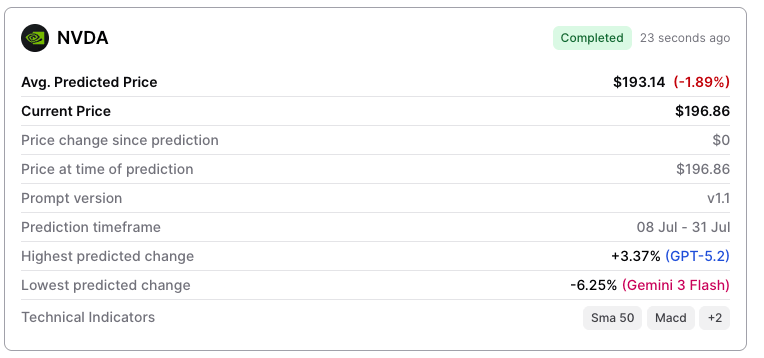
The forecast was produced using a multi-model machine learning system that incorporates predictions from Claude Opus 4.6, DeepSeek Chat, Gemini 3 Flash, and GPT-5.2.
The prediction also included technical indicators, including the Moving Average Convergence Divergence (MACD), Relative Strength Index (RSI), stochastic oscillator, MACD slope, 50-day SMA, and 200-day SMA.
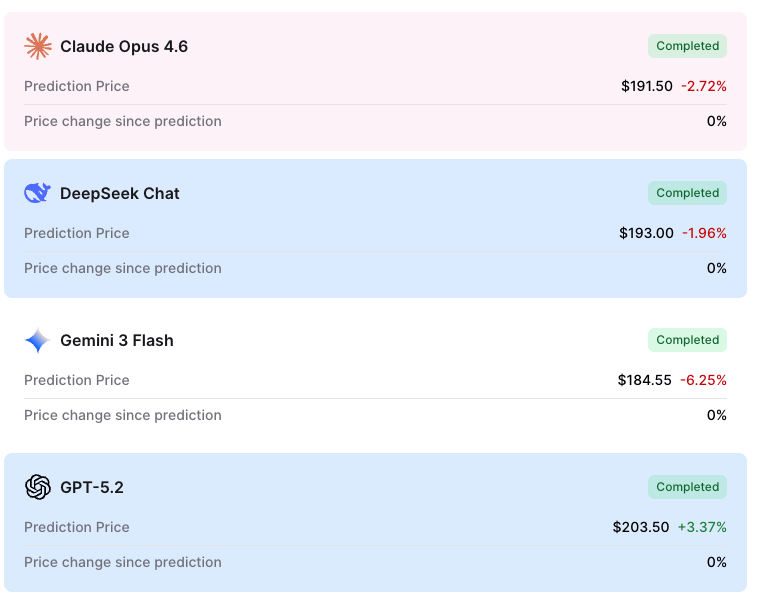
Among the models, GPT-5.2 delivered the most bullish outlook, projecting NVDA to reach $203.50, implying a gain of 3.37% from current levels. Claude Opus 4.6 forecast a price of $191.50, while DeepSeek Chat predicted $193.
Gemini 3 Flash issued the most bearish projection, estimating Nvidia would fall to $184.55, representing a 6.25% decline.
Nvidia stock’s strong fundamentals
The short-term bearish forecast comes despite Nvidia posting some of the strongest financial results in its history.
For fiscal 2026, the company generated $215.9 billion in revenue, up roughly 66% year-over-year, while net income climbed to approximately $120 billion.
Momentum continued into the first quarter of fiscal 2027, when Nvidia reported a record $81.6 billion in revenue, an 85% annual increase, driven primarily by its data center business.
The company’s AI infrastructure segment remains its primary growth engine, with data center revenue reaching $75.2 billion during the quarter.
Gross margins have remained near 75%, supported by strong demand for Nvidia’s advanced AI hardware and software ecosystem.
At the same time, investor sentiment toward Nvidia continues to be driven by the rapid expansion of artificial intelligence infrastructure spending.
The company’s Blackwell platform is ramping production as cloud providers, enterprises, and governments increase investments in AI computing capacity.
Nvidia also maintains a strong competitive position through its CUDA software ecosystem, networking solutions, and roadmap visibility extending beyond Blackwell to future architectures.
In addition, Nvidia continues returning capital to shareholders through share repurchases and dividends. During the first quarter of fiscal 2027, the company returned approximately $20 billion through buybacks and dividends and authorized an additional $80 billion in stock repurchases.