
In the night between July 29 and July 30, Meta Platforms (NASDAQ: META) stock followed one of the most common trends among big tech equities in 2026: it suffered a severe price plunge shortly after publishing its quarterly earnings.
Specifically, after sliding 1.31% from $593.41 to $585.61 in the regular session preceding the filing, META shares collapsed 9.24% to $531.50 by press time on Thursday morning.
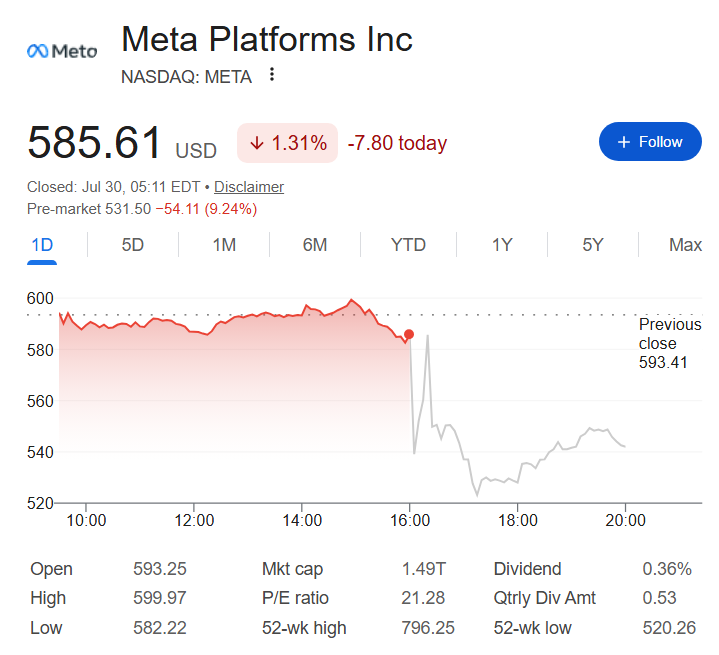
Overall, Mark Zuckerberg’s company is down 18.28% year-to-date (YTD), with the total market capitalization collapse amounting to roughly $320 billion following the plunge from $1.67 trillion at the end of 2025 to $1.35 trillion in the July 30 pre-market.
Why Meta stock is down 9%
Examining the document covering Meta Platforms’ performance in the second quarter (Q2) of 2026, earnings per share (EPS) appear to be the most obvious culprit for the fall. Indeed, Q2 EPS came in at $6.18 – well below the expected $7.22.
Digging deeper reveals other factors that lead shareholders to lose confidence. Specifically, Meta’s revenue guidance proved lighter than the expected $63.15 billion, as it came in at between $61 billion and $64 billion for a middle estimate of $62.5 billion.
Meanwhile, the company’s free cash flow fell from $8.5 billion one year earlier to just $784 million, and capital expenditure (CapEx) projections slightly increased to between $130 billion and $145 billion from between $125 billion and $145 billion.
Notably, investors have been penalizing blue-chip technology companies for increasing their CapEx plans due to the effect they have on free cash flow, the vast amounts of money already spent, and for continuous efforts to obscure actual returns.
In recent years, most big tech firms expended much effort making predictions regarding the benefits of artificial intelligence (AI) and claiming they are seeing substantial returns, but few actual numbers got published.
Lastly, a saving grace in Meta Platforms’ filing came in the form of Q2 revenue, which, at $60.80 billion, came in above the forecasted $60.17 billion.
Featured image via Shutterstock