
The semiconductor giant Nvidia (NASDAQ: NVDA) revealed a massive increase in its investments between the third and fourth quarters (Q3 & Q4) of 2025 in its February 17, 13-F filing.
Specifically, the blue-chip chipmaker’s portfolio value increased by a staggering $9 billion from the $3.8 billion revealed for September 30 and $13.1 billion unveiled for December 31.
The filing also highlighted a shift in Nvidia’s strategy, as the number of actual holdings decreased from 6 to 5.

Nvidia reduces stocks owned while adding $10 billion to its portfolio
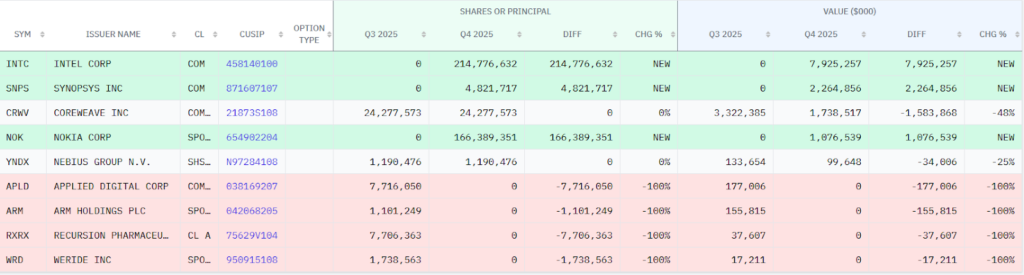
The world’s top semiconductor company completely cleared its positions in Applied Digital Corp (NASDAQ: APLD), Arm Holdings (NASDAQ: ARM), Recursion Pharmaceuticals (NASDAQ: RXRX), and WeRide Inc (HKG: 0800).
Simultaneously, Nvidia opened new positions in Intel (NASDAQ: INTC), Synopsys Inc (NASDAQ: SNPS), and Nokia (NYSE: NOK).
The ownership of 24 million Coreweave (NASDAQ: CRWV) and 1.2 million Nebius Group NV (NASDAQ: NBIS) shares remained entirely unchanged.
These are the biggest stocks in the Nvidia portfolio
Nvidia’s investment in Intel – unveiled in September 2025 and set at $5 billion – made the other semiconductor giant the single biggest holding within the portfolio, accounting for, as of December 31, 60% of the total value.
On the same date, SNPS accounted for 17% of the portfolio, CRWV for 13%, NOK for 8.2%, and NBIS – listed in the 13-F under its former ticker YNDX – for just 0.8%.

Despite the small size of the position, the Coreweave holdings can easily be described as the most contentious in late 2025 and early 2026. The former cryptocurrency miner turned data center company has been at the center of controversy for some time.
Why Coreweave stock remains a controversial Nvidia portfolio holding
Nvidia’s decision to invest in the firm was widely seen as propping up an otherwise failing business, and the controversy has, arguably, only increased as late 2025 brought forward allegations of circular deals and essentially faked revenue between major artificial intelligence (AI) companies.
Furthermore, if the bears prove correct, exposure to CRWV could represent a major risk, as some, like the prominent analyst Ed Zitron, believe Coreweave will be the first company to collapse should the AI bubble burst.
Still, it is worth noting that there is no consensus that the sector will truly collapse, and there are no guarantees Nvidia remains exposed at press time on February 18, 2026.
Indeed, the semiconductor giant is known to have walked back on some of its earlier investment plans as the previously-unveiled planned $100 billion injection in OpenAI has, seemingly, disappeared recently.
Featured image via Shutterstock