
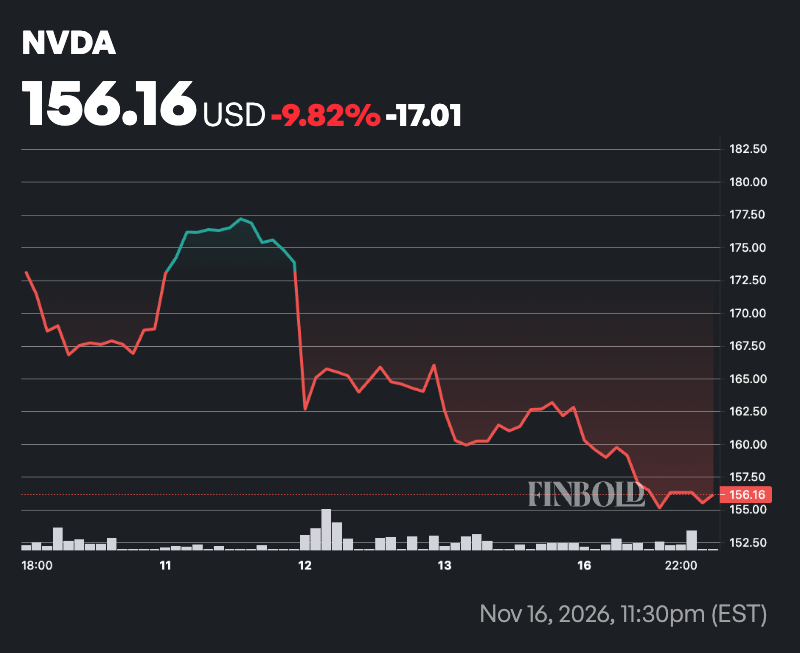
Traders betting against Nvidia (NASDAQ: NVDA) shares have accumulated an estimated $24 billion in paper profits as the stock has tumbled from its all-time high set on October 6.
Notably, the gains stem from the sharp decline that accelerated in early November amid leadership transition at the semiconductor giant.
Nvidia shares closed Monday at $156, following a 4.1% drop that marked one of their weaker sessions in recent weeks. Over the past week, NVDA shares have plunged 10%.
Short interest now stands at approximately 1.22% of the company’s public float, representing roughly $46 billion in notional value, according to S3 Partners.
The figure highlights the scale of bearish exposure, although it does not necessarily indicate an unusually crowded short trade relative to Nvidia’s enormous market capitalization.
At the same time, as of October 30, approximately 279.6 million Nvidia shares had been sold short, equivalent to 1.21% of the float.
The short-interest ratio stood at 2.8 days, meaning it would theoretically take less than three days of average trading volume for short sellers to close their positions.
Increase in Nvidia bearish position
Interestingly, reported short interest declined 7.3% between October 15 and October 30, suggesting that bearish positioning was not increasing consistently throughout the period.
More recent estimates indicate that traders increased their bearish bets as the November selloff accelerated, although the estimated $24 billion in profits remain unrealized and could shrink if a rebound forces short covering.
Meanwhile, individual investors have bought a record $2 billion worth of Nvidia shares during the volatility, highlighting a divergence between institutional bears and retail dip-buyers.
The buying has occurred even as the shares fell to levels not seen since the middle of 2025 in some measures, highlighting a divergence between professional short sellers and retail dip-buyers.
Nvidia leadership transition
The selloff intensified following the resignation of longtime chief executive Jensen Huang on November 12.
Huang stepped down amid a scandal involving personal relationships that raised national security concerns, including reports of an affair with a woman identified by U.S. intelligence as a suspected Chinese spy and another with a company executive who reported to him.
Chief financial officer Colette Kress has taken over as interim chief executive while the board searches for a permanent successor.
Beyond the leadership transition, investor skepticism about the long-term sustainability of heavy capital spending on artificial intelligence infrastructure has grown, compounded by political pushback against rapid data-center expansion following recent U.S. midterm elections and lingering effects from earlier tariff policies.
Attention now turns to Nvidia’s third-quarter fiscal 2027 results, due after the market close on Tuesday.
The company had guided for revenue of about $108 billion, plus or minus 2%, while analysts expect figures near $109 billion and adjusted earnings of roughly $2.47 per share.
The results will provide the first detailed assessment of Nvidia’s business under interim leadership, including customer demand and its AI growth outlook.
Forward guidance will be particularly important, as stronger forecasts could trigger short covering, while disappointing projections may reinforce bearish bets.
Featured image via Shutterstock