
American semiconductor giant Nvidia (NASDAQ: NVDA) is set to begin its 2026 dividend schedule with a quarterly payout expected before the end of the quarter.
The payment will mark the company’s first dividend distribution of the new year and continues Nvidia’s long-standing quarterly dividend policy.
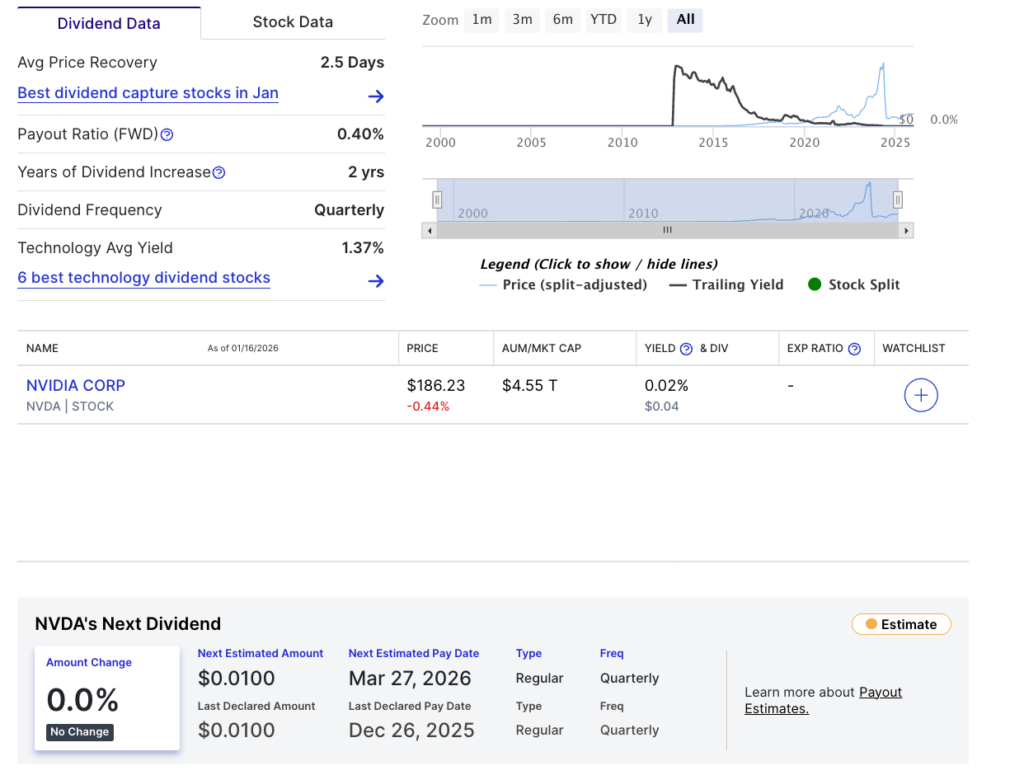
The dividend is estimated at $0.01 per share, unchanged from the company’s most recent payout in December 2025. With Nvidia shares trading at about $186.23 as of the January 16 market close, the forward annual dividend stands at $0.04 per share, translating into a forward yield of roughly 0.02%.
The payout ratio remains extremely low at around 0.40%, highlighting that Nvidia’s capital return strategy is still heavily tilted toward reinvestment and growth rather than income distribution.
Nvdia dividend payout
For investors holding 100 shares of Nvidia, the upcoming March payment would result in earnings of $1 before taxes. On an annualized basis, assuming the dividend remains unchanged across all four quarterly payments in 2026, those same 100 shares would generate a total of $4 in dividend income for the year.
Nvidia pays dividends every quarter and currently has two consecutive years of dividend increases, although the pace of growth has been modest. The company’s average price recovery time after the ex-dividend date is about 2.5 days, suggesting that dividend-related price effects tend to be short-lived.

Compared with the broader technology sector, where the average dividend yield is approximately 1.37%, Nvidia’s yield remains far lower, reinforcing its classification as a growth-focused stock rather than a dividend play.
This approach aligns with broader market expectations for Nvidia. Recent analyst insights point to continued heavy investment in artificial intelligence, data center expansion, and next-generation chip platforms as the core drivers of shareholder value.
As a result, dividends represent only a small component of total returns, with most investor gains historically coming from share price appreciation.
Featured image via Shutterstock