
A $10,000 investment in Intel (NASDAQ: INTC) a year ago would be worth almost $50,000 today after the Nvidia (NASDAQ: NVDA)-backed chipmaker delivered a roughly 370% return over the past 12 months.
Intel shares closed at $97 on August 11, up from about $20.65 a year earlier. Based on the stock’s 372.25% gain, a $10,000 investment would have grown to approximately $47,225, generating a profit of about $37,225.
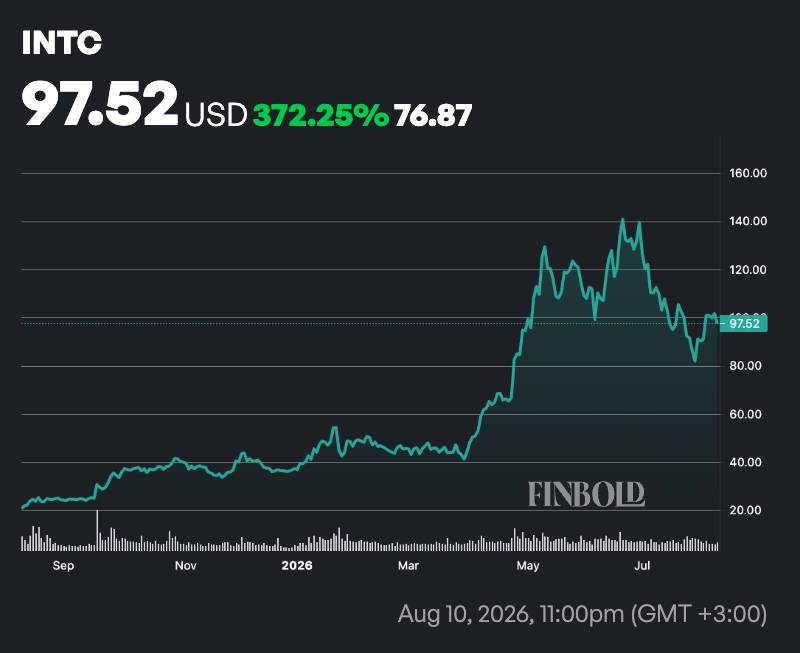
The rally has transformed Intel from one of the semiconductor industry’s biggest laggards into one of its strongest-performing large-cap stocks, driven by growing artificial intelligence demand, improving financial results, and strategic backing from Nvidia.
Nvidia’s Intel investment
A major turning point came in September 2025 when Nvidia agreed to invest $5 billion in Intel for a roughly 4% stake.
The deal, completed in December following regulatory approval, involved Nvidia purchasing more than 214 million Intel shares at $23.28 each through a private placement. Beyond the capital injection, the companies agreed to collaborate on future AI and computing products.
Under the partnership, Intel will manufacture custom x86 processors for Nvidia’s AI infrastructure platforms while integrating Nvidia graphics technology into future Intel PC chips and system-on-chips. The agreement also strengthens Intel’s position in the rapidly expanding AI hardware market.
The investment provided a significant vote of confidence in Intel’s manufacturing roadmap and foundry ambitions at a time when the company was working to regain market share and rebuild investor trust.
Intel’s rally has also been supported by improving fundamentals. In the second quarter of 2026, revenue rose 25% year over year to $16.1 billion, its fastest growth rate in more than 15 years, while the Data Center and AI segment surged 59%.
Intel also raised its full-year capital expenditure outlook to more than $20 billion as it expands manufacturing capacity and advances next-generation chip technologies.
Intel’s recovery comes as spending on artificial intelligence infrastructure continues to accelerate across the technology sector.
Cloud providers, enterprises, and governments are investing heavily in data centers and AI computing systems, creating demand not only for accelerators and GPUs but also for the server processors that support those workloads.
While Nvidia remains the dominant force in AI hardware, its investment in Intel has increased investor confidence that the chipmaker can capture a larger share of the industry’s growth opportunities through manufacturing services and data-center products.
Intel’s near-term weakness
However, despite remaining firmly in positive territory over the past year, Intel stock has experienced increased volatility in recent weeks. On August 10, shares came under pressure after the company announced a $15 billion stock offering.
The move weighed on the stock as investors reacted to the roughly 3% dilution from the new share issuance. Intel said the proceeds will fund AI-related growth initiatives, manufacturing expansion, advanced packaging, and foundry operations.
The company is raising equity following a strong rally to support higher capital spending while maintaining balance-sheet flexibility rather than taking on additional debt.
Earlier weakness in the stock was also linked to a broader semiconductor sell-off, concerns about returns on AI infrastructure spending, delays in achieving profitable 18A yields, and intensifying competition in the data-center market.
Featured image via Shutterstock