
Nvidia (NASDAQ: NVDA) could face a significant correction over the coming months, with a trading analyst projecting the stock may fall to as low as $125 by mid-October 2026.
The forecast by TradingShot, shared in a TradingView post on June 5, is based on Nvidia’s monthly and weekly chart structure, which shows the stock trading within a decade-long channel up pattern marked by recurring bullish and bearish cycles.
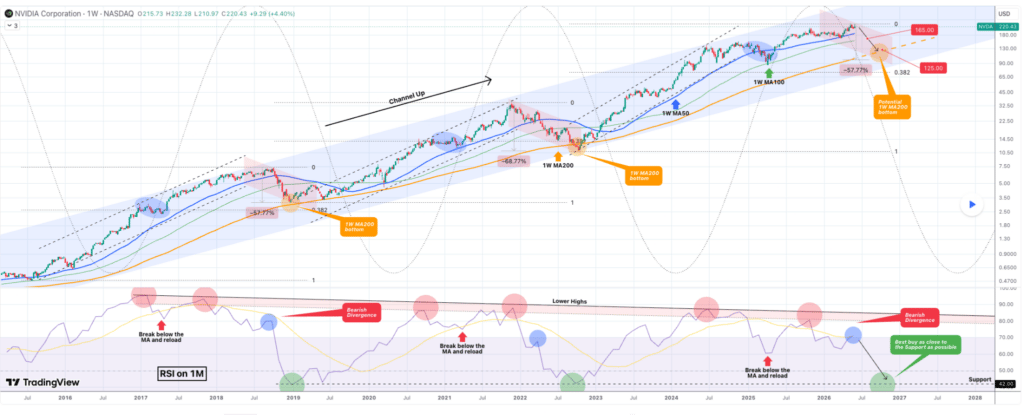
According to the analysis, Nvidia may be nearing a cycle peak similar to those seen in 2018 and 2022, potentially paving the way for a prolonged correction.
The bearish outlook comes despite Nvidia’s strong fundamentals and continued AI-driven growth. By press time, NVDA shares were trading at $204, having gained over 10% year-to-date.
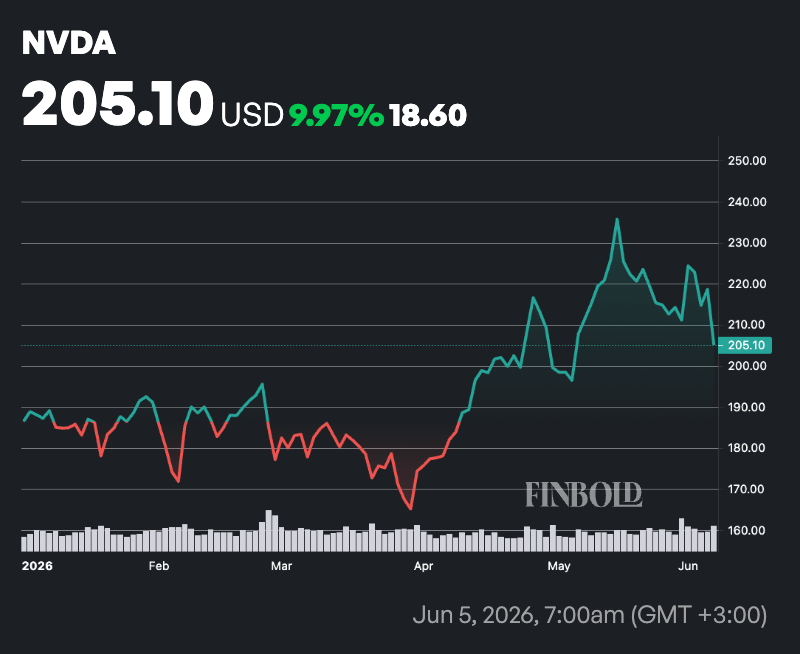
TradingShot noted that previous cycle tops in 2018 and 2022 were followed by extended declines before Nvidia established new long-term bottoms.
The analyst believes 2026 could mark the next major peak, citing a bearish divergence on the monthly Relative Strength Index (RSI) that has been developing since June 2024. Similar RSI patterns have historically preceded significant pullbacks in Nvidia shares.
The outlook also shows Nvidia’s March 2026 rebound from the 50-week moving average closely mirroring price action seen before previous market tops.
At the same time, the monthly RSI remains near the overbought 70 level, which coincided with major declines following the 2018 and 2022 peaks.
Nvidia stock key price levels to watch
According to the analysis, the 100-week moving average near $165 represents the minimum downside target in a correction and aligns with key support levels from September 2025 and March 2026.
If that level fails, Nvidia could extend its decline toward the 200-week moving average, which is projected to reach about $125 by mid-October 2026.
The $125 target would represent a deeper bear-cycle extension, though still less severe than the roughly 58% decline recorded during Nvidia’s 2022 correction.
While the technical outlook points to elevated downside risk, Nvidia’s underlying business fundamentals remain strong.
Nvidia stock fundamentals
Meanwhile, Nvidia’s fundamentals remain strong despite the bearish technical outlook. For instance, the semiconductor giant reported record fourth-quarter fiscal 2026 revenue of $68.1 billion, while full-year revenue climbed to $215.9 billion, up 65% year over year, driven primarily by demand for its AI-focused data center products.
Growth continues to be supported by strong adoption of Nvidia’s Blackwell platform, with the next-generation Vera Rubin architecture scheduled to launch in the second half of 2026.
The company also sees significant long-term opportunities across AI infrastructure, inference computing, robotics, autonomous systems, and enterprise AI.
Reflecting that strength, Wall Street analysts remain largely bullish on Nvidia and continue to project upside from current levels.