

While silver has lost momentum in 2026, the precious metal’s long-term technical outlook suggests there is room for the asset to rally to $300 by early June 2039.
Notably, such a price target would imply a gain of nearly 400% from the last closing price of around $60.
The outlook, shared by TradingShot in a TradingView post on October 2, is based on the view that silver remains within a century-long bullish channel despite its recent correction from 2026 highs.
The analyst noted that silver is trading inside an “All Time Channel Up” that has guided price action since the 19th century.
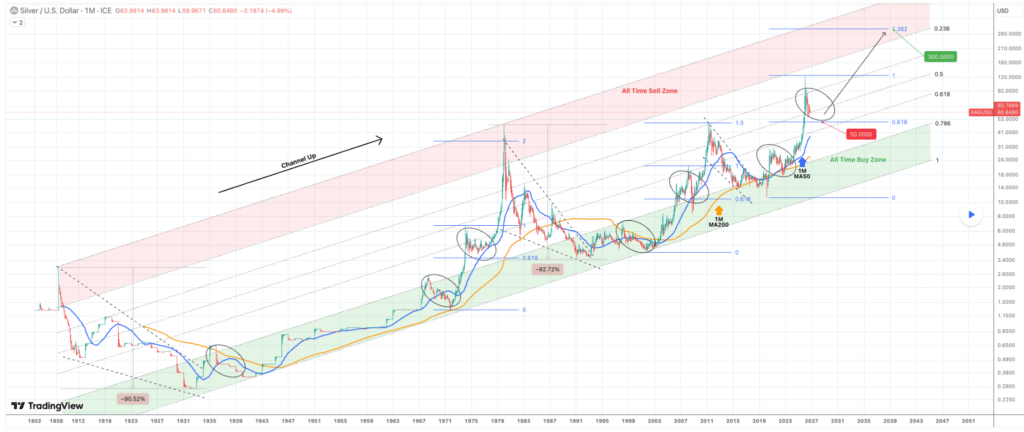
Based on the chart structure, silver’s latest peak occurred just below the channel’s 0.236 Fibonacci level, an area the analyst described as part of a historical “sell zone” where previous super-cycle tops have formed.
The analysis suggests silver is now undergoing a correction similar to several mid-cycle pullbacks seen throughout its long-term uptrend.
The analysis identified the $50 level as a potential downside target, aligning with the 0.618 Fibonacci retracement and the monthly 50-period moving average (MA).
Once that correction is completed, the analyst expects silver to resume its broader uptrend toward the 1.382 Fibonacci extension at $300.
The projected target would mark silver’s first major move back into the upper historical sell zone since previous cycle peaks in 1980 and 2011.
Tesla’s bullish fundamentals
The bullish long-term outlook comes as silver continues to benefit from a structural supply deficit.
In this line, according to the World Silver Survey 2026, the silver market recorded a 40.3 million-ounce deficit in 2025, marking the fifth consecutive annual shortfall. The deficit is expected to widen to 46.3 million ounces in 2026, extending the streak to six years.
The report estimates cumulative market deficits of roughly 762 million ounces between 2021 and 2026, contributing to a decline in above-ground inventories.
While mine production increased in 2025, global supply growth remains limited because most silver is produced as a by-product of copper, gold, lead, and zinc mining. As a result, supply tends to respond slowly to higher prices.
At the same time, investment demand remains robust with physical silver investment in the form of coins and bars forecast to rise 18% in 2026 to approximately 257.6 million ounces, helping offset weaker demand from jewelry and some industrial segments.
Overall, silver has witnessed a pullback attributed to profit-taking, interest-rate sensitivity, and reduced silver usage per solar cell as manufacturers pursue efficiency gains.
However, persistent market deficits and strong investment demand continue to provide long-term support for prices.
Featured image via Shutterstock