
A trading expert is projecting that Tesla (NASDAQ: TSLA) stock could decline to $250 by early January 2027, citing the equity’s technical structure.
In a TradingView post on September 14, TradingShot noted that the projected pullback would likely precede the resumption of Tesla’s longer-term uptrend.
The forecast comes as Tesla trades at $358 and approaches a key resistance zone near $460 on the weekly chart.
Based on historical price patterns and Fibonacci extensions, the analyst expects TSLA to undergo a correction that could erase about 31% of its value from current levels before creating a major long-term buying opportunity.
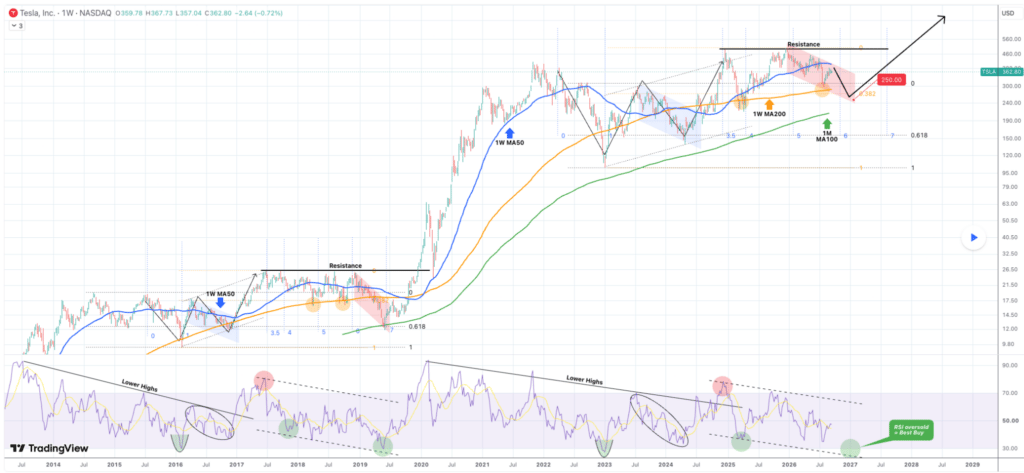
According to the analysis, Tesla’s current price action closely resembles the pattern seen between 2015 and 2019.
The outlook highlights a recurring cycle in which the stock rallies toward resistance, breaks below its 0.382 Fibonacci retracement level, and eventually bottoms near its long-term moving averages.
The analyst identified the period between the sixth and seventh Fibonacci time extensions as the most likely window for Tesla’s next major low, pointing to a potential bottom in early January 2027.
The forecast targets a decline to around $250, near the weekly 200-period moving average (MA), before the stock resumes its broader uptrend.
The thesis is also supported by the weekly Relative Strength Index (RSI). Historically, Tesla’s strongest long-term buying opportunities have emerged when the RSI falls below 30, and the analyst expects a similar oversold signal to accompany the projected pullback.
While the analyst expects such a move over the coming months, the longer-term outlook remains constructive.
The analysis suggested that once the correction is complete, Tesla could enter a new expansion phase that carries the stock to fresh cycle highs above $560.
Tesla stock fundamentals
The bearish technical outlook contrasts with several developments supporting investor optimism around Tesla.
The company recently launched commercial Cybercab robotaxi operations in Austin and is working to expand its autonomous driving business. Tesla’s Full Self-Driving technology is also undergoing regulatory review in Europe ahead of a potentially significant approval vote later this year.
At the same time, Tesla continues to advance its autonomous vehicle strategy through software updates and robotaxi-focused features while preparing to unveil a new version of the Roadster in October.
However, regulatory scrutiny remains a risk. U.S. safety regulators recently opened an investigation into Tesla’s certification process for Cybercab robotaxis, adding another layer of uncertainty for investors.
Tesla also reported producing about 860,000 vehicles and delivering roughly 838,000 vehicles during the first half of 2026 while continuing to expand its energy storage and autonomous driving businesses.
Featured image via Shutterstock