
Rothschild Redburn, global financial services, downgraded Broadcom (NASDAQ:AVGO) from “Buy” to “Neutral” on Friday, November 13, cutting its Broadcom stock price target by 33% from $595 to $398 on artificial intelligence (AI) financing concerns.
The firm noted that, with the current guidance, Broadcom trades at approximately 11 times its fiscal 2028 earnings per share (EPS). However, it cautioned that the quality and sustainability of those earnings remain under scrutiny.
Furthermore, the company carries a price-to-earnings (P/E) ratio of 46.3, and its Price/Earnings-to-Growth (PEG) ratio of 0.43 points to a relatively low valuation compared with expected near-term earnings growth.
Advertisement
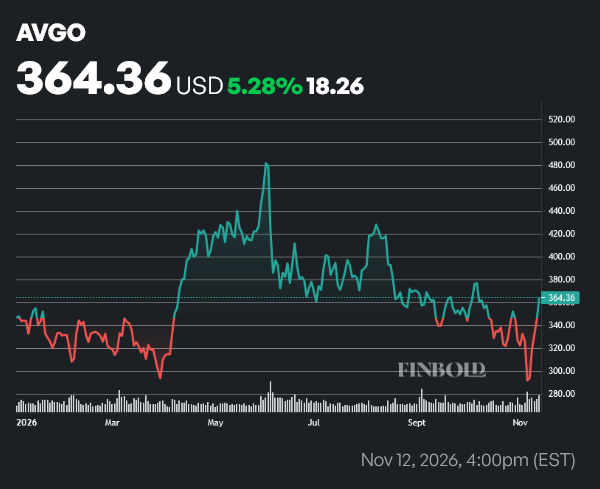
Broadcom shares currently trade at $364.36, marking a 5.28% gain so far in 2026.
Anthropic and OpenAI are a key concern for Broadcom stock, analysts say
According to Rothschild Redburn, a key concern is Broadcom’s exposure to Anthropic and OpenAI. Namely, the investment case depends on both developers maintaining a long-term competitive advantage over open-source models, all reaching financial self-sufficiency in a short period.
In addition, the financial company highlighted that the market must be reassured that Alphabet’s (NASDAQ: GOOGL) customer-owned tools will not become an industry-wide trend. If things go favorably for Broadcom, its shares could meet meaningful upside. However, Rothschild Redburn believes progress is not going to be quick.
As for Broadcom itself, the company expects fiscal 2028 AI revenue to reach $230 billion, supported by expectations of up to 15 gigawatts of computing capacity for Anthropic and OpenAI. Nonetheless, both of those companies are still heavily dependent on credit markets, and securing investment-grade credit ratings would reduce the need for Broadcom to provide further financial support.
Custom silicon could boost Broadcom
That said, the firm acknowledged that Broadcom’s custom silicon still offers AI developers a potential cost advantage, which could help Broadcom’s market position. While this is a silver lining, though, intensifying competition can still put downward pressure on gross margins.
What’s more, Meta’s (NASDAQ: META) early progress with its own consumer-facing agentic AI platform suggests that the competitive landscape is evolving. That is, instead of focusing primarily on model intelligence and related tools, big market players are increasingly looking to leverage a combination of AI capabilities, application infrastructure, and distribution.
Featured image via Shutterstock