

As Meta Platforms, Inc. (NASDAQ: META) stock wiped out more than $160 billion over the past 24 hours, more than a dozen Wall Street analysts set its 12-month price target on July 30.
On Thursday, Lloyd Walmsley, an analyst at Mizuho, reiterated an ‘Outperform’ rating for META stock. Walmsley lowered the firm’s 12-month price target to $750 from $835, which represents a 10.18% decline. With Meta shares trading at $533.27 at press time, he signals a potential 40.64% upside.
“We remain buyers on the dip and expect a near-term compute monetization product. While Meta did not outline definitive plans to sell compute today, management indicated it will have ‘more to share’ on AI monetization soon,” Walmsley noted.
Walmsley expects Meta to expand its AI (Artificial Intelligence) monetization through products such as compute, coding tools, API (Application Programming Interface) access, and Business AIs, while highlighting continued strength in its advertising business. He noted that advertising revenue growth excluding foreign exchange (FX) accelerated by 60 basis points on a two-year basis, with the high end of revenue guidance implying roughly 4 percentage points of sequential acceleration in Q3.
The analyst also said the increase in FY2026 cost guidance reflected only a legal fine, while the unchanged high end of capital expenditure guidance leaves FY2027 expectations largely unchanged.
META stock forecast 2026
As all the Wall Street analysts signaled bullish sentiment for Meta shares, 42 analysts surveyed by TipTanks have issued an average 12-month price target of $764.92, implying a possible 43.18% upside.
Among other experts who reiterated a Buy rating for this company today are Ken Gawrelski, an analyst from Wells Fargo & Co. (NYSE: WFC), Jeffrey Wlodarczak from Pivotal Research, and Brad Erickson, a researcher at RBC Capital.
Price outlook
META stock price has fallen more than 11% over the past 5 days, trading at about $533.27 at the time of reporting. The stock tumbled after its latest Meta quarterly earnings report revealed that ballooning AI infrastructure costs squeezed profit margins and reduced free cash flow, hence missing Wall Street’s expectations, as Finbold explained.
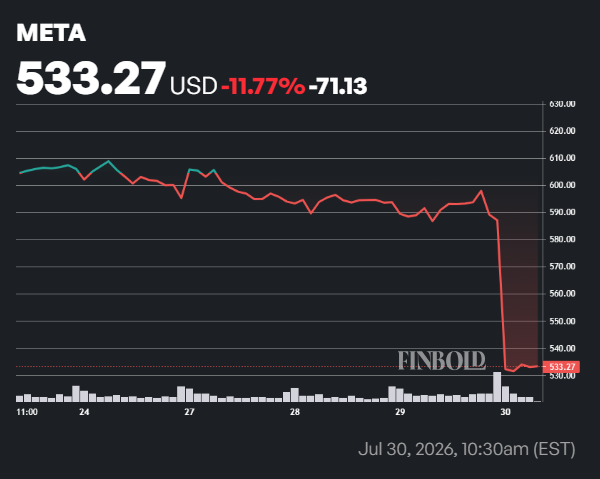
However, Wall Street analysts remain bullish on the company’s stock amid expectations of revenue growth fueled by AI monetization.