

Berkshire Hathaway (NYSE: BRK.A) stock has significantly outperformed the S&P 500 over the past month, highlighting a growing divergence between the conglomerate and the broader U.S. stock market.
As of press time, Berkshire Hathaway Class A shares were trading at $889,793.80, up 12.71% over the past month, while the S&P 500 stood at 7,561.67, down 2.36%.
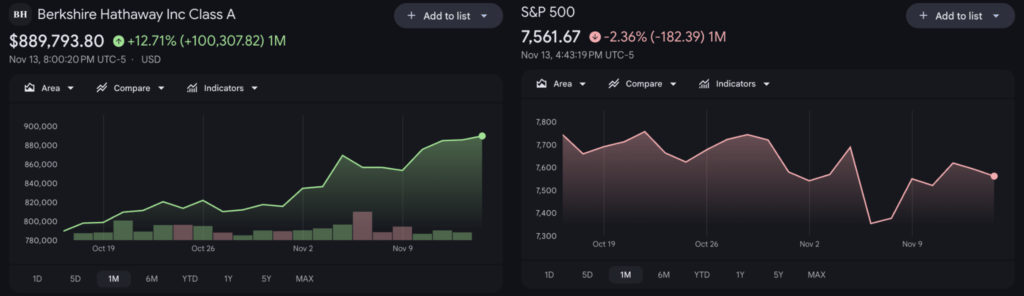
The rally reflects a shift in investor sentiment toward companies with diversified operations and less exposure to the artificial intelligence (AI) trade.
Advertisement
Berkshire has benefited as investors reassess major technology stocks amid concerns over heavy AI infrastructure spending and the sustainability of the sector’s gains.
Why Berkshire stock surpassed S&P 500
The shift became particularly evident in November, when technology shares came under pressure following Nvidia’s leadership turmoil.
The semiconductor-heavy Nasdaq suffered significant losses, while Berkshire attracted investors seeking exposure to a more diversified business.
Investors appeared to be rotating away from technology stocks and toward Berkshire’s insurance, energy, railroad, manufacturing and consumer businesses, helping the conglomerate outperform the S&P 500 after previously lagging the index.
Another factor supporting Berkshire Hathaway stock is its capital allocation strategy under new CEO Greg Abel, who succeeded Warren Buffett in January 2026.
The company’s third-quarter results revealed an acceleration in share repurchases. Berkshire bought back $9.6 billion of its own stock between July and September, followed by approximately $2 billion in October.
Advertisement
The purchases suggest a greater willingness under Abel to deploy Berkshire’s substantial financial resources through buybacks, which can support shareholder value.
Berkshire’s September 30 financial statements also showed $352.3 billion in cash, cash equivalents and U.S. Treasury bills, giving the conglomerate considerable flexibility to pursue acquisitions, invest in public companies and repurchase shares.
According to its latest regulatory filing, the company repurchased $14.4 billion of its shares during the first nine months of 2026.
Berkshire stock challenges
Despite the stock rally, Berkshire’s latest financial results were mixed. The conglomerate reported third-quarter operating earnings of $12.71 billion, down 6% from the corresponding period in 2025.
Net earnings fell 28% to $22.11 billion, reflecting weaker insurance performance and lower investment gains.
However, Berkshire’s shareholders’ equity reached $761.4 billion at September 30, an increase of $43.9 billion since the beginning of the year.
Advertisement
Berkshire’s diversified operations, investments, and substantial cash reserves offer investors an alternative to companies heavily dependent on the AI boom, particularly during periods of uncertainty in the technology sector.
However, the recent rally does not guarantee continued outperformance. Weaker insurance earnings, acquisition challenges and the difficulty of deploying its enormous cash reserves remain potential obstacles.
Featured image via Shutterstock