
Although Intel (NASDAQ: INTC) has recorded a notable short-term drop in line with the broader equities market, insights from an artificial intelligence model suggest the stock is likely to see further gains in the second half of the year.
Notably, INTC shares have been among the standout performers of 2026 as the company continued to make further inroads into the artificial intelligence chip sector.
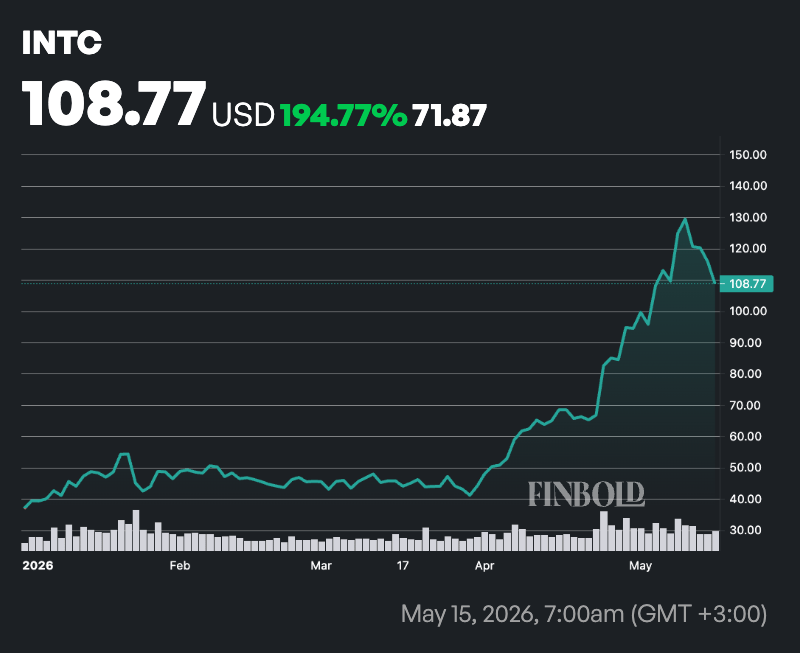
Year-to-date, Intel has rallied almost 200%. However, the stock ended Friday’s session down more than 6%, trading at $108, as markets reacted to concerning United States economic data.
To determine how the stock might trade at the end of Q2 2026, Finbold turned to OpenAI’s ChatGPT, which offered several scenarios for the stock.
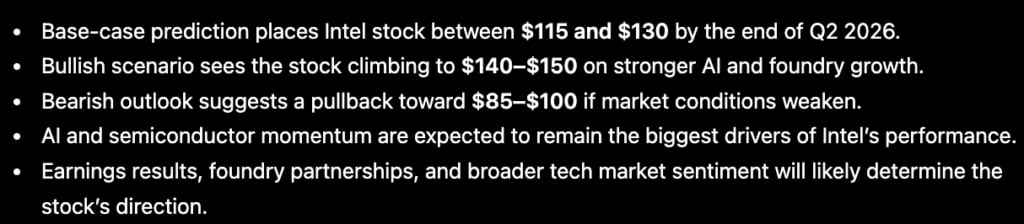
According to the model, Intel’s stock is expected to trade in a base range of between $115 and $130 by the close of Q2 2026.
ChatGPT’s outlook also outlined a bullish scenario in which Intel stock could climb to between $140 and $150 if the company secures additional foundry partnerships, expands adoption of its AI chips, and delivers another strong earnings performance in the coming months.
At the same time, the AI model warned that volatility remains elevated, noting that Intel has become one of the market’s most momentum-driven AI trades.
Therefore, in a bearish scenario, the stock could retreat toward the $85 to $100 range if semiconductor sentiment weakens, AI spending slows, or Intel disappoints investors with weaker margins or delayed manufacturing progress.

Intel stock fundamentals
The prediction also identified several key catalysts likely to shape Intel’s trajectory through the end of Q2, including earnings guidance, AI-related product announcements, progress in its foundry expansion, and broader macroeconomic conditions such as Treasury yields and overall market appetite for technology stocks.
The forecast comes after Intel staged a powerful rally in 2026 following stronger-than-expected quarterly earnings and renewed confidence in the company’s long-term restructuring efforts under Chief Executive Lip-Bu Tan
Notably, the company posted stronger-than-expected first-quarter results, with revenue reaching $13.6 billion and its Data Center & AI segment growing 22% year over year. CEO Tan has also boosted investor confidence through aggressive cost-cutting and execution-focused reforms as demand for Intel’s AI-capable chips strengthens pricing power.
Investor sentiment has further improved following several major strategic partnerships. For instance, Nvidia (NASDAQ: NVDA) invested $5 billion in Intel in late 2025, taking an estimated 4% to 5% stake, while the two firms continue collaborating on AI-focused processors and data center products.
Intel also secured a major Terafab partnership involving Elon Musk’s Tesla, SpaceX, and xAI, alongside ongoing talks with Apple to manufacture chips in the United States.
Despite ongoing challenges such as losses, high spending requirements, and competition from AMD and TSMC, investors are increasingly betting on Intel’s AI- and foundry-driven recovery.