

Amazon (NASDAQ: AMZN) stock could rally about 175% to $700 if its long-term bullish trend continues.
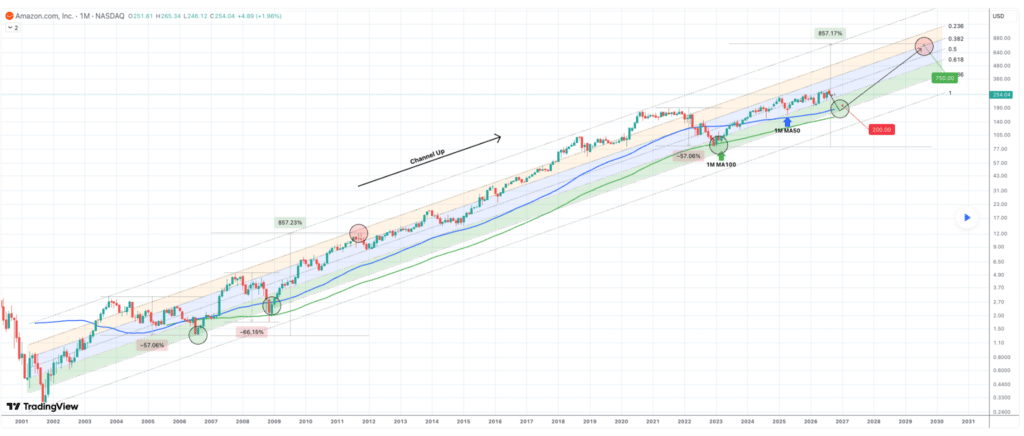
The projection by TradingShot in a TradingView post on October 28 is based on a 25-year ascending channel that has guided Amazon’s share price since the October 2001Dot-com crash bottom.
The analysis identified $750 as a potential target by 2030.
With AMZN closing at $253.10 on Tuesday, a move to $700 would represent a gain of approximately 177%, while reaching $750 would imply an increase of about 196%.
The monthly chart shows Amazon trading within the ascending channel, with the 100-month moving average (MA) acting as long-term support.
AMZN stock historical context
The stock has experienced three major corrections of approximately 57% to 66%, each finding support near the channel’s lower boundary before resuming its uptrend.
Amazon is currently trading within the channel’s middle Fibonacci zone, between the 0.382 and 0.618 levels. The 0.618–0.786 zone has historically served as a buying area during major corrections.
TradingShot also drew a parallel with the 2006–2010 period, when Amazon shares rallied approximately 857%. A similar pattern could propel the stock toward $750 by 2030, although historical performance does not guarantee future returns.
Despite the bullish long-term outlook, the outlook suggested Amazon could experience another correction in 2027.
Meanwhile, the 50-month moving average has provided support since November 2023, with the analysis identifying approximately $200 as a potential retest level.
A decline from $253.10 to $200 would represent a drop of roughly 21%. While this would not necessarily invalidate the ascending-channel pattern, a sustained break below key support could weaken the bullish outlook.
On the other hand, Amazon’s cloud computing business provides additional context for the bullish outlook.
In its second-quarter 2026 results, published on July 30, Amazon reported revenue of $200.6 billion, up 20% year over year. Operating income rose 43% to $27.5 billion, while Amazon Web Services (AWS) revenue climbed 37% to $42.2 billion.
AWS operating income increased to $16.6 billion from $10.2 billion a year earlier. Amazon’s trailing 12-month operating cash flow also rose 33% to $161.4 billion.
Amazon stock risks
However, free cash flow turned negative, reaching an outflow of $7.6 billion over the same period. Amazon attributed the decline primarily to increased capital expenditure, particularly investments in infrastructure supporting artificial intelligence (AI).
These investments could drive future growth in cloud computing and AI services, although their returns remain an important consideration for investors.
Amazon’s earnings report, scheduled for October 29, could influence its near-term direction. Investors will be watching for updates on AWS growth, AI infrastructure spending, operating margins and cash flow.
Featured image via Shutterstock