
The U.S. banking sector is flashing a bearish warning as the KBW Bank Index (BKX) approaches a potential death cross.
The index closed at 168.99 on November 17, down 3.50 points, or 2.03%, falling below its 200-day moving average (MA) of about 173.47. Its 50-day average is also approaching the longer-term indicator, raising the risk of a bearish crossover.
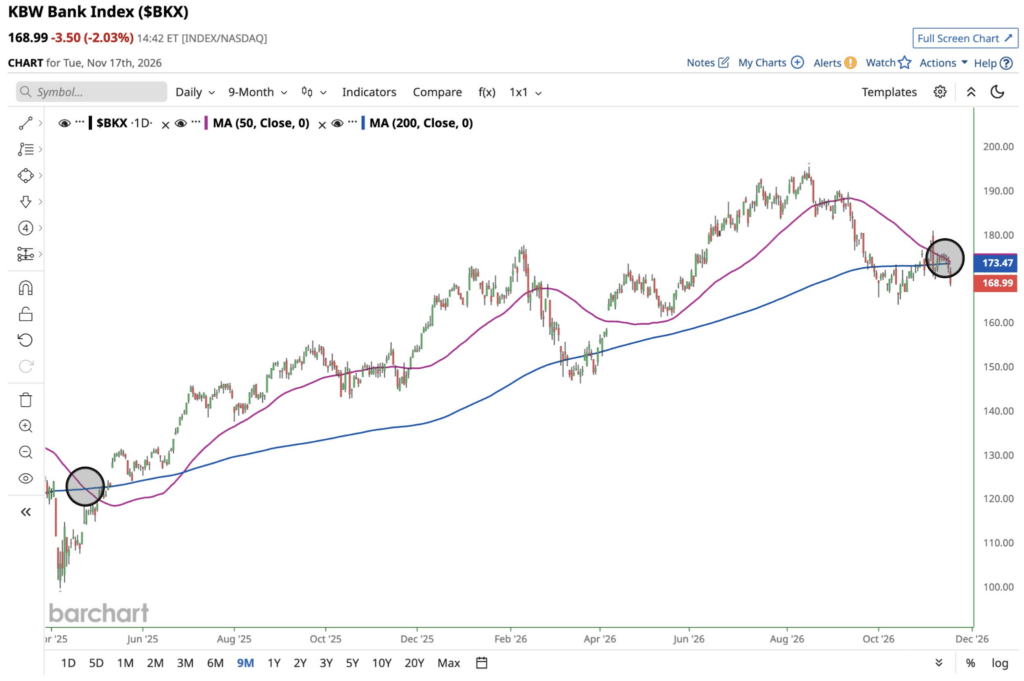
A death cross occurs when the 50-day moving average falls below the 200-day average, signaling deteriorating price momentum.
The potential crossover is significant because the 24-stock index has recorded the pattern only eight times over the past decade.
Its last occurrence was in April 2025, following market turmoil triggered by President Donald Trump’s tariff announcements.
Signs of banking sector disruptions
Previous occurrences have also coincided with major market disruptions, including the 2023 banking crisis.
The latest weakness follows six consecutive weeks of losses, with the index shedding approximately 11% since early September, marking its longest losing streak since the 2008 financial crisis.
Notably, major lenders have also come under pressure. Goldman Sachs (NYSE: GS) and Morgan Stanley (NYSE: MS) have fallen more than 15% from their August highs, while JPMorgan Chase (NYSE: JPM) has lost close to 10% from its peak.
Several factors are weighing on banking shares, particularly rising funding costs and concerns about artificial intelligence (AI).
Rising Treasury yields and higher interest rates are increasing competition for deposits, potentially squeezing banks’ net interest margins as customers demand better returns.
Major U.S. lenders faced mounting deposit competition despite solid third-quarter loan growth. JPMorgan Chase, Citigroup, and Wells Fargo all reported higher net interest income.
However, JPMorgan’s deposit margin fell to 2.78% from 2.79% a year earlier, while Wells Fargo’s net interest margin declined to 2.43% from 2.61%.
Banking operational disruptions
Operational disruptions have added to the pressure on financial stocks. For instance, JPMorgan Chase experienced a software-related processing issue, while Charles Schwab reported website disruptions.
An outage affecting the U.S. National Security Agency’s internal communications network on November 17 also heightened concerns about technology-related risks.
Despite the bearish technical outlook, industry data does not point to widespread balance-sheet deterioration.
The Federal Reserve Bank of St. Louis reported that U.S. banking assets increased 2% quarter over quarter to $33.3 trillion in the second quarter of 2026.
Annualized returns on average assets rose to 1.30%, their highest level since 2021, while the industry’s average net interest margin stood at 3.24%.
However, rising auto loan and credit card delinquencies point to growing consumer financial stress. Banks also recorded greater reliance on wholesale funding and a slight decline in capital levels.
Featured image via Shutterstock