

The first trading week of February generated significant losses across financial markets, and on February 9, 2026, the famous ‘Big Short’ investor Michael Burry took to X to offer a laconic insight into what is behind the sell-off.
In his X post, the famous trader opined that the markets have been ‘jittery’ due to ‘historic overvaluation, historic capital expenditures, and tiny “AI” revenue.’ Interestingly, the tweet was in response to Tae Kim, a former Bloomberg columnist and current Barron’s senior tech writer.
Specifically, Michael Burry was apparently unconvinced by Kim’s estimate that the latest financial markets downturn was driven by ‘a completely false narrative’ regarding Anthropic’s artificial intelligence (AI) plugin for legal topics.
Why Antropic AI is not behind the February market drop
Indeed, while Kim’s point that Anthropic’s plugin has largely been misinterpreted by the media, thus leading to a downturn among legal technology and publishing firms’ stocks – Relx PLC (NYSE: RELX) was possibly the most dramatic with an 18% weekly drop – is relevant for the sector, Burry’s rebuttal speaks to a wider trend seen across industries.
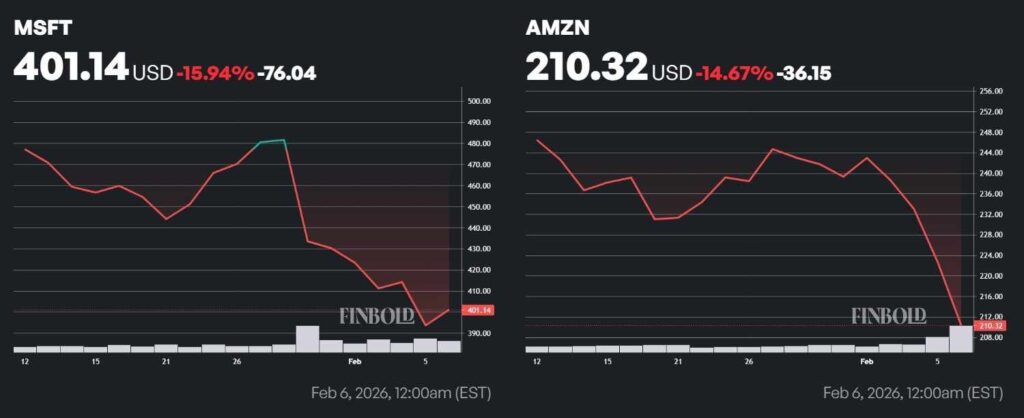
The first week of February also generated substantial stock market drops for multiple ‘Magnificent 7’ big tech companies, with Microsoft (NASDAQ: MSFT) and Amazon (NASDAQ: AMZN) leading the way.
Why Microsoft stock is crashing in February
Zooming in on Microsoft, its share price collapse amounted to 16.71% between January 28 and press time on February 9 and was triggered by the company’s latest earnings report.
While the publication showed a variety of strong results, including both a revenue and earnings per share (EPS) revenue beat, it echoed Michael Burry’s point about ‘historic overvaluation’ and tiny “AI” revenue.’
Microsoft’s growth has, as the earnings showed, slowed down, and the company’s margins are dropping to multi-year lows, while the report simultaneously showed a massive backlog dependence on OpenAI, a company whose ‘tiny “AI” revenue’ – estimated at about $20 billion – is orders of magnitude smaller than its capital expenditure commitments.
Why Amazon stock is crashing in February
Amazon stock’s 13.43% fall since February 2, from $242.96 to $210.32 in the morning of February 9, largely echoes Microsoft’s recent story.
The e-commerce and technology giant reported almost across-the-board strong results, with the modest EPS miss being the only outlier, but also unveiled continued dependence on AI-driven growth for key divisions like AWS.
Data centers – a key element for AWS – have been an outsized part of the massive big tech capital expenditure expectations and have been generating significant controversy.
On the one hand, their construction and growing hunger for electricity have put great strain on power grids while fueling fears of water shortages, triggering large-scale community backlash that led to multiple project cancellations since late 2025.
On the other hand, certain observers, such as the prominent AI bear Ed Zitron, have estimated that the mismatch between hardware production, electricity availability, and actual demand could leave as much as 25% of data centers dormant.
Why ‘historic capital expenditures’ for AI might just be burning money
While historical infrastructure buildouts have been beneficial in the long run, even if new capacity was not used immediately upon construction, the issue with AI infrastructure is that advanced semiconductors usually have a relatively short shelf life.
The issue in 2026 is also exacerbated by a global memory shortage that has led Nvidia (NASDAQ: NVDA), another blue-chip technology company that saw its stock experience major volatility in the first week of February, to announce it is pausing gaming chip production.
Advanced gaming chips have been Nvidia’s core business for years before the start of the AI boom.